
What if the best underbite treatment depends less on how it looks and more on what’s causing it? If you’re unsure whether your child’s bite is related to tooth position, jaw development, or both, you’re not alone. The right underbite treatment options for kids depend on the teeth, jaw relationship, and your child’s stage of growth. An assessment can help explain what’s contributing to the bite and whether treatment or monitoring is appropriate.
You may wonder whether waiting could make care more complicated, or whether an appliance might feel uncomfortable or disrupt school and everyday routines. Those are understandable concerns. A specialist can examine your child’s bite, explain the findings, and discuss approaches suited to the cause. Imaging, including Cone Beam CT when clinically appropriate, can provide a more detailed view, though it isn’t needed for every child.
In this guide, you’ll learn what can contribute to an underbite, which signs to mention at an evaluation, and how treatment choices may change as a child grows. You’ll also find practical questions to ask so you can consider the next step with greater confidence.
Key Takeaways
- A child’s lower front teeth sitting ahead of the upper teeth can be a reason to learn more, not a reason to diagnose the bite at home.
- An assessment can help clarify whether tooth position, jaw structure, or both may be contributing to the underbite.
- The right underbite treatment options for kids depend on the child’s specific bite and stage of growth.
- An evaluation doesn’t mean treatment has to start right away. It can help you understand the findings and consider next steps calmly.
- Mountain West Dental Specialists provides pediatric and orthodontic care in Las Vegas, including Cone Beam CT imaging as part of its diagnostic capabilities.
What Is an Underbite in a Child, and What Signs Should Parents Notice?
Noticing that your child’s teeth don’t meet as expected is a reason to learn more, not to diagnose a bite problem at home. An underbite generally describes a bite in which the lower front teeth sit ahead of or overlap the upper front teeth when the mouth is closed. The difference may be subtle or easy to see, but appearance alone can’t show what’s causing it, how significant it is, or whether treatment is needed.
A child’s bite can involve tooth position, the relationship between the jaws, or both. A lower jaw that appears prominent may accompany an underbite, but a profile doesn’t reveal the full bite relationship. The Class III Malocclusion (Underbite) overview describes this general category of bite difference; an individual child’s bite needs to be assessed by a specialist.
How does an underbite differ from a normal bite?
In a typical bite, the upper front teeth sit slightly ahead of the lower front teeth. With an underbite, the lower front teeth may meet the upper teeth edge to edge or sit in front of them. This describes how the teeth come together, not why they do so. Tooth position, jaw structure, or a combination can contribute, and facial appearance by itself doesn’t establish how significant the bite difference is.
For example, a parent might notice a forward-looking lower jaw in a photograph while the teeth meet comfortably. Another child may have a less noticeable profile but find it awkward to bite into certain foods. These observations can help you explain what you’ve noticed, but they can’t replace an assessment of how the teeth and jaws fit together.
Which signs may prompt a child’s bite evaluation?
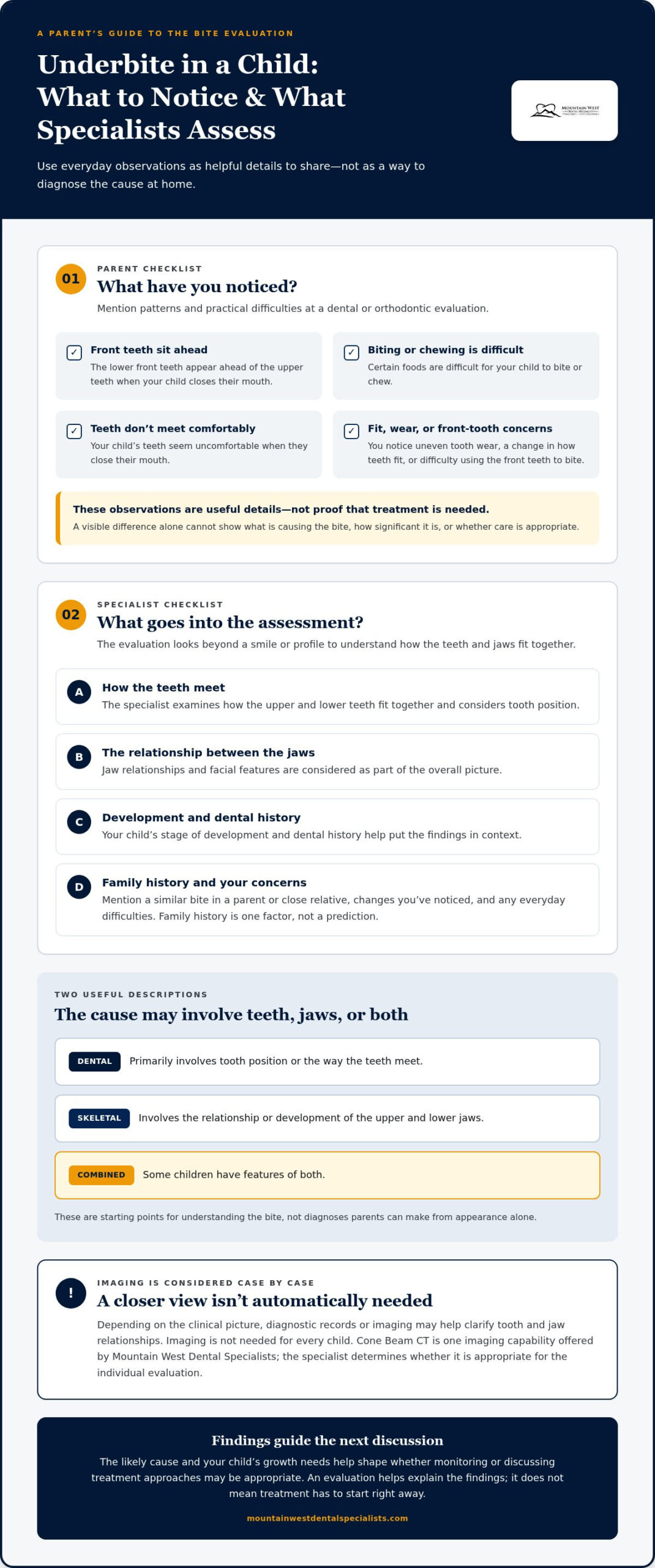
Mention the bite at your child’s dental or orthodontic evaluation if the lower front teeth appear ahead when your child closes their mouth, or if the bite seems to interfere with everyday comfort. Focus on patterns and practical difficulties rather than trying to measure the bite yourself.
- Your child has difficulty biting or chewing certain foods.
- Their teeth don’t seem to meet comfortably when they close their mouth.
- You notice uneven tooth wear or a change in how the teeth fit together.
- Your child mentions discomfort or difficulty using the front teeth to bite.
These signs don’t prove that a child needs treatment. They give you useful details to share with a dental professional. Some bite differences are difficult to judge by looking, so an orthodontic evaluation can examine how the teeth meet and whether jaw position may also be involved. That information helps clarify whether monitoring or discussing underbite treatment options for kids is appropriate, without assuming that every visible difference requires an appliance or immediate care.
How Specialists Assess the Cause of a Child’s Underbite
A useful assessment looks beyond how the bite appears in a smile or profile. An underbite may relate mainly to tooth position, the relationship between the jaws, or a combination of both. Understanding the factors involved and how your child is developing helps a specialist explain which approaches may be worth considering and whether monitoring is appropriate.
What is the difference between a dental and skeletal underbite?
A dental underbite primarily involves tooth position or the way the teeth meet. A skeletal underbite involves the relationship or development of the upper and lower jaws. Some children have features of both. These descriptions are useful starting points, not diagnoses parents can make from appearance alone. The American Association of Orthodontists explains these bite patterns and assessment considerations in its Underbite Treatment Options from AAO.
Family history can also be relevant. If a parent or close relative has a similar bite, mention it at the visit, but remember that it doesn’t predict exactly how your child’s teeth or jaws will develop. A specialist considers family history alongside the child’s bite, development, dental history, and concerns.
What might happen during an orthodontic assessment?
The specialist examines how the upper and lower teeth fit together and considers the teeth, facial features, and jaw relationships as a whole. They may ask about your child’s dental history and what you’ve noticed, such as changes in the bite or difficulties with everyday function. Your child’s stage of development also matters because it helps put the findings in context.
Depending on the clinical picture, the assessment may include diagnostic records or imaging to clarify tooth and jaw relationships. Imaging isn’t automatically needed for every child. Mountain West Dental Specialists offers Cone Beam CT imaging, and the specialist determines whether it’s appropriate for the individual evaluation.
The findings connect the likely cause with possible next steps. If tooth position appears to be the main factor, the discussion may differ from one involving jaw development or a combination. That’s why underbite treatment options for kids aren’t one-size-fits-all: recommendations are guided by the diagnosis and the child’s growth needs, rather than appearance alone.
If you’d like a clearer understanding of your child’s bite, a pediatric and orthodontic assessment at Mountain West Dental Specialists in Las Vegas can help you discuss the findings and what they may mean for your family.
Underbite Treatment Options for Kids: What Each Approach May Address
There isn’t one appliance that corrects every underbite. The suitable approach depends on what the assessment shows, including whether tooth position, jaw relationships, or both are involved, and how your child is developing. The options below are examples a specialist may discuss, not a treatment plan for every child.
| Approach | General purpose | Factors the specialist considers |
|---|---|---|
| Braces | Move teeth and address certain bite relationships. | Tooth position, bite pattern, dental development, and the overall treatment goals. |
| Clear aligners | Shift teeth in selected cases where aligners are suitable. | The specific tooth movements needed and whether the child can follow the wear instructions. |
| Expander | Widen the upper dental arch in cases where expansion may be appropriate. | Upper arch shape, bite findings, and the child’s development. |
| Reverse-pull headgear | Apply forward-directed force to the upper jaw in selected growing-child cases. | Jaw relationship, growth stage, and whether this approach fits the diagnosis. |
| Monitoring | Track changes over time when immediate treatment isn’t recommended. | Current bite, development, and whether findings change at follow-up. |
When might orthodontic appliances be considered?
Braces may be considered when tooth alignment or the way the teeth meet is a central concern. An expander or reverse-pull headgear may suit some children with specific upper-jaw or bite findings, but neither is appropriate for every underbite. The specialist weighs examination results and development before recommending an appliance, then explains its intended role in your child’s plan. Mountain West Dental Specialists provides orthodontic care, including braces and clear aligners for children, teens, and adults.
How do treatment options differ for dental and jaw-related concerns?
If tooth position is the main factor, a tooth-focused approach may be discussed. If jaw development is involved, planning needs to account for the child’s growth and the relationship between the jaws. Some children have both concerns, so treatment may need to address more than one part of the bite.
That distinction helps make sense of underbite treatment options for kids: a recommendation should connect to the diagnosis, not be selected just because an appliance is familiar or commonly discussed. Braces can move teeth, but they don’t automatically address every jaw-related concern. Likewise, an appliance used to guide or influence a bite is considered when the findings suggest it may be suitable.
For complex jaw-related cases, a specialist assessment can clarify what orthodontic care may address and whether additional specialist input should be part of the discussion. In some cases, jaw surgery may be considered as part of care planned with the appropriate specialists. It isn’t appropriate to assume surgery will be needed, or that orthodontic treatment will always avoid it. Your child’s diagnosis and growth needs guide that conversation.
When Should Parents Seek Underbite Treatment for Kids?
An evaluation helps you understand your child’s bite; it doesn’t commit you to starting treatment. Depending on the bite, your child’s growth, and the clinical findings, a specialist may recommend treatment, monitoring, or another step. You can wait to decide what to do until you understand what the assessment shows.
Should a parent wait until all permanent teeth come in?
Waiting for every permanent tooth isn’t a universal rule for underbites. The right time to assess a bite depends on the child and the findings, so don’t rely on a single age or milestone to decide whether to seek guidance. If you notice a bite difference or your child has trouble biting, chewing, or closing comfortably, an evaluation can clarify whether to monitor the situation or discuss next steps.
What can families expect if treatment is recommended?
If an approach is recommended, ask what it’s intended to address and how the specialist will follow your child’s progress. Talk through everyday concerns before making a plan. An appliance may feel unfamiliar at first, and your child may need time to fit it into their routine. Share concerns about comfort, school, meals, sports, or other activities so the discussion reflects your family’s day-to-day life.
A calm way to move forward is to take these steps in order:
- Note what you’ve noticed. Write down when the bite looks different and any practical difficulty your child describes. Specific observations are more useful than trying to label the cause.
- Arrange an assessment. A specialist can examine the bite and consider your child’s development. This visit gathers information; it doesn’t automatically start treatment.
- Discuss the findings. Ask whether the concern appears related to tooth position, jaw relationships, or both, and what that means for timing.
- Consider the recommendations. Talk through the purpose of any proposed approach, follow-up expectations, and how it may fit your child’s routines. Use that information to make a considered decision with the specialist.
It’s reasonable to ask how an appliance might affect eating, speaking, cleaning teeth, or participating in activities. Your child can also share what feels worrying or uncomfortable. Bring those concerns to the conversation rather than assuming they’re too small to matter. The plan should be grounded in the examination and your child’s needs, not pressure to act before you understand the options.
If you’ve noticed a bite concern, arrange a pediatric orthodontic assessment with Mountain West Dental Specialists in Las Vegas to discuss what the findings may mean for your child.
Finding Underbite Care for Kids in Las Vegas: A Calm Next Step
A clear next step starts with understanding how your child’s teeth meet, identifying what may be contributing to the bite, and discussing options that fit the findings and your child’s development. You don’t need to arrive with a diagnosis or treatment decision. A specialist visit can turn your observations and questions into an informed conversation about what may come next.
What information should parents bring to an evaluation?
A few notes can help you explain what you’ve noticed. Jot down when the bite difference first became apparent, whether it seems to have changed, and whether your child has difficulty biting or chewing. Bring relevant dental history and mention any concerns your child has shared, including worries about comfort or how an appliance could fit into daily routines.
There’s no need to prepare a perfect timeline. Your observations, your child’s perspective, and your questions all help shape the discussion. Consider asking what the examination shows, whether the concern involves tooth position, jaw relationships, or both, and what options or monitoring might be appropriate. It’s fine to ask for an explanation in everyday language.
How can families take the next step in Las Vegas?
Mountain West Dental Specialists is a family-owned Las Vegas practice led by Dr. Keaton Tomlin and Dr. Allison Tomlin, offering pediatric and orthodontic care. The practice provides Cone Beam CT imaging as part of its diagnostic capabilities; whether imaging is useful depends on the child’s individual clinical needs. An assessment is an opportunity to understand the findings and discuss possible next steps, not a requirement to begin treatment.
As you consider care, look for a process that connects the explanation of your child’s bite to the options being discussed. The practice’s Las Vegas orthodontist guide offers additional context for families thinking about orthodontic care in the area.
When you’re ready, schedule an appointment with Mountain West Dental Specialists in Las Vegas to share your child’s concerns and discuss what an evaluation may clarify. You can take the conversation one step at a time, without deciding on treatment before you understand the findings.
Take the Next Step With Confidence
Your child doesn’t need to have all the answers before an orthodontic visit. A helpful next step can be listening to what feels different to them, noting any concerns they want to share, and making room for their questions. Including your child in the conversation can help them feel more comfortable and give the specialist a fuller picture of their experience.
There’s no need to choose an appliance or decide on a plan in advance. An appointment is a chance to discuss your child’s bite and understand which underbite treatment options for kids may be relevant to their individual needs. You can take time to consider the information and talk through any recommendations together.
When you’re ready, schedule an appointment with Mountain West Dental Specialists in Las Vegas to discuss your child’s bite. A thoughtful conversation can be a reassuring first step for your family.
Frequently Asked Questions
Is an underbite in a child always hereditary?
No. Family history can be one influence on how teeth and jaws develop, but it can’t predict a child’s bite with certainty. Tooth position, jaw development, or a combination of factors may also be involved. If relatives have had similar bite concerns, mention that during the assessment, but don’t assume your child will have the same needs. A specialist can consider family history alongside your child’s own findings.
Can a child outgrow an underbite?
Growth can change how a child’s teeth and jaws relate, but you shouldn’t assume an underbite will resolve on its own. The likely course depends on the individual bite and development. An orthodontic assessment can help determine whether monitoring or discussing possible treatment makes sense. If you’re keeping an eye on changes, note what you observe over time and share those details rather than trying to predict the outcome from appearance.
How long does underbite treatment take for a child?
There isn’t one timeline that applies to every child. The duration depends on the type of underbite, the approach selected, your child’s development, and how care progresses. After assessing the bite and discussing a plan, a specialist can give you a more relevant estimate. Online examples or another child’s experience may not reflect your child’s situation, so use them cautiously when considering underbite treatment options for kids.
What happens if a child’s underbite is left untreated?
The effects vary with the bite and its severity. Some children may experience difficulty biting or chewing, uneven tooth wear, or discomfort; others may have fewer noticeable concerns. An evaluation can help clarify what’s happening for your child and whether follow-up or a treatment discussion is appropriate. If you’ve noticed a new concern, such as avoiding foods that are hard to bite, share that specific example with the specialist.
Does underbite treatment hurt for kids?
Some children may notice pressure or temporary soreness with orthodontic approaches, but experiences differ, and no treatment can be promised to be painless. The likely sensations depend on the recommended approach and your child’s situation. Before treatment begins, talk with the specialist about what your child might feel, how to raise comfort concerns, and what guidance is available if an appliance feels uncomfortable during everyday activities.
Can an underbite affect a child’s speech or eating?
It may affect biting or chewing for some children, and some underbites are associated with speech concerns, but the experience isn’t the same for everyone. A photo or description alone can’t confirm the cause. If your child struggles with certain foods, has difficulty speaking clearly, or finds it uncomfortable to close their mouth, note when you see the issue and mention it at a dental or orthodontic evaluation.