
The right choice isn’t always the practice that treats the most age groups. The pediatric dentist vs family dentist decision is less about choosing a universally better option and more about matching care to your child’s age, comfort, and dental needs.
It’s understandable to want convenient visits for the whole household while making sure your child feels safe and supported. Pediatric dentists complete additional residency training focused on children’s oral health, development, and behavior guidance. Family dentists care for patients of different ages, which may suit families looking for one dental home for everyone. The American Academy of Pediatric Dentistry recommends a child’s first dental visit by age one, or within six months of the first tooth appearing.
This guide explains the practical differences, including when specialized pediatric care may help and how to weigh your child’s comfort alongside family convenience. You’ll also learn how Mountain West Dental Specialists supports children in Las Vegas with pediatric checkups, baby dental care, airway management, tongue-tie release, and orthodontic care at different stages of growth.
Key Takeaways
- The pediatric dentist vs family dentist choice depends on what best fits your child, not on one practice model being right for every family.
- Compare the care each practice focuses on and how its approach may support your child’s specific needs.
- Use a simple checklist to weigh your child’s current concern, comfort, communication needs, and continuity of care alongside convenience.
- Mountain West Dental Specialists offers families in Las Vegas pediatric-focused care and orthodontic support as children grow.
Pediatric Dentist vs. Family Dentist: What Do the Terms Mean?
For your household, the choice may sound practical: bring everyone to one dental practice, or choose a setting focused specifically on your child. The labels offer a starting point, but they don’t tell the whole story. A practice’s services, the ages it sees, and how it approaches a child’s needs can vary.
A pediatric dentist centers care on children’s oral health; a family dentist commonly provides care to patients across multiple age groups. That distinction can help you compare options, but your child’s needs and the practice’s approach matter more than the label alone.
What does a pediatric dentist do?
Pediatric dentistry focuses on the oral health of infants, children, and adolescents, including how teeth and mouths change as children grow. Pediatric dentistry describes this child-focused area of care and its scope. A pediatric dentist may explain steps in age-appropriate language, help a child understand what to expect, and adapt communication to the child’s developmental stage. Specific services and approaches vary by clinician and practice.
What does a family dentist do?
Family dental practices commonly care for patients in different age groups, which can allow parents and children to visit the same office. The age range and services depend on the practice. One office may see young children for checkups, while another may focus its pediatric care differently. The family-dentist label alone doesn’t tell you which child-specific procedures or supports are offered.
Think of the terms as descriptions of a practice’s general focus, not guarantees about every visit. A child coming in for a routine checkup may have different needs from one who feels uneasy in the dental chair, has a concern related to oral development, or needs a more tailored approach. The practice’s experience and services can matter in each situation, but the label alone won’t answer every question.
Choosing a family practice for convenience doesn’t automatically mean your child’s care will be a poor fit. A child-focused setting isn’t automatically the right choice for every family either. The key is understanding what your child needs now and how a practice communicates with young patients. If you’re weighing pediatric dentist vs family dentist, look beyond whether an office sees children. Consider whether its care model suits your child’s age, comfort, and dental concerns, as well as your household’s preference for one practice or more focused care.
How Pediatric and Family Dentists Differ in Training and Child-Focused Care
Training can help explain why practices approach a child’s visit differently, but it doesn’t tell you everything about the care your child will receive. Pediatric dentists complete additional education focused on children’s oral health. Family dentists are trained to care for patients across age groups, and their experience with children can vary. Neither model is automatically the right fit for every child.
| Comparison | Pediatric dentist | Family dentist |
|---|---|---|
| Typical focus | Children’s oral health and development | Dental care for patients across age groups |
| Patient ages | Typically infants, children, and adolescents | Varies by practice; may include children and adults |
| Child-specific approach | Advanced training centers on children’s development and care | Approach and pediatric experience differ among clinicians |
What additional training may a pediatric dentist receive?
After dental school, pediatric dentists complete advanced education focused on children’s oral health. The American Academy of Pediatric Dentistry describes a minimum 24-month residency, with study that can include child development, behavior guidance, and care for patients with special health needs. This training builds specialized knowledge; it doesn’t guarantee that every child will respond the same way or feel comfortable at every visit.
That background can be useful when care needs to reflect a child’s developmental stage. A young child may benefit from simple explanations and a gradual introduction to exam steps, while an older child may want more detail and a chance to ask questions. The dentist’s communication style still matters, so consider how the clinician listens to both you and your child.
What should parents compare about a child’s care?
For a practical pediatric dentist vs family dentist comparison, focus on the care your child needs now rather than assuming a title tells the full story. Consider how the practice handles prevention, explains recommendations, and supports a child who feels uncertain. If your child has a particular concern or needs care related to development, consider whether the practice’s services and experience fit that need.
As you compare, consider these points:
- Age and experience: Does the clinician regularly care for children at your child’s stage?
- Communication: Are explanations clear and suited to your child, with room for you to share concerns?
- Prevention and services: Does the practice’s approach fit your child’s preventive and current dental needs?
- Comfort and individual support: How does the team adapt its communication and care to each child?
These details make the choice more concrete than the practice label alone. Families in Las Vegas looking for focused pediatric care can learn about pediatric dental checkups at Mountain West Dental Specialists.
When Is a Pediatric Dentist or Family Dentist the Better Fit?
There isn’t one right choice for every child. A family dentist may suit a child who’s comfortable with routine visits and whose needs fit the practice’s services. A pediatric-focused practice is worth considering when your child needs an approach centered on children’s development, has difficulty feeling at ease during visits, or has a concern that calls for specialized assessment.
A common misconception is that family dentists can’t care for children. Many family practices see young patients, though their pediatric experience, age ranges, and services differ. The useful question isn’t simply whether an office accepts children. It’s whether its care and communication fit your child and the reason for the visit.
When might a family dentist suit a child’s routine care?
If your child is due for a routine checkup and feels comfortable with the practice, having several household members visit the same office may make ongoing care easier to organize. Familiarity with one practice can also help your child see dental visits as part of a regular family routine. The fit depends on the practice’s services and how well its approach meets your child’s needs, not convenience alone.
For example, if your child is relaxed during exams and needs preventive care, a family practice that sees children may be a comfortable option. If a new concern arises, consider whether that practice provides care suited to it. Household convenience matters, but it shouldn’t replace a clear understanding of your child’s current needs.
When might specialized pediatric care be helpful?
Child-focused care may help if age-specific communication, support with dental anxiety, or attention to a developmental concern is especially important to your family. A child who finds unfamiliar settings difficult may appreciate an approach that takes time to explain what’s happening and responds to their comfort level. A pediatric setting won’t automatically resolve anxiety; each child’s experience is individual.
Specialized assessment can also matter when a concern involves oral function or development. Mountain West Dental Specialists provides airway management and tongue-tie release as part of its care for children. Whether either service is appropriate depends on an individual clinical assessment, rather than the name of a practice or a parent’s assumption about the cause of a concern.
Pediatric-focused care may be especially worth considering when a child’s age, comfort, or specific developmental needs call for attention tailored to children. That’s a reason to explore the option, not a rule that every child needs a pediatric dentist. A family dentist may be a good fit for some children, while others may benefit from more specialized support.
To make the choice, start with the concern that brought you to the dentist. Then weigh your child’s comfort, the care the practice provides, and the ease of maintaining visits for your household. Families exploring child-focused dental care in Las Vegas can learn about pediatric dental care and airway management at Mountain West Dental Specialists.
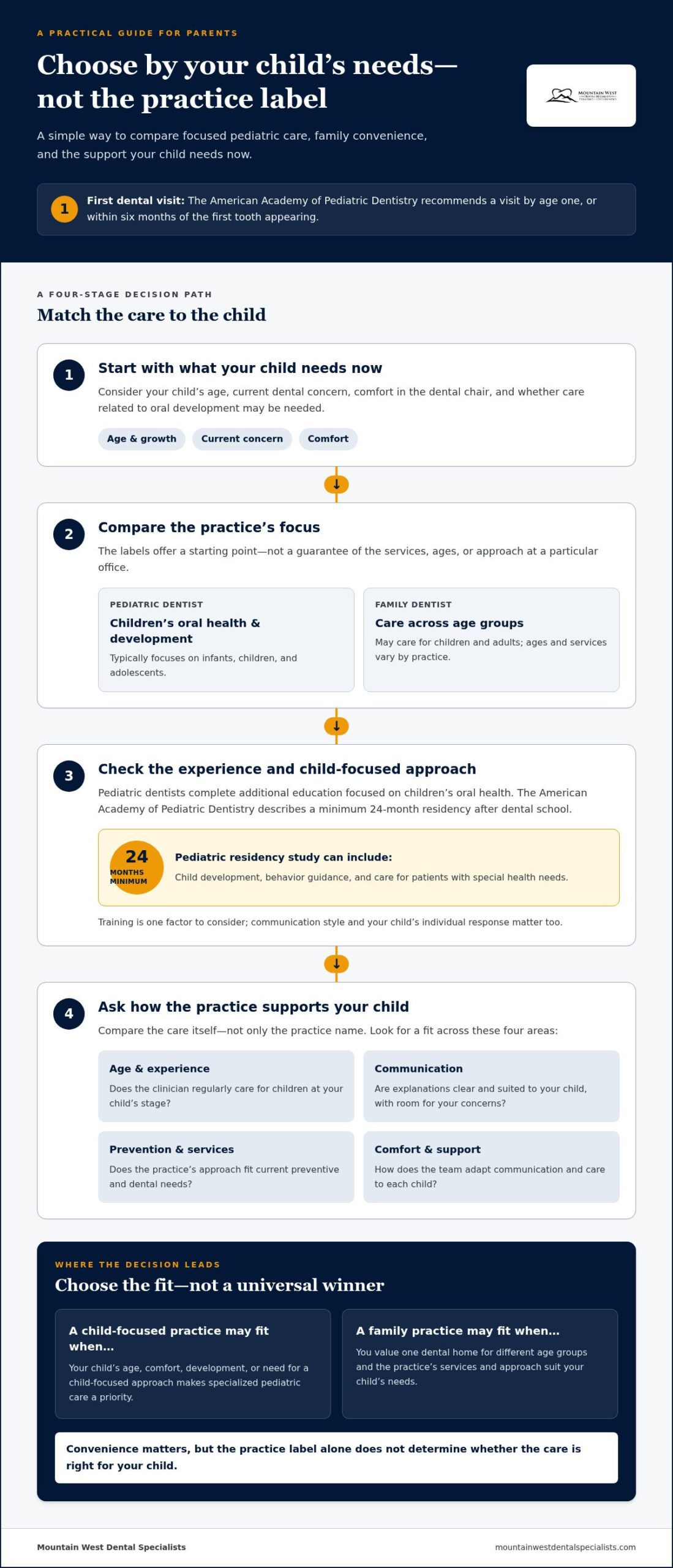
How to Choose Between a Pediatric Dentist and Family Dentist
Start with your child’s reason for needing care, then consider which practice model fits your family. A routine checkup, a concern about comfort, and a question about tooth or jaw development may call for different conversations. Clarifying the need first helps you compare options without letting convenience or a practice label make the decision for you.
Questions to consider before choosing a dental setting
Use this checklist to organize your thoughts before a visit. You don’t need every answer; the goal is to identify what matters most for your child.
- 1. Name the current need. Is your child due for preventive care, do you have a specific concern to assess, or are you looking for attention beyond a routine checkup?
- 2. Consider comfort. How does your child respond to unfamiliar places, dental tools, and new people? Think about what helps them feel heard, such as clear explanations or time to adjust.
- 3. Match services to the concern. Consider whether the practice’s services fit the care your child may need. Share relevant health history, previous dental experiences, and concerns about development during the visit.
- 4. Notice communication. Does the clinician explain recommendations in a way you and your child can understand? Clear discussion makes it easier to weigh next steps and raise questions.
- 5. Weigh continuity and convenience. One practice for several household members may simplify routines. Balance that practical benefit with your child’s comfort and individual care needs.
If you’re preparing for an infant’s first appointment, knowing what to expect can make planning easier. This guide to your baby’s first dental visit offers parents a helpful starting point.
How to think about specialized or orthodontic needs
Some concerns need an assessment before you can know which care path makes sense. Describe what you’ve noticed and when it occurs, rather than trying to diagnose the cause yourself. The clinician can consider your child’s individual needs and discuss appropriate next steps. Sharing relevant medical and dental history can help inform that conversation.
Orthodontic questions are distinct from routine dental checkups. If you’re concerned about tooth alignment or jaw development, an orthodontic evaluation can help assess those concerns; it doesn’t automatically mean treatment is needed. For background as you consider that question, explore this Las Vegas orthodontist guide.
The pediatric dentist vs family dentist decision becomes clearer when you put your child’s needs first, then compare comfort, communication, relevant services, and household logistics. Families considering child-focused care in Las Vegas can explore pediatric dental care at Mountain West Dental Specialists.
Pediatric Dental Care in Las Vegas: How Mountain West Supports Families
For Las Vegas families weighing a child-focused dental setting, Mountain West Dental Specialists offers pediatric care within a broader specialty practice. Family-owned and operated by Dr. Keaton Tomlin and Dr. Allison Tomlin, the practice provides pediatric dental checkups and baby dental care, along with services that address aspects of oral development and function. This gives parents a place to discuss a child’s needs as they change over time.
Specialized care for children and growing smiles
Children’s needs can change at different stages, from early dental care in infancy to questions about development as they grow. Pediatric checkups and baby dental care support families seeking care focused on young patients. For questions beyond a routine visit, sharing what you’ve noticed and your child’s health history helps the care team understand your concerns and explain relevant next steps.
Mountain West also provides airway management and tongue-tie release. These services relate to individual concerns involving oral function or development, but they aren’t appropriate for every child. An assessment helps the clinician understand the child’s circumstances and determine suitable care. Parents can discuss their child’s needs, ask questions, and understand the reasoning behind recommendations.
For some concerns, careful assessment may involve imaging. Cone Beam CT imaging is among the practice’s technologies and can support evaluation when clinically appropriate. It isn’t needed for every child or every visit; the clinician determines whether it has a role in assessing a particular concern.
As children grow, orthodontic questions may become part of the conversation too. Mountain West provides orthodontic care with braces and aligners for children, teens, and adults. Orthodontic care is distinct from routine pediatric checkups, so a concern about tooth alignment or development can be discussed as its own need rather than assumed to be part of a regular dental visit.
A reassuring next step for Las Vegas families
Choosing between a pediatric dentist vs family dentist is ultimately about the care that fits your child, not simply the practice label. When you visit Mountain West, bring your questions, relevant health history, and any concerns you’ve noticed. Clear communication helps the care team understand what matters to your family and discuss an appropriate path.
Whether you’re arranging baby dental care, seeking a pediatric checkup, or exploring a developmental or orthodontic concern, you can take the next step at a pace that feels comfortable. Schedule a visit with Mountain West Dental Specialists to discuss your child’s needs with the Las Vegas team.
Make Your Child’s Next Dental Step Feel Clear
You don’t have to settle every question about your child’s long-term dental care before taking the next step. Start with what would help now: a preventive visit, a conversation about a concern, or guidance about your child’s developing smile. Sharing what your child finds comfortable, along with your questions, can help make the visit more useful for your family.
The choice between a pediatric dentist vs family dentist is personal. Let your child’s needs, comfort, and the care you’re seeking guide the decision, rather than feeling pressure to choose one model for every stage. A thoughtful conversation can help you understand what comes next and feel more at ease about your child’s care.
When you’re ready to take that step, schedule a visit with Mountain West Dental Specialists. Your questions are a welcome place to begin, and your family can move forward one visit at a time.
Frequently Asked Questions
Is a pediatric dentist better than a family dentist for children?
Neither is automatically better for every child. The pediatric dentist vs family dentist choice depends on what your child needs and how they respond to care. For example, a child who is uneasy in a dental setting may benefit from discussing comfort and communication needs before choosing a practice. A child with a straightforward concern may have different priorities. Share your child’s needs with a dental professional to help decide what setting makes sense.
Can a family dentist treat toddlers and young children?
Some family dentists see toddlers and young children, but their experience, services, and approach can differ. Before a visit, consider what your toddler may need: a routine exam, help getting used to the dental setting, or attention to a specific concern. Sharing your child’s age and previous dental experiences can make the appointment more relevant. If needs extend beyond routine care, pediatric-focused care is another option to consider.
At what age should a child see a pediatric dentist?
The American Academy of Pediatric Dentistry recommends a first dental visit no later than a child’s first birthday, or within six months after the first tooth appears. The visit can help parents discuss early care and questions about their baby’s mouth. If you notice a concern with teeth, feeding, or oral development, raise it rather than waiting for a routine milestone. Mountain West Dental Specialists’ baby dental visit guide can help you prepare.
Do pediatric dentists receive extra training?
Yes. Pediatric dentists generally complete advanced education after dental school focused on children’s oral health; the American Academy of Pediatric Dentistry describes a minimum 24-month residency. Training can include child development and behavior guidance. This describes the specialty’s educational path, not a promise about how an individual child will feel during care. A family dentist’s experience treating children also varies, so consider the clinician’s approach alongside the practice type.
Can my child see a pediatric dentist for braces or an orthodontic evaluation?
A child may receive pediatric dental care and have a separate orthodontic evaluation when questions about tooth alignment or development arise. One doesn’t replace the other: a routine checkup and an assessment of a developing bite address different concerns. Mountain West Dental Specialists provides pediatric and orthodontic care in Las Vegas, including braces and aligners. A clinician can assess your child’s situation and explain whether an orthodontic evaluation is appropriate.
Should siblings see the same dentist?
Siblings can share a practice if its approach and services fit each child, but they don’t need identical care arrangements. One child may feel comfortable with routine visits, while another may need more support or have a different dental concern. Compare each child’s needs separately, then consider whether coordinating visits at one practice is practical for your household. Convenience is valuable, but it shouldn’t obscure an individual child’s needs.
What should I expect at a pediatric dental visit in Las Vegas?
The visit depends on why you’re bringing your child in. You may be asked about dental history, health concerns, or what your child finds difficult during appointments, followed by an examination and a discussion of next steps. Mountain West Dental Specialists offers pediatric checkups for families in Las Vegas. Before the visit, note your main questions so you can discuss what matters most to your family.