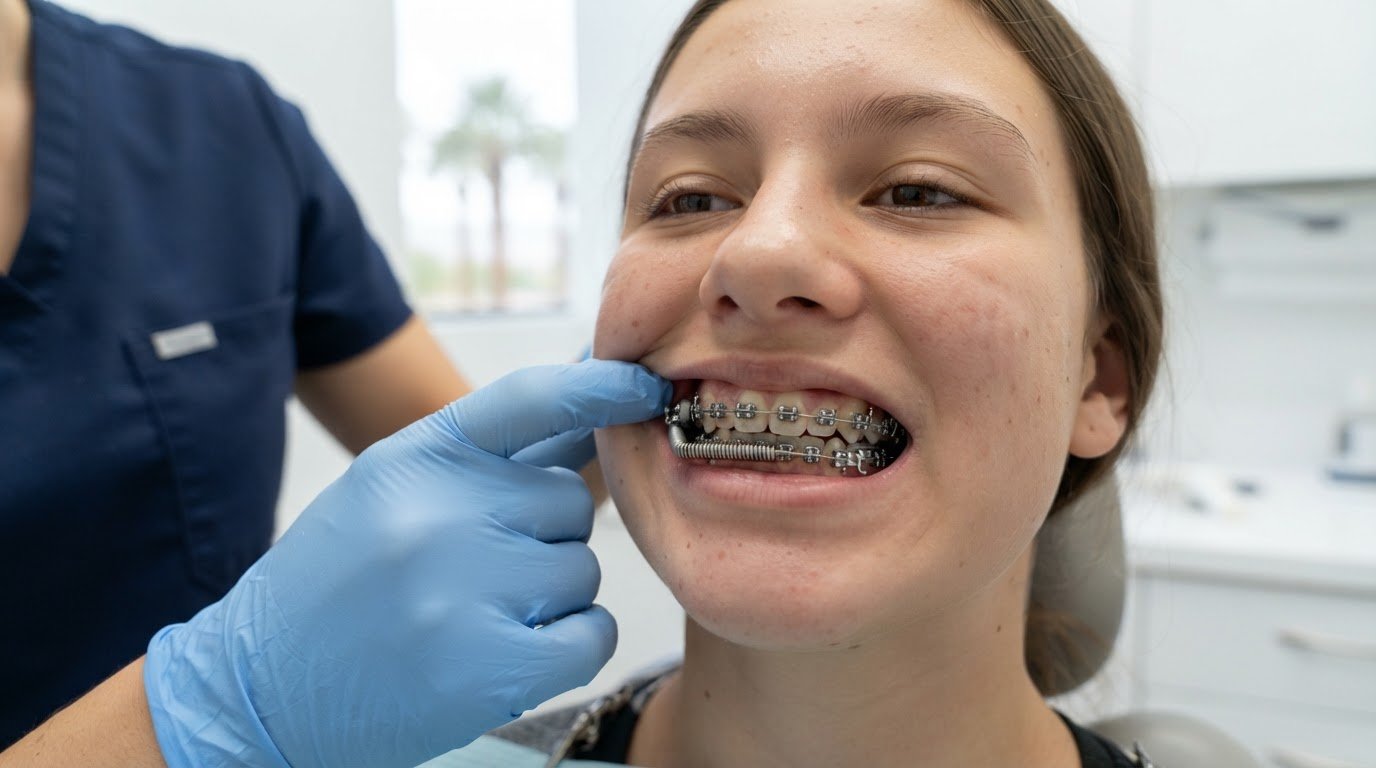
Headgear for braces alternatives include appliances such as palatal expanders, temporary anchorage devices (TADs), and Forsus, but each addresses a different orthodontic need. Headgear applies gentle pressure to teeth and jaws to guide bite correction as a child grows. A palatal expander widens the upper jaw when expansion is appropriate, while Forsus may be considered for adolescents.
It’s understandable to wonder whether an option that doesn’t use traditional headgear could still support your child’s treatment. The right fit depends on the bite problem and the movement needed, so these appliances aren’t interchangeable. This guide explains what headgear does and compares palatal expanders, TADs, and Forsus. Knowing their different roles can help you ask focused questions about a treatment plan without assuming one alternative works for every child.
Key Takeaways
- Learn how headgear guides bite correction and why its purpose matters when weighing other appliances.
- See when widening the upper jaw may make a palatal expander relevant, and how its role differs from other options.
- Understand how TADs and the Carriere Motion Appliance fit into the comparison of orthodontic approaches.
- Explore why Forsus may be considered for adolescents and how an orthodontic treatment plan matches an appliance to the bite concern.
What is orthodontic headgear?
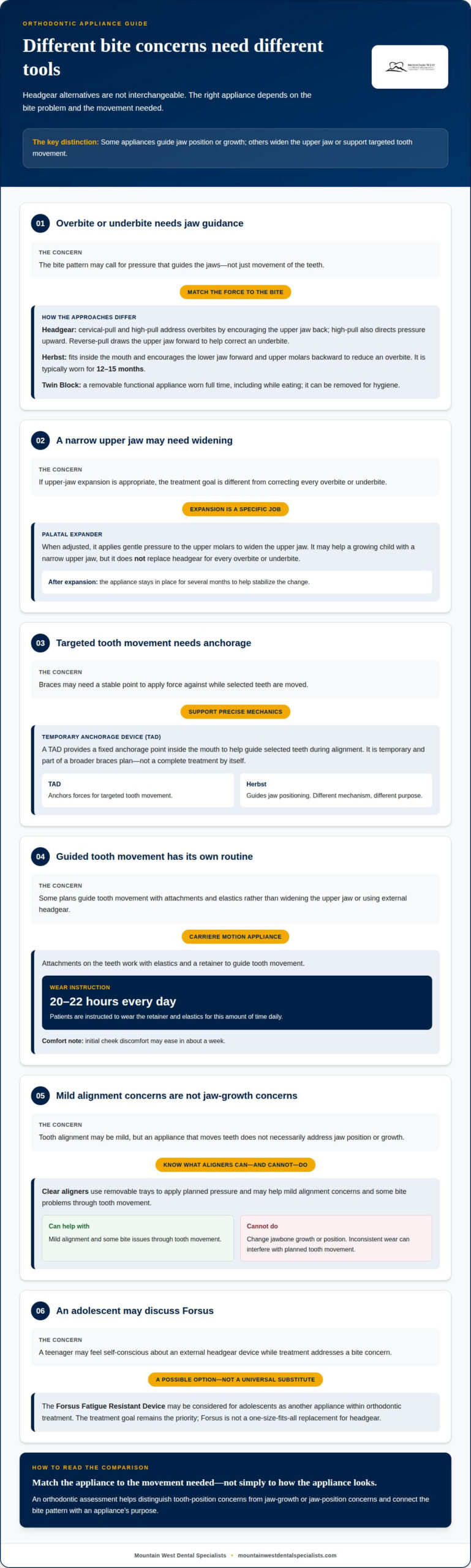
Orthodontic headgear applies pressure to guide teeth and jaws, usually while a child is growing. It may be prescribed with braces or on its own for selected bite problems. Cervical-pull and high-pull headgear address overbites by encouraging the upper jaw back; high-pull also directs pressure upward. Reverse-pull headgear draws the upper jaw forward to help correct an underbite. The direction of force depends on the bite pattern being treated.
Clear aligners are among the headgear for braces alternatives families may consider for mild alignment concerns. A series of removable trays applies planned pressure to move teeth and may improve some bite problems through tooth movement. However, aligners don’t change jawbone growth or position. That distinction matters for growing children: an expander can widen a narrow upper jaw when appropriate, while aligners alone cannot. More complex bite problems may call for braces or another appliance.
In the United States, the cost of headgear for braces alternatives depends on the case and is given after a quote request. Appliance type, bite complexity, and the treatment plan affect the cost. Effectiveness depends on matching the appliance to the needed movement. Aligners can address mild alignment and some bite issues, but they don’t guide jaw growth. An overbite involving jaw position may need an approach that addresses more than tooth alignment.
The main concern with an unsuitable alternative is that it may move teeth without addressing an underlying jaw problem. With clear aligners, inconsistent wear can interfere with planned tooth movement. An orthodontic assessment helps distinguish tooth-position concerns from jaw-growth concerns and determine whether aligners, braces, an expander, or another appliance fits the treatment goal.
Are palatal expanders an alternative to headgear?
A palatal expander and headgear solve different problems. When adjusted, an expander applies gentle pressure to the upper molars to widen the upper jaw if expansion is appropriate. It may help a growing child with a narrow upper jaw, but it doesn’t replace headgear for every overbite or underbite. After the desired expansion, the expander stays in place for several months to help stabilize the change.
Functional appliances focus more directly on jaw position. A Twin Block is removable and is worn full time, including while eating, but can be taken out for hygiene. A Herbst appliance fits inside the mouth, so it avoids an external headgear frame. It encourages the lower jaw forward and upper molars backward to reduce an overbite, and is typically worn for 12-15 months. These appliances have different designs and wear instructions, so comfort and daily routines vary.
The Carriere Motion Appliance offers another approach to bite correction. It uses attachments on the teeth with elastics and a retainer to guide tooth movement. Patients are instructed to wear the retainer and elastics for 20 to 22 hours every day. This approach moves teeth, rather than widening the upper jaw like an expander or relying on an external headgear device. Initial cheek discomfort may ease in about a week.
So, is an expander an alternative to headgear? Only when widening the upper jaw addresses the treatment need. A Twin Block or Herbst may be considered when lower-jaw positioning is central, while Carriere Motion focuses on guided tooth movement. An underbite, narrow upper jaw, or overbite calls for a different mechanical approach, not simply a different-looking appliance. A personalized orthodontic treatment plan can help connect the bite concern with the appliance’s purpose.
Temporary anchorage devices (TADs) as an alternative
For braces patients, alternatives to headgear include TADs, intraoral appliances, expanders, and clear aligners. A TAD provides a fixed anchorage point for orthodontic forces, helping guide selected teeth during alignment. Unlike external headgear, it sits inside the mouth. Its role is to support planned tooth movement, not widen the upper jaw or automatically address every jaw-growth concern.
The orthodontist plans TAD placement around the movement needed. For example, a TAD can give braces a stable point to apply pressure against while moving other teeth. This can help control the direction of movement when tooth-to-tooth anchorage isn’t enough. The device is temporary, but it remains part of a broader braces plan rather than serving as a complete treatment by itself. Patients still need to follow the instructions for their braces and appliance.
An intraoral Herbst appliance offers a different approach. It fits inside the mouth and repositions a child’s jaws, avoiding an external headgear frame. Its mechanism differs from a TAD: a Herbst guides jaw positioning, while a TAD provides anchorage for targeted tooth movement. This distinction explains why the appliances aren’t interchangeable, even when both are considered instead of headgear.
Other options address different needs. A palatal expander widens the upper jaw when appropriate, while clear aligners move teeth and may help with mild alignment concerns. Forsus is another appliance considered for adolescents. The bite pattern and intended movement guide the choice because each appliance applies force differently. The need for tooth anchorage, for example, differs from a narrow upper jaw or a jaw-positioning concern. TADs support precise mechanics, but they don’t replace every function of headgear. Understanding these differences can help families discuss an appliance’s role in the braces plan and what using it involves.
Forsus as an alternative to headgear
The Forsus Fatigue Resistant Device is an alternative to headgear that may be considered for adolescents. It offers another option to discuss when orthodontic treatment addresses a bite concern. Traditional headgear applies pressure from outside the mouth; Forsus is used as an alternative appliance within orthodontic treatment. That difference may matter to a teenager who feels self-conscious about an external device, though the treatment goal remains the priority.
Forsus isn’t a universal substitute. Different types of headgear can guide the upper jaw in different directions, while a Forsus recommendation depends on the bite and planned movement. An orthodontic assessment helps distinguish a tooth-position issue from a jaw-growth concern. A narrow upper jaw, for example, may point toward expansion, while an adolescent’s bite may lead the orthodontist to consider Forsus among other appliances. The appliance’s name alone doesn’t determine whether it fits.
The key takeaway is that an alternative should match the mechanics needed, not simply look different. Clear aligners move teeth but don’t change jawbone growth or position. A palatal expander widens the upper jaw when appropriate, and a TAD provides anchorage for selected tooth movements. Forsus may be considered for adolescents, but each appliance serves a distinct role. Comparing the intended movements helps families understand why a treatment plan may use one device rather than another.
Families can ask about dental insurance when planning orthodontic treatment, without assuming a particular appliance is covered. Ask how the proposed approach relates to the bite, what role the device plays, and how it fits with braces. These focused questions can make the discussion clearer and help you feel more confident about the plan. Forsus is most relevant when an orthodontic assessment identifies a reason to consider it, not as a general replacement for headgear.
Discuss whether Forsus fits your orthodontic treatment plan.
Mountain West Dental Specialists: Orthodontic Braces and Aligners
Mountain West Dental Specialists offers orthodontic braces and aligners to help families explore treatment options for bite and alignment concerns. If you’re weighing headgear, Forsus, TADs, or another appliance, an orthodontic evaluation can clarify the movement a treatment plan needs to address. That distinction matters: an appliance suited to tooth movement may not serve the same purpose as one designed to guide jaw position or widen the upper jaw.
For a child or teen, a pediatric dental checkup can also be a starting point for discussing oral health and orthodontic concerns. The next step is a conversation about the bite, the desired movement, and which approach fits the treatment needs. Contact Mountain West Dental Specialists to discuss orthodontic braces and aligners.
Take the next step with a clear treatment goal
Choosing among alternatives to headgear for braces starts with identifying the bite concern, the movement needed, and how an appliance fits into everyday life. If you’re considering headgear for braces alternatives, use those priorities to guide a focused conversation about treatment options. You might also consider what matters most to your child, such as comfort at school or confidence around peers.
A thoughtful discussion can turn a long list of appliance names into a clearer path forward. Bring questions about the proposed approach, how it addresses the treatment goal, and your family’s role in following the plan. You don’t need to choose an appliance before starting that conversation. Mountain West Dental Specialists provides orthodontic care for families considering braces and aligners, along with pediatric dental checkups and tongue-tie release.
Contact Mountain West Dental Specialists to talk through your orthodontic questions and next steps. A calm, informed conversation is a good place to begin.
Frequently Asked Questions
Do adults ever need headgear?
Headgear is used mainly for growing children, but adults can also receive orthodontic treatment for bite and alignment concerns. Whether headgear is considered depends on the movement needed and the nature of the bite problem. For an adult, an orthodontist weighs the treatment goal and available mechanics rather than assuming a child-focused appliance is suitable.
Does avoiding headgear make treatment take longer?
Not by itself. Treatment length depends on the bite problem, the movements required, and how consistently a patient follows appliance instructions. For example, a removable option that isn’t worn as directed may not achieve its planned tooth movements as intended. The useful comparison is the full treatment plan, not simply whether it includes headgear.
How does headgear-free treatment look and feel day to day?
Daily routines depend on the appliance. Clear aligners are removable, and the stated wear schedule is 20 to 22 hours daily, so meals and cleaning require planning around wear. Fixed appliances stay in place during everyday activities. Comfort also varies: a new device can feel unfamiliar, and any serious discomfort or a loose or broken appliance should be discussed with the orthodontist.
Is there anything I can do to make this treatment easier for my child?
Build appliance use into a predictable routine, such as pairing wear time with a familiar evening activity. If headgear is prescribed, the orthodontist may recommend starting with a few hours and gradually increasing wear time. Help your child keep track of instructions, and contact the orthodontist if a component breaks, becomes loose, or causes serious discomfort.
What is orthodontic headgear and when is it prescribed?
Orthodontic headgear is an appliance that applies pressure to guide teeth and jaws during bite correction. It has mainly been prescribed for growing children with selected bite problems, with or without braces. The type and direction of force depend on the issue being addressed. An orthodontist considers the bite pattern and growth when deciding whether headgear fits the treatment plan.
Can Forsus springs replace orthodontic headgear?
Forsus may be an alternative to headgear for adolescents, but it isn’t a direct replacement in every case. The appliances work differently, and the right choice depends on the bite and the movement needed. A useful discussion focuses on why Forsus is being considered, what it is intended to change, and how it fits with braces.