
If you’re searching for a dentist for anxious children Las Vegas families can turn to, it helps to know what to look for before you book. Your child may worry about unfamiliar equipment, not knowing what will happen, or a difficult past visit. Rather than expecting them to stop feeling nervous, focus on clear explanations, a chance to share concerns, and a plan suited to their dental needs.
This guide offers practical ways to assess a pediatric dental practice, prepare for an appointment, and talk with your child about what to expect. Mountain West Dental Specialists provides pediatric dental care in Las Vegas, including checkups and care for infants and children. The family-owned practice is led by Dr. Keaton Tomlin and Dr. Allison Tomlin. Use the questions and steps below to make your child’s first or next visit easier to plan.
Key Takeaways
- Look for pediatric care that includes clear communication and attention to your child’s responses.
- Compare practical details, such as what the appointment is for, what it may involve, and how the team communicates with children.
- Share your child’s worries and past experiences with the dental team before care begins.
- Consider both your child’s immediate dental needs and how to make ongoing care more familiar.
- Mountain West Dental Specialists provides pediatric dental care at its Las Vegas office and is led by Dr. Keaton Tomlin and Dr. Allison Tomlin.
Finding a dentist for anxious children in Las Vegas: what matters most
If your child tries to avoid appointments, asks repeated questions, cries, or resists getting ready, those reactions are useful information for the dental team. They are not a reason to blame your child or assume every visit will go the same way. Dental fear and anxiety can look different from one child to another, as described in this overview of dental fear and anxiety. A child’s nervousness is not, by itself, a diagnosis.
When looking for a dentist for anxious children in Las Vegas, pay attention to how the practice communicates as well as the care it provides. Can you explain what your child is worried about? Do you understand the purpose of the appointment and the next steps? These are practical ways to assess whether the experience is a good fit for your family.
Signs a child may need extra reassurance at dental visits
Notice when the worry appears and what seems to trigger it. Your child may become reluctant as the appointment approaches, ask what the dentist will do, or show distress when you discuss the visit. Write down a few specific examples, including what your child says and what you observe. This gives you useful details to share without treating a single reaction as a prediction of future visits.
Before the appointment, tell the practice about any difficult past experiences, current worries, and ways your child prefers to receive information. For example, your child may want a simple explanation before each step, or may find it easier when you avoid giving too much detail in advance. Sharing this context helps make the conversation about your child’s needs more specific. When persistent stress or fears extend beyond dental visits into everyday life, consulting child and teen mental health practices such as balanced-minds.com can also help families develop helpful coping strategies.
What parents should expect from a child-centered dental experience
A child-centered experience should be understandable to both you and your child. The team should explain the purpose of the visit and give you an opportunity to ask questions. If your child seems confused or distressed, raise that concern rather than assuming they are comfortable because they are quiet. You can ask what the next step is and how it relates to your child’s dental needs.
Every child responds differently, and no communication style can guarantee a worry-free appointment. A dentist for anxious children Las Vegas families consider should be prepared to discuss the child’s needs with the parent and explain the care being considered. At Mountain West Dental Specialists, pediatric dental care is part of a family-owned practice led by Dr. Keaton Tomlin and Dr. Allison Tomlin. An ongoing relationship with a dental team can help make routine care more familiar over time.
How to evaluate a Las Vegas dentist for an anxious child
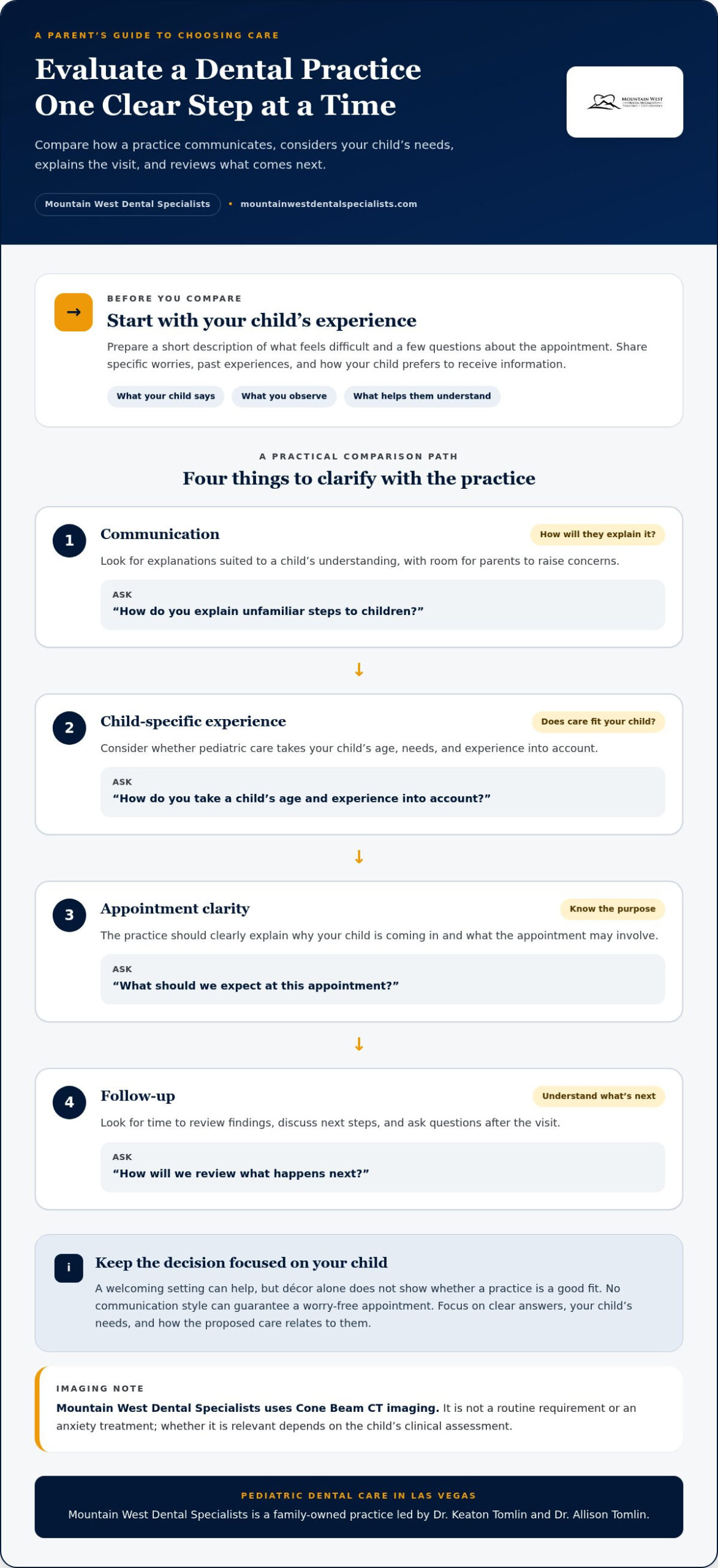
A welcoming setting can help, but décor alone won’t tell you whether a practice is a good fit. Compare how the practice communicates, how it explains appointments, and whether its pediatric care matches your child’s needs. Before you schedule, prepare a short description of what your child finds difficult and a few questions about the visit.
Use this checklist to organize the details that matter. The answers can help you understand the appointment and decide what you want to discuss with the dental team.
| What to compare | What to look for | A useful question |
|---|---|---|
| Communication | Clear explanations suited to a child’s understanding, with room for parents to raise concerns. | “How do you explain unfamiliar steps to children?” |
| Child-specific experience | Pediatric dental care that takes a child’s age, needs, and experience into account. | “How do you take a child’s age and experience into account?” |
| Appointment clarity | A clear explanation of the visit’s purpose and what it may involve. | “What should we expect at this appointment?” |
| Follow-up | Time to review findings, discuss next steps, and raise questions after the visit. | “How will we review what happens next?” |
Questions that reveal how a practice communicates with children
Ask how the team explains unfamiliar steps and how parents can share concerns during a visit. Listen for a clear, practical answer that addresses your question, rather than a promise that your child will not feel nervous. The American Academy of Pediatric Dentistry outlines behavior guidance techniques for pediatric dental care. You do not need to request a particular method. Focus on understanding how the dental team considers your child’s needs and response.
How specialized care and modern imaging fit into the decision
Pediatric dental care is a distinct part of Mountain West Dental Specialists, a family-owned practice led by Dr. Keaton Tomlin and Dr. Allison Tomlin. When discussing care, explain what worries your child and ask how the recommended plan addresses their dental needs. The practice uses Cone Beam CT imaging. This imaging is not a routine requirement or an anxiety treatment. Its relevance depends on the child’s clinical assessment.
To learn more about pediatric care in Las Vegas, visit Mountain West Dental Specialists’ pediatric dental care.
What happens before and during an anxious child’s dental appointment?
There is no single script that fits every appointment. Your child’s age, dental needs, past experiences, and response during the visit all matter. Before care begins, share your concerns and ask what the appointment is intended to address. A dentist for anxious children Las Vegas families consider should explain the proposed care so parents can understand the plan and raise questions.
Preparing your child does not mean predicting every step. A simple, honest overview and a conversation with the dental team can make the visit easier to understand.
How parents can prepare a child without increasing worry
Use simple, truthful language. For example, you might say, “The dentist will look at your teeth and talk with us about how to care for them.” Avoid threats and avoid promising that something will or will not happen if you do not know the appointment plan. A calm tone can reassure your child without dismissing their questions or telling them not to be scared.
Tell the practice what happened at a previous visit, what your child is worried about now, and what tends to help them feel heard. You do not need to rehearse every possible step at home. Leave room for questions, and answer honestly in words your child understands.
What to expect from the first conversation through follow-up
Think of the appointment as four connected steps. The details may vary with your child’s needs, but this sequence can help you prepare:
- Share concerns: Explain your child’s worries, past experiences, and any specific needs you have noticed.
- Understand the visit: Discuss the appointment’s purpose, what the team proposes, and any questions you or your child have before care proceeds.
- Support the child: Help your child follow the conversation, and let the team know if they seem confused or distressed. Their response and clinical needs inform how the appointment continues.
- Review next steps: Ask what the team observed, whether follow-up is needed, and what you should keep in mind after the visit.
Before proposed care moves forward, make sure you understand what is planned and have had a chance to discuss your concerns. During the appointment, check in if your child seems unsettled. A quiet child is not necessarily a comfortable child. The precise plan depends on clinical assessment and can vary from one child to another.
After the visit, ask your child what felt manageable and what was still hard. You can share those observations with the dental team before a future appointment. Focus on your child’s effort and what they noticed, rather than expecting them to have been perfectly calm. These details can help you prepare for the next conversation.
Choosing child dental care in Las Vegas: concerns, fit, and next steps
Choosing care for an anxious child means weighing immediate dental needs against the goal of continuing regular care. You may need an assessment or a discussion about a recommended treatment, while also wanting visits to become more familiar over time. A dentist for anxious children Las Vegas families feel comfortable choosing should take both priorities seriously without promising a stress-free experience.
Matching the care experience to your child’s needs
Consider your child’s age, current dental needs, previous experiences, specific worries, and communication preferences. One child may want a parent to explain the visit in advance; another may prefer a brief overview. Before the appointment, ask your child what part feels hardest and what they would like the dental team to understand.
Share those details with the team as context for a discussion, not as a predetermined solution. Every child is different, and no particular way of preparing or communicating can guarantee an easy appointment.
If your family has an infant, the practice’s published guide to a baby’s first dental visit can help you consider how early dental care fits into your child’s needs as they grow.
When a parent should discuss anxiety with the dental team
Bring up strong distress, a difficult past visit, or worry about planned treatment before care begins. Be specific: describe what your child says they fear, what you have observed, and what made a previous appointment difficult. This context helps the treating dental professional understand your concerns alongside your child’s dental needs.
Clinical recommendations should be individualized by the treating dental professional, based on the child’s needs and assessment. Anxiety alone does not determine whether a procedure, a particular care plan, or medication is appropriate. Ask the dental professional to explain the recommendation and discuss your concerns so you understand the next step.
As you weigh immediate dental needs and longer-term goals, a clear conversation can help you decide how to proceed. Explore pediatric dental care at Mountain West Dental Specialists for your child in Las Vegas.
Meet Mountain West Dental Specialists: pediatric dental care in Las Vegas
Mountain West Dental Specialists provides pediatric dental care in Las Vegas. The family-owned practice is led by Dr. Keaton Tomlin and Dr. Allison Tomlin. If you are looking for a “dentist for anxious children Las Vegas,” start by identifying what makes visits difficult and what you want to understand about your child’s care.
A family-owned specialist practice for Las Vegas families
Mountain West Dental Specialists provides pediatric care as part of its specialist practice, along with orthodontic care. The team provides pediatric checkups and care for infants and children. The office is on S. Cimarron Road in Las Vegas. The practice also uses Cone Beam CT imaging when appropriate to the child’s clinical needs.
Learn more about the practice’s pediatric dentist Las Vegas information as you consider care for your family.
Taking a comfortable first step with your child
You do not need to have every concern neatly organized before scheduling. Share what your child says or does when a dental visit comes up, describe any past experiences that still worry them, and mention what helps your family communicate. These details give the dental team context for a practical conversation about pediatric care.
Before the appointment, write down a few questions, such as what the visit is intended to address and how the care plan will be explained. You can also tell the practice about your child’s worries so you do not have to remember every detail during the visit. This gives you a clear starting point for discussing your child’s needs.
When you are ready, schedule a visit with Mountain West Dental Specialists and share what would help your child feel heard. A clear conversation can help your family take the next step with a better understanding of the care being considered.
Take the next step toward more predictable dental visits
Choosing a dentist for anxious children Las Vegas families can trust starts with clear communication, attention to your child’s needs, and a care plan based on clinical assessment. Sharing your child’s worries and asking what to expect can help you prepare, even if confidence takes time to build.
Mountain West Dental Specialists provides pediatric dental care at its Las Vegas office on S. Cimarron Road. Family-owned and operated by Dr. Keaton Tomlin and Dr. Allison Tomlin, the practice also uses Cone Beam CT imaging when clinically appropriate. Imaging is not required for every child.
Ready to discuss your child’s dental care? Schedule a visit with Mountain West Dental Specialists and share what your child finds difficult. A clear first conversation can help you understand the next steps.
Frequently Asked Questions
How do I find a dentist for an anxious child in Las Vegas?
Look for a pediatric dental practice that explains appointments clearly and considers your child’s individual needs. Ask how the team communicates with children and how you can share past experiences or current concerns. Mountain West Dental Specialists provides pediatric dental care in Las Vegas and is family-owned and operated by Dr. Keaton Tomlin and Dr. Allison Tomlin. The answers to your questions can help you decide whether the practice feels like a suitable fit.
Can an anxious child still go to the dentist?
Yes. Feeling nervous does not automatically mean a child cannot receive dental care. Tell the dental team about your child’s worries, previous experiences, and any distress you have noticed. Your child may still feel uneasy, and that does not mean the visit has failed. Honest conversations can help your family make informed decisions about care over time.
What should I tell my child before a dental appointment?
Give a simple, truthful explanation, such as, “The dentist will look at your teeth and talk with us about how to care for them.” Avoid threats or promises about what will happen if you do not know the plan. Let your child ask questions, and answer in words they understand. You can also tell the practice about specific worries before the appointment.
What happens at a child’s first dental visit?
A first visit gives the dental professional a chance to learn about your child’s oral health and discuss their needs with you. The appointment can vary based on your child’s age, dental needs, and clinical assessment. The American Academy of Pediatric Dentistry recommends a first dental visit by a child’s first birthday or within six months of the first tooth erupting. Share your concerns and ask what to expect beforehand.
Should an anxious child be sedated for a dental appointment?
Anxiety alone does not determine whether sedation is appropriate. Discuss that decision with the treating dental professional, who can consider your child’s dental needs, health, and clinical assessment. Explain what your child finds difficult and ask about the recommendation and its reasoning. A clear conversation can help you understand the care being considered and make an informed decision for your child.
How can I help my child feel more comfortable at the dentist?
Use a calm tone, explain the visit honestly, and give your child room to ask questions. Before the appointment, share their worries and past experiences with the practice. During the visit, let the team know if your child seems confused or distressed. Afterward, talk about what felt manageable. Every child responds differently, so focus on understanding your child’s needs rather than expecting a completely worry-free visit.