
What if the best next step for your child’s bite isn’t treatment, but simply keeping an eye on how their smile develops? It’s natural to wonder whether interceptive orthodontics for children means braces right away, a long treatment journey, or a chance of needing braces again later. An early evaluation helps you understand your child’s development. It doesn’t commit you to starting treatment.
The American Association of Orthodontists recommends an orthodontic evaluation by age 7, when a specialist can assess how the teeth and jaws are developing. Some children may benefit from early care, while others may only need periodic observation. The recommendation depends on each child’s findings.
This guide explains what interceptive orthodontics may address, why timing can matter, and what to expect during an evaluation. It also covers the purpose and limits of early treatment, including why it can’t guarantee that later orthodontic care won’t be needed. Knowing what to expect can help you discuss your child’s development and choose a thoughtful next step.
Key Takeaways
- Learn how interceptive orthodontics for children can address developing bite or jaw concerns while permanent teeth are coming in.
- Recognize signs such as crowding or a crossbite as reasons to seek an assessment, not as a diagnosis.
- Understand why a specialist may recommend early care, periodic observation, or comprehensive orthodontics later.
- Know what to expect as the orthodontist reviews your child’s development, explains findings, and discusses a next step.
- Explore coordinated pediatric dental and orthodontic care with Dr. Keaton Tomlin and Dr. Allison Tomlin at Mountain West Dental Specialists in Las Vegas.
What Is Interceptive Orthodontics for Children?
Interceptive orthodontics is an assessment and, when appropriate, early care for developing bite or jaw concerns. It’s also called early orthodontic treatment or Phase 1 orthodontics. The focus is on how a child’s teeth and jaws are developing, not on automatically straightening every tooth while baby teeth are still present.
Orthodontics covers tooth alignment and the relationship between the teeth and jaws. A general overview of Orthodontics explains the broader field, while an orthodontist can assess what a particular child’s development may call for. Depending on the findings, the next step might be treatment, monitoring over time, or waiting until more permanent teeth have come in before considering comprehensive care.
An orthodontic evaluation is a chance to understand your child’s development, not a promise that treatment will begin. Its purpose is to gather information and discuss whether there’s a concern to address now, something to monitor, or no immediate orthodontic action to take.
How Is Interceptive Orthodontics Different from Regular Braces?
Early orthodontic care focuses on a child’s development and specific concerns affecting the bite or jaws. Comprehensive treatment, often associated with braces or aligners, focuses on aligning teeth when the timing is appropriate for that child. The approaches have different purposes, and their timing depends on individual development. Early care may be followed by comprehensive orthodontics later; it doesn’t replace that treatment in every case.
Why Do Parents Hear About an Orthodontic Check Around Age 7?
The American Association of Orthodontists recommends an initial orthodontic evaluation no later than age 7. Children commonly have a mix of baby and permanent teeth at this age, giving a specialist an opportunity to assess how the bite and teeth are developing. The visit is an assessment, not a treatment deadline. A child may need only observation, and recommendations depend on individual findings.
Which Developing Bite and Jaw Concerns Can Early Orthodontics Address?
As a child grows, changes in the teeth and jaws can affect how the bite comes together. An orthodontist may assess concerns such as crowding, crossbites, or developing differences in jaw alignment. Whether a finding calls for early care depends on the child’s development and clinical assessment. The goal is to understand the concern and decide whether guidance now, monitoring, or another plan makes sense. Early treatment doesn’t necessarily prevent future orthodontic care.
Crowding happens when teeth appear to have limited room to line up comfortably. You might notice overlapping teeth or a permanent tooth emerging out of line, but appearance alone can’t show why it’s happening or whether treatment is needed.
A crossbite is a bite relationship in which one or more upper teeth sit inside the lower teeth when the child bites down. It can involve teeth toward the front or back of the mouth. Not every crossbite requires immediate treatment. The orthodontist considers the child’s bite, development, and other findings before recommending a next step.
What Might Parents Notice in a Child’s Bite or Developing Smile?
You may notice that the upper and lower teeth don’t meet evenly, that teeth overlap, or that the jaw seems to shift as your child closes their mouth. These observations are useful to share, but they aren’t a checklist for diagnosing an orthodontic condition. A single tooth or photo may not show the full picture. If something catches your attention, note what you’ve seen over time and discuss it at an evaluation.
What Treatment Approaches Might a Specialist Discuss?
Recommendations depend on the concern and your child’s stage of development. The specialist may suggest observation and reassessment as the teeth change. If treatment is appropriate, the discussion could include an appliance or a limited course of orthodontic care. An expander or partial braces are examples of orthodontic approaches, not a standard plan for every child or a promise of what a particular child will need.
The specialist should explain what a recommended approach is intended to address, why it may suit your child, and what follow-up will involve. This helps you understand the options without treating a visible sign as a diagnosis or assuming a specific result. Interceptive orthodontics for children is individualized: the right response to a developing concern may be care now, monitoring, or considering treatment later.
If you’d like a specialist to assess a concern you’ve noticed, you can schedule an orthodontic evaluation with Mountain West Dental Specialists in Las Vegas.
Does Every Child Need Phase 1 Orthodontic Treatment?
No. An orthodontic evaluation doesn’t automatically lead to Phase 1 care. The specialist considers the child’s bite and development, then discusses whether the next step is early treatment, observation, or comprehensive orthodontics later. Some children may benefit from addressing a specific concern while they’re still growing; others can be monitored without starting treatment now.
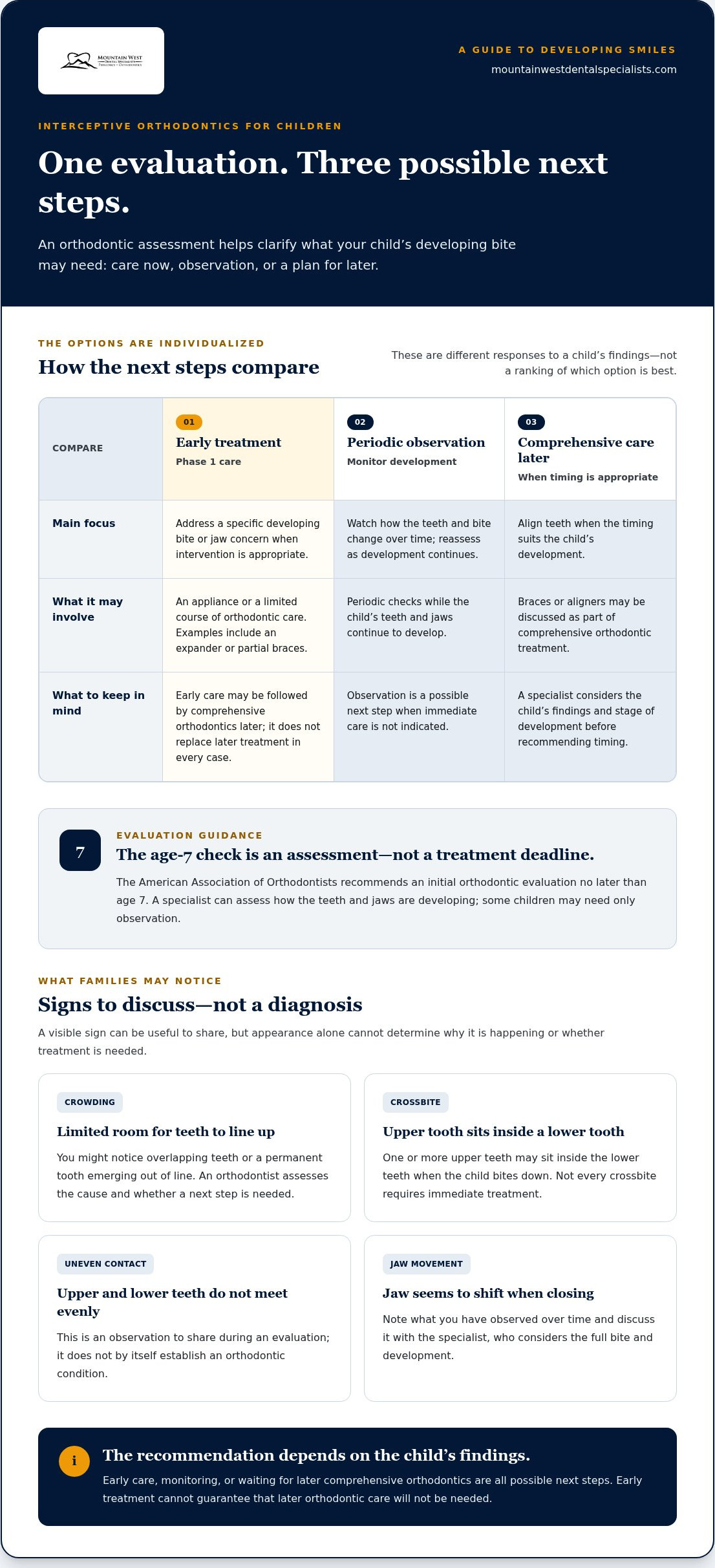
These options aren’t a ranking from most to least helpful. They reflect different responses to a child’s findings and stage of development. The comparison below is a general guide, not a way to decide what your child needs on your own.
Early treatment: Phase 1 care may be recommended during development when a specific concern calls for intervention. The specialist explains its purpose for your child.
Periodic observation: If immediate care isn’t indicated, the specialist may recommend monitoring changes and reassessing at an appropriate interval.
Later comprehensive orthodontics: Braces or aligners may be considered when more permanent teeth are present and the timing is right for comprehensive alignment.
Phase 1 Treatment and Phase 2 Treatment: What Is the Difference?
Phase 1 refers to care during development when an individual concern warrants intervention. Phase 2 is comprehensive orthodontic treatment, such as braces or aligners, to align teeth when more permanent teeth are present. A child who has Phase 1 care may later benefit from Phase 2, but early treatment doesn’t guarantee that later treatment can be avoided. Not every child needs both phases, and some need neither at that time.
For families considering interceptive orthodontics for children, it helps to think of “Phase 1” as a description of timing and purpose, not a required first step in a standard sequence. The specialist’s recommendation should reflect the child’s specific findings, rather than an assumption that every developing smile needs treatment.
When Might Observation Be the Recommended Next Step?
Observation may be appropriate when the specialist doesn’t see a reason to intervene immediately. Follow-up gives the orthodontist an opportunity to reassess how the bite and teeth are changing as the child develops. The timing depends on the child’s needs, so there isn’t one schedule that fits everyone.
Monitoring is active care, not a dismissal of a parent’s concern. Ask what the specialist is watching, what changes would prompt another discussion, and when a follow-up assessment is recommended. This gives you a clear plan while avoiding treatment that isn’t currently indicated. The recommendation can change as your child’s development changes.
What Happens During a Child’s Interceptive Orthodontic Evaluation?
An orthodontic evaluation is a chance to understand your child’s development and discuss any concerns. It isn’t a commitment to begin treatment. The specialist gathers information, examines how the teeth and jaws are developing, and explains what the findings may mean. The next step could be treatment, observation, or another assessment later, depending on your child’s needs.
The visit may include a review of relevant dental records and a clinical examination of the teeth, bite, and jaw relationship. If additional diagnostic information would help with planning, the specialist may recommend records or imaging. Not every child needs imaging; the choice depends on what the evaluation shows.
A personalized orthodontic plan starts with your child’s clinical findings. Those findings guide whether treatment, monitoring, or further information is the appropriate next step.
How Can Parents Prepare for the First Orthodontic Visit?
A little preparation can help you make the most of the conversation. You don’t need to identify or name an orthodontic problem. Share what you’ve observed and what you’d like to understand.
- Bring questions about your child’s bite development, treatment timing, and possible follow-up.
- Share relevant dental and medical history, including information about previous dental care or concerns.
- Describe observations in everyday language, such as noticing that the teeth meet unevenly or that a new tooth looks crowded.
- If you have existing dental records, ask whether they would be useful to bring or share.
It can also help to tell your child that the visit is an opportunity to have their teeth and bite checked and to ask questions. A calm, simple explanation can make the appointment feel less intimidating.
How Do Examination and Imaging Support Treatment Planning?
The clinical examination helps the specialist understand how your child’s bite fits together and how their teeth and jaws are developing. Those findings guide whether more diagnostic information would be useful. Imaging isn’t assumed for every evaluation; it’s considered when it may help answer a treatment-planning question.
When clinically appropriate, Cone Beam CT imaging provides greater precision, safety, and confidence in treatment planning. The specialist can explain why imaging is recommended and how the results relate to the plan. If imaging isn’t needed, the evaluation can still inform a recommendation based on the clinical findings.
For families considering interceptive orthodontics for children, understanding why a recommendation is made can be as helpful as knowing the next step. At Mountain West Dental Specialists, pediatric dentist Dr. Keaton Tomlin and orthodontist Dr. Allison Tomlin provide coordinated care in a family-owned practice in Las Vegas. Schedule your child’s orthodontic evaluation to discuss their development with a specialist.
Discuss Your Child’s Orthodontic Development with a Las Vegas Specialist
Questions about your child’s bite or developing smile don’t have to lead to a rushed treatment decision. Mountain West Dental Specialists is a family-owned Las Vegas practice offering pediatric dental and orthodontic care under one roof. Families can discuss a concern, understand what an evaluation shows, and consider an appropriate next step for their child.
Dr. Keaton Tomlin is a pediatric dentist, and Dr. Allison Tomlin is an orthodontist. Their distinct areas of expertise support a thoughtful conversation about a child’s dental health and orthodontic development. An evaluation can help clarify whether a concern calls for attention now, follow-up over time, or no immediate orthodontic care.
Why Can Pediatric and Orthodontic Care Under One Roof Help Families?
Having pediatric and orthodontic care at one practice can make it more convenient to discuss a child’s needs in a family-focused setting. The clinicians bring different perspectives to care, while recommendations remain specific to the child. This doesn’t mean every child needs both types of care. It gives families a place to discuss dental and orthodontic questions in a setting designed around children.
How Can Las Vegas Parents Take the Next Step?
If you have questions about your child’s bite, development, or the timing of an orthodontic evaluation, start by sharing what you’ve noticed and what you’d like to understand. The specialist can explain the findings and discuss whether treatment, observation, or another step is appropriate.
Before the visit, gather relevant dental or medical history and jot down questions you don’t want to forget. You might ask what the evaluation will assess, what the recommendation is based on, and whether follow-up is suggested. These questions can help you leave with a clearer understanding of the plan, without feeling that you need to decide before you have the information.
- Ask how your child’s bite and teeth are developing.
- Discuss whether the recommendation is treatment, monitoring, or waiting.
- Clarify what follow-up, if any, would involve.
For families exploring interceptive orthodontics for children, an individualized evaluation can turn uncertainty into a clearer picture of what a child may need. Mountain West Dental Specialists is located on S. Cimarron Road in Las Vegas. To discuss your child’s development, call (702) 899-3600 or schedule an orthodontic evaluation.
Take the Next Step at Your Family’s Pace
Your child’s orthodontic development is a process, not a decision you have to make all at once. Start by bringing your questions to a specialist and learning what the assessment suggests. A thoughtful conversation can help you decide whether to act now, keep observing, or revisit the discussion later.
As you consider interceptive orthodontics for children, focus on finding a clear next step that fits your child’s needs. You don’t need to predict how their smile will develop or arrive with a treatment preference. Share what you’ve noticed and ask for guidance. Understanding the reasoning behind a recommendation can help your family move forward with greater confidence.
If you’re ready to discuss your child’s orthodontic development, schedule a child’s orthodontic evaluation at Mountain West Dental Specialists in Las Vegas.
Frequently Asked Questions
Is interceptive orthodontics the same as Phase 1 braces?
They’re related, but interceptive orthodontics describes early orthodontic care broadly, while “Phase 1 braces” suggests a particular appliance-based approach. Early care doesn’t always involve braces. After reviewing your child’s development, an orthodontist may discuss an appliance, recommend monitoring, or suggest returning for a review as more teeth emerge. Ask what concern a recommendation addresses and why that approach fits your child’s current stage.
Can interceptive orthodontics prevent braces later?
No early treatment can guarantee that a child will avoid braces or other orthodontic care later. Interceptive orthodontics may address a specific concern, but each child’s development continues over time. One child may benefit from early care, while another may be monitored or receive comprehensive treatment when older. Ask the orthodontist what follow-up may be appropriate and what factors could shape that recommendation.
Does every child need interceptive orthodontics?
No. An evaluation doesn’t mean treatment is necessary. The orthodontist considers your child’s development and specific findings before recommending care, observation, or reassessment. If a concern doesn’t call for immediate action, the specialist may explain what changes they’ll watch for and when to review them. The goal is a decision suited to your child, not an automatic treatment plan based on age alone.
How long does interceptive orthodontic treatment take?
There isn’t one standard treatment length. The expected course depends on the concern being addressed, the recommended approach, and your child’s response and development. During treatment planning, ask what milestones the orthodontist will use to assess progress, how often follow-up is expected, and what could affect the timeline. The orthodontist can give a more relevant estimate after evaluating your child and explaining the plan.
Is interceptive orthodontic treatment painful for children?
Some children may notice pressure or temporary discomfort with certain orthodontic appliances, and each child’s experience can differ. Before treatment begins, ask what sensations are typical for the specific approach being recommended and what your child should tell you or the orthodontist if something feels uncomfortable. Knowing what to expect can help you prepare your child calmly and share concerns during follow-up visits.
Can a child have an orthodontic evaluation while baby teeth are still present?
Yes. An orthodontist can assess how baby teeth and permanent teeth are developing together. For instance, the specialist may consider how an emerging permanent tooth relates to surrounding teeth and available space. Baby teeth are a normal part of a child’s development, not by themselves a reason to start treatment. The evaluation helps determine whether observation or intervention is appropriate based on the overall findings.
What should I ask the orthodontist about my child’s early treatment plan?
Ask which finding prompted the recommendation, why the timing suits your child, and whether observation is a reasonable alternative. You can also ask what follow-up involves, how progress will be assessed, and what changes might lead the specialist to adjust the plan. These questions keep the conversation grounded in your child’s individual needs and help you understand the reasoning before deciding on a next step.