
What if the right approach to an open bite depends on more than straightening the teeth? For teens, open bite treatment should reflect the bite pattern, possible causes, and how the jaws are growing. Braces or aligners may be part of a plan, but understanding what contributes to the gap helps guide which option may fit.
If you’re unsure whether your teen needs treatment, or concerned that an appliance alone may not address the cause, those are understandable questions. An open bite may leave a space between the front teeth or the back teeth, and it can be related to tooth position, oral habits, or jaw development. An orthodontic evaluation can clarify the pattern and what may be influencing it. Imaging, including Cone Beam CT, may support assessment when clinically appropriate, but not every teen needs it.
This guide explains the different types of open bite, why one can develop during the teen years, and how an orthodontic assessment can shape a personalized plan. At Mountain West Dental Specialists in Las Vegas, care starts with a conversation for teens and parents, so your family can understand possible options and feel prepared for the next step.
Key Takeaways
- An open bite means some upper and lower teeth don’t meet when the back teeth close. The gap may affect the front teeth or the back teeth.
- Tooth position, jaw relationship, oral habits, or a combination may contribute, so identifying the pattern matters when considering care.
- Open bite treatment for teens may involve braces or clear aligners. Suitability depends on the teen’s bite, growth, oral health, and clinical findings.
- Prepare for an orthodontic assessment by noting what you’ve observed and bringing relevant history to discuss with the orthodontist.
- A careful assessment can help families understand the bite and possible contributors before discussing treatment options at Mountain West Dental Specialists in Las Vegas.
What Is a Teen Open Bite and When to Evaluate It?
An open bite is a bite pattern in which some upper and lower teeth don’t meet when the back teeth close. A visible space alone can’t explain why it’s there or which teeth are involved. Unlike general spacing, where neighboring teeth have gaps between them, an open bite describes how upper and lower teeth come together when the jaw closes.
For teens, that distinction matters. A gap may involve the front teeth, the back teeth, or a wider relationship between the jaws. The Open bite overview describes these patterns; an orthodontic examination can assess how they appear in an individual teen. A parent’s observation is a helpful reason to seek guidance, not a diagnosis. An evaluation can clarify whether the bite needs monitoring or whether open bite treatment for teens may be appropriate.
Because teens are still developing, the assessment considers more than appearance. The orthodontist examines which teeth touch and which remain apart, then looks at the bite as a whole. This gives families a clearer starting point without assuming every visible gap has the same cause or calls for the same response.
How is an anterior open bite different from a posterior open bite?
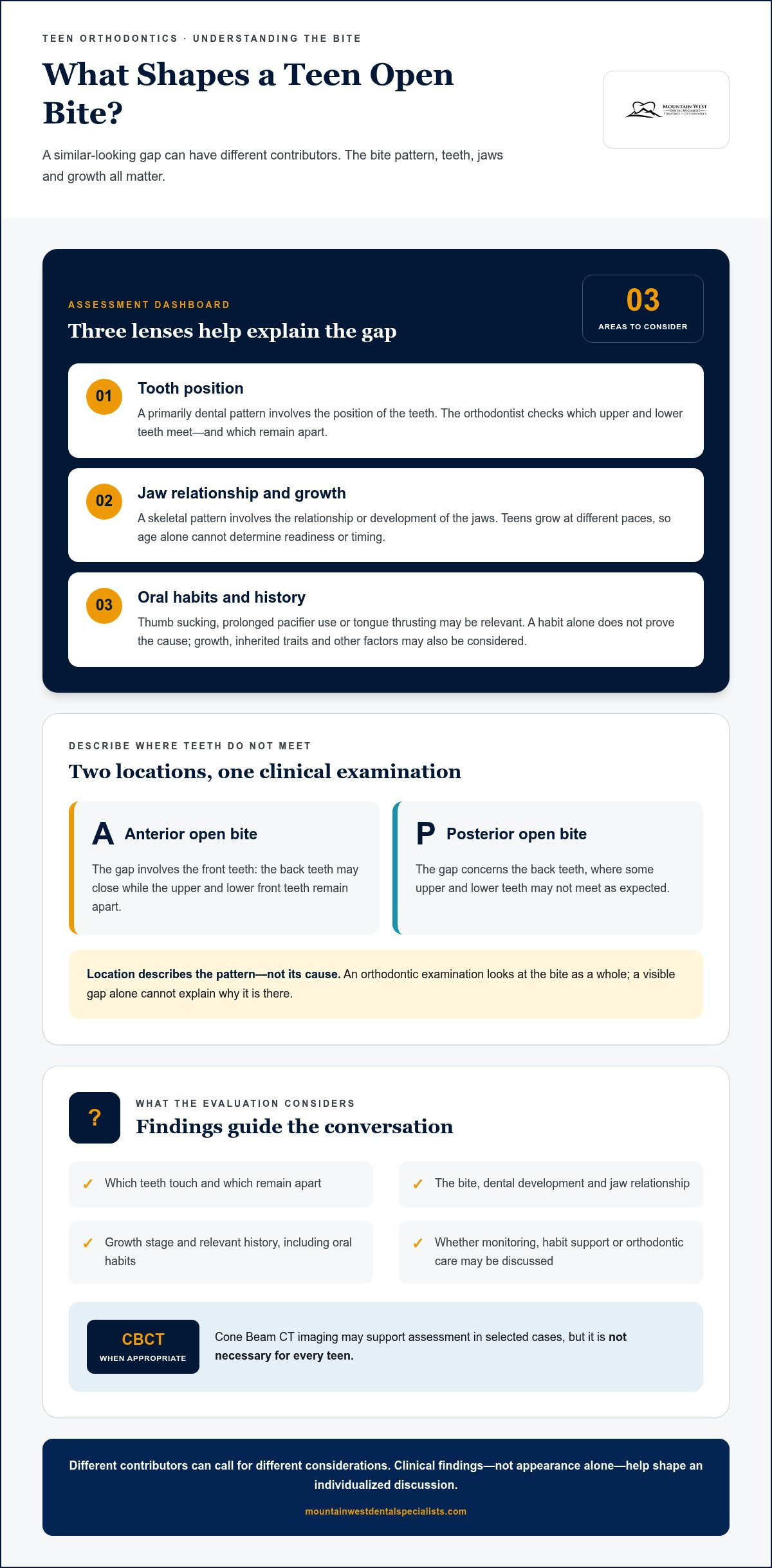
An anterior open bite affects the front teeth. For example, when a teen closes their back teeth together, the upper and lower front teeth may still have a space between them. A posterior open bite concerns contact among the back teeth, where some upper and lower teeth may not meet as expected. The gap’s location helps describe the pattern, but doesn’t explain its cause. An orthodontic examination identifies which teeth and bite relationships are involved.
What signs might prompt a parent to seek an evaluation?
You might notice that your teen’s front teeth don’t touch when they bite down, or that some back teeth seem not to meet. These observations are worth discussing, particularly if your teen also mentions difficulty biting or chewing certain foods or has speech concerns. Avoid trying to classify the bite at home: tooth contact can be hard to judge, and a brief look doesn’t show the full relationship between the teeth and jaws.
An evaluation is an opportunity to understand what you’re seeing and whether it has a practical impact. The orthodontist can examine the bite and explain the findings in terms you and your teen can follow. Treatment isn’t automatically needed just because a gap is visible. A professional assessment helps determine whether care is appropriate and gives your family a clearer basis for discussing next steps.
What Can Cause an Open Bite in Teenagers?
An open bite can relate to tooth position, the relationship between the upper and lower jaws, or both. A gap may look similar from the outside even when the factors behind it differ. That’s why an orthodontist looks beyond the visible space and considers the teen’s overall bite, dental development, and growth.
Identifying the bite pattern and possible contributors helps guide treatment planning. A primarily dental pattern involves tooth position; a skeletal pattern involves the relationship or development of the jaws. These aren’t diagnoses a family needs to make at home. They help explain why an assessment matters before discussing open bite treatment for teens.
Oral habits can be one part of the picture, but they don’t tell the whole story. A history of thumb sucking, prolonged pacifier use, or tongue thrusting may be relevant because persistent habits can influence tooth position or bite development. Their presence doesn’t prove they caused a particular teen’s open bite. Jaw growth, inherited traits, and other factors may also be considered.
How can oral habits relate to an open bite?
Repeated pressure from a habit may affect how teeth develop or meet over time. The orthodontist can ask about past or current habits and consider that history alongside the examination. A habit may have stopped before the teen years and still be useful background information, but it shouldn’t be treated as the sole explanation without supporting findings.
Why do growth and jaw relationships matter?
Teens don’t all grow at the same pace, so age alone can’t determine readiness or timing. The orthodontist considers the bite and jaw relationship alongside the teen’s stage of development. When appropriate, records or imaging may provide additional detail. Cone Beam CT imaging can support assessment in selected cases, but it isn’t necessary for every teen.
These details shape the conversation about whether to monitor the bite, address contributing habits, or consider orthodontic care. They also help explain why a plan suited to one teen may not fit another with a similar-looking gap. The aim is to connect clinical findings with the teen’s development rather than assume one appliance or approach will address every cause.
For families in Las Vegas, an individualized orthodontic assessment can help clarify what may be contributing to a teen’s bite and provide a starting point for discussing next steps.
Which Open Bite Treatments May Suit a Teen?
Once the orthodontist understands the bite pattern and the teen’s development, the conversation can turn to possible treatment. Braces and clear aligners are orthodontic options, but they aren’t interchangeable or suitable for every case. The choice depends on the tooth movements and bite goals involved, as well as the teen’s growth, oral health, and clinical findings.
To compare options, ask what each appliance involves and how the orthodontist will determine whether it fits your teen’s needs. The overview below is a starting point for that discussion, not a recommendation for a particular teen.
| Appliance type | General considerations | Clinician-led suitability |
|---|---|---|
| Braces | Fixed appliances work on the teeth throughout treatment and may be considered for a range of orthodontic needs. | The orthodontist assesses whether they can support the tooth movements and bite goals identified for the teen. |
| Clear aligners | Removable trays are another orthodontic option. Their use involves following the prescribed wear plan. | The orthodontist considers the bite pattern, planned movements, oral health, and whether the teen’s needs suit this approach. |
When might braces or clear aligners be considered?
Either option may be discussed after an examination, but the appliance alone doesn’t define the plan. The orthodontist considers which teeth need to move, how the upper and lower teeth should meet, and how the teen’s development affects those goals. Ask how the recommended option addresses the specific findings and what role your teen will have in following the plan.
Does every teen with an open bite need surgery?
No. An open bite by itself doesn’t determine whether surgery is part of care. If the concern relates mainly to tooth position, the treatment discussion may differ from one involving the relationship between the jaws. That distinction requires an individualized orthodontic evaluation; a visible gap alone can’t predict the right approach.
In more complex cases, the orthodontist can explain how the clinical findings affect possible next steps. This doesn’t mean surgery will necessarily be needed or avoided. It helps clarify the factors behind the recommendation and the role orthodontic care may play.
For parents and teens, the most helpful questions focus on the reasoning: What bite goals are being considered? How does growth affect the timing? Why is one appliance preferred for these findings? Clear answers can make open bite treatment for teens feel less like a choice between devices and more like a personalized care plan.
At Mountain West Dental Specialists, orthodontic braces and aligners are part of care for teens and other ages. A discussion of the assessment findings can help your family understand the options and the reasoning behind them. Explore orthodontic care for teens in Las Vegas.
How Can Teens and Parents Prepare for Treatment and Support Progress?
A little preparation can help teens feel included and give parents a clear way to share what they’ve noticed. An orthodontic assessment is a conversation as well as an examination. The orthodontist reviews the bite and relevant records before recommending a plan, so families can use the visit to understand the findings and raise practical concerns.
Use this four-step sequence to get ready:
- Note observations. Write down what you’ve seen, such as teeth that don’t seem to meet or trouble biting or chewing. Keep it factual; there’s no need to diagnose the pattern.
- Bring relevant history. Share useful dental history and any past or current oral habits you’re aware of. Mention concerns or changes your teen has raised.
- Attend the assessment together. Encourage your teen to describe their experience in their own words. The orthodontist will examine the bite and review relevant records to understand the clinical picture.
- Discuss options and daily care. Ask how the proposed plan fits the findings, what appliance care involves, and what appointments or follow-up may look like.
What should families expect during an orthodontic assessment?
The appointment can include a conversation about your teen’s concerns, dental history, and goals, followed by an examination of the teeth and bite. The orthodontist may review diagnostic records to inform a recommendation. The assessment depends on the individual. Imaging, including Cone Beam CT, may be used when clinically appropriate, but it isn’t needed for every teen.
What helps a teen follow an orthodontic plan?
Teens are better prepared to take part when they understand their role. Discuss how to care for the recommended appliance, keep scheduled visits, and maintain oral hygiene. If school, sports, activities, or everyday routines raise questions, bring them up early so the guidance can fit your teen’s plan.
Keep expectations realistic. Progress and follow-up needs vary with the individual treatment plan, so avoid comparing one teen’s experience with another’s. Families can support steady participation by making room for questions and helping the teen understand what the orthodontist has asked them to do.
Mountain West Dental Specialists offers braces and aligners for teens in Las Vegas. Schedule an orthodontic assessment to discuss your teen’s bite and possible next steps.
Where Can Las Vegas Families Discuss Teen Open Bite Treatment?
For families considering open bite treatment for teens, the next step is an individualized assessment. Start by identifying which teeth are involved, then explore possible contributors, including tooth position, jaw relationships, and growth. With those findings in view, an orthodontist can discuss options that may suit the teen’s needs.
Mountain West Dental Specialists is a family-owned Las Vegas practice offering orthodontic braces and aligners. An evaluation gives parents and teens a chance to talk through the bite, development, concerns, and goals without assuming a particular appliance or outcome in advance. The discussion can help your family understand what the examination shows and what questions remain.
What can families expect from individualized orthodontic care?
The orthodontist considers the teen as a whole, not just the visible gap. The discussion may include how the teeth meet, the teen’s dental history, growth and development, and what they hope to address. Examination findings and relevant diagnostic records help shape the recommendation. Since the details vary from one teen to another, clinical need guides the assessment and treatment discussion.
Diagnostic tools can support that process when appropriate. Cone Beam CT imaging is available at Mountain West Dental Specialists, but imaging is selected according to clinical need, not automatically used for every teen. The orthodontist can explain how recommended records inform the assessment and how the findings relate to possible care.
How can a Las Vegas family take the next step?
Before an evaluation, bring questions about the bite, development, and practical differences between braces and aligners. It may also help to note any eating or speech concerns and share relevant dental or habit history. These details give the orthodontist useful context and help teens take an active part in the discussion.
After the assessment, ask for the findings and next steps to be explained in clear language. You can discuss how the suggested approach relates to your teen’s specific bite, what appliance care may involve, and what follow-up will look like. There’s no need to decide on treatment before the evaluation. The purpose is to understand the options in light of your teen’s clinical picture.
Mountain West Dental Specialists is located on S. Cimarron Road in Las Vegas. Families can schedule an orthodontic evaluation to discuss their teen’s bite and possible care. For additional perspective on local orthodontic considerations, explore this Las Vegas orthodontist guide.
Take the Next Step With Confidence
Your teen’s next step doesn’t need to begin with a decision about braces, aligners, or a particular treatment. It can begin with a conversation about what’s happening, what matters to your teen, and what an orthodontic assessment can clarify. That gives your family a chance to move forward thoughtfully, with a better understanding of the choices ahead.
For open bite treatment for teens, a personalized evaluation helps connect clinical findings with your teen’s needs and goals. At Mountain West Dental Specialists, family-owned care is led by Dr. Keaton Tomlin and Dr. Allison Tomlin. You and your teen can discuss questions together and learn what the assessment may suggest without needing to have every answer before you arrive.
When you’re ready to take that first step, schedule an orthodontic evaluation with our Las Vegas team. A clear conversation can help your family feel prepared, with your teen involved from the start.
Frequently Asked Questions
Can an open bite in a teenager correct itself?
It’s best not to assume a teen’s open bite will close on its own. What happens depends on the bite pattern, possible contributors, and the teen’s development. A gap that appears to involve the front teeth, for example, may have different contributing factors from one involving the back teeth. An orthodontic assessment can help determine whether monitoring or treatment should be discussed, rather than relying on appearance to guess the cause.
Can an open bite affect speech or chewing?
It can be associated with speech or chewing concerns for some teens, though the effects vary. Notice whether your teen struggles to bite into foods such as a sandwich or mentions a change in how certain sounds feel to say. Share those observations during an orthodontic evaluation. The specialist can consider them alongside the bite and decide whether they’re relevant to planning care, rather than assuming the bite explains every concern.
Is open bite treatment different for a 13-year-old and a 17-year-old?
It can be, but age alone doesn’t determine the plan. Two teens of the same age may be at different stages of dental development or growth, and their open bite patterns may differ as well. An orthodontist considers those details together when discussing timing and options. A 13-year-old isn’t automatically ready for one approach, nor is a 17-year-old automatically limited to another.
Can clear aligners treat an open bite in a teen?
Clear aligners may be considered for some teens, but they aren’t suitable for every bite or treatment goal. The orthodontist assesses the teeth, how the bite relates, and the teen’s development before discussing options. The teen’s ability to follow the prescribed plan also matters. This assessment helps clarify whether aligners, braces, or another approach is appropriate to discuss for that individual.
What happens if a teen’s open bite is left untreated?
The effects vary, and an open bite doesn’t automatically lead to a serious problem. Depending on its pattern and possible contributors, it may remain a concern or be associated with functional difficulties. If you’re deciding whether to act now, an orthodontic evaluation can help explain what the findings mean for your teen and whether monitoring or treatment makes sense. That’s more reliable than predicting consequences from appearance alone.
How long does open bite treatment take for a teenager?
There isn’t one timeline for every teen. Duration depends on the diagnosis, the extent of the tooth and bite changes, the approach selected, and individual progress during care. An estimate is more useful after the orthodontist has examined your teen and outlined a plan. You can also ask what milestones will be reviewed along the way, so your family understands how progress and follow-up are assessed.
Is an open bite an emergency for a teenager?
An open bite by itself is generally a reason to arrange an orthodontic evaluation, not an emergency visit. If your teen has a separate acute problem, such as significant pain or an injury, seek prompt dental guidance for that concern. For a bite pattern without an urgent injury or sudden severe symptoms, a planned assessment can help clarify what’s happening and what next steps may be appropriate.