
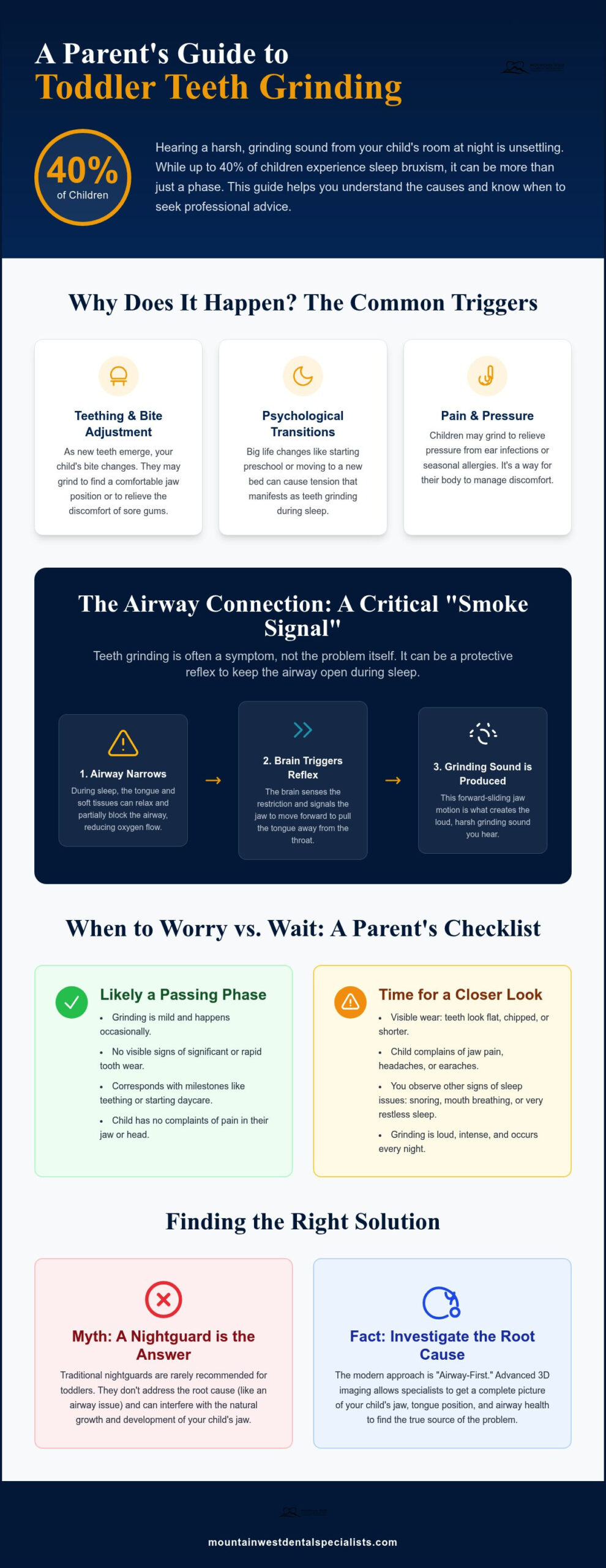
You’re tiptoeing into your child’s room to tuck them in, but instead of the soft rhythm of peaceful breathing, you hear a harsh, grit-on-grit sound that makes your skin crawl. This unsettling noise of toddler teeth grinding at night is a common experience for many parents, yet it often leaves you feeling caught between “wait and see” advice and the fear that your little one is permanently wearing down their brand-new teeth. While research suggests that up to 40% of children experience some form of sleep bruxism, that doesn’t make the sound any less concerning when it’s your own child.
We understand the worry that comes with every crunching sound you hear through the baby monitor. You want to protect your child’s smile and ensure they’re getting the deep, restorative rest they need to grow. This guide will help you uncover the root causes of this habit, from simple teething to more complex airway concerns. You’ll learn exactly which warning signs require a visit to a specialist and discover actionable steps to improve your child’s sleep quality. By looking beyond the surface, we can help you decide if this is a phase they’ll likely outgrow by age six or a “smoke signal” for something that deserves a closer look.
Key Takeaways
- Discover why your child makes that loud crunching sound and how to determine if it is a normal part of their development.
- Learn how grinding can serve as a “smoke signal” for underlying airway issues that might be affecting your little one’s rest.
- Identify the specific signs of tooth wear that mean it’s time to transition from “wait and see” to seeking professional guidance.
- Find out why traditional nightguards aren’t usually recommended and learn better ways to address toddler teeth grinding at night.
- See how advanced 3D imaging technology can give you peace of mind by providing a complete picture of your child’s airway health.
What is Toddler Bruxism? Understanding the Sound of Nighttime Grinding
Hearing your child make a loud, scraping sound while they sleep can feel quite alarming. You’re likely wondering if they’re hurting themselves or if this habit will damage their brand-new smile. This habit, known as toddler teeth grinding at night, often sounds much worse than it actually is. It occurs when a child involuntarily clenches their jaw or slides their teeth back and forth against one another during sleep cycles.
To start with the basics, What is Bruxism? refers to the involuntary clenching or grinding of teeth, usually during sleep. It sounds incredibly intense because a toddler’s jaw muscles are surprisingly strong for their size, and their primary teeth have thinner enamel than adult teeth. This combination creates a high-pitched, resonant sound that can echo through a baby monitor. You aren’t alone in hearing this; research suggests that sleep bruxism affects between 15% and 40% of children, making it a very common milestone in early development.
You might notice the grinding increases during big life changes. Toddlers are sensitive to new routines, like starting preschool or moving to a big-kid bed. These psychological transitions often manifest as physical tension during sleep as their little brains process the day’s events.
Common Causes of Grinding in Early Childhood
While stress plays a role, physical factors are often the primary drivers. Teething is a major contributor to toddler teeth grinding at night. As new teeth emerge, they change the “bite” sensation in your child’s mouth, leading them to grind as they subconsciously try to find a comfortable resting position for their jaw.
These sounds can also be a response to physical discomfort elsewhere. If your child has an ear infection or seasonal allergies, the resulting pressure in the inner ear can be painful. Grinding the teeth helps equalize that pressure, providing temporary relief. Often, what looks like a dental problem is actually a clever way for your child’s body to manage discomfort or minor stress.
Primary vs. Permanent Teeth: Does Grinding Matter Now?
Because baby teeth are softer and thinner than permanent teeth, you might see visible wear quite quickly. You may notice the tips of the canines looking flat or the edges of the front teeth appearing slightly chipped. While this wear is common, it’s vital to remember that primary teeth serve as essential “space maintainers” for the adult teeth waiting beneath the gums.
Baby teeth guide the permanent teeth into their correct positions. If baby teeth are worn down too significantly, it can impact how the adult teeth eventually erupt. Bruxism is a developmental symptom often linked to physical or emotional transitions. Keeping these early teeth healthy ensures a smoother path for your child’s future orthodontic health.
The Airway Connection: Why Nighttime Grinding Isn’t Always Just a Habit
While many people assume that the sound of toddler teeth grinding at night is simply a dental habit or a response to teething, it’s often a “smoke signal” for how your child is breathing. There’s a fascinating biological link between the jaw and the airway. When a child’s airway becomes restricted during sleep, the body triggers a survival instinct. To keep the passage open, the brain signals the jaw to move forward, which helps pull the tongue and soft tissues away from the back of the throat. This repetitive, compensatory sliding is what creates the grinding sound you hear through the monitor.
In the clinical world, we see this as a potential sign of Sleep Disordered Breathing (SDB). Pediatric dentists are often the first line of defense because we see the physical evidence of this struggle before it manifests as more severe health issues. At Mountain West Dental Specialists, our “Airway-First” philosophy means we don’t just look at the wear on the teeth. We look deeper. We evaluate the whole child to understand why the jaw is working so hard in the first place.
Tongue-Ties and Jaw Development
Restricted tongue movement, often called ankyloglossia or a tongue-tie, plays a significant role in how your child’s mouth develops. When a tongue is “tied,” it cannot rest against the roof of the mouth to help widen the palate during growth. This often results in a narrow upper jaw, which directly reduces the space available for a clear, healthy airway. If your child is struggling with this structural issue, a Tongue-Tie Release can often be a gentle, life-changing step toward better breathing and quieter nights.
Mouth Breathing and Enlarged Tonsils
You might notice your child sleeping with their mouth open, or perhaps they have dry lips and dark circles under their eyes. These are classic signs of mouth breathing, often caused by enlarged tonsils or adenoids that block the natural nasal passage. When the airway is crowded by inflamed tissue, the body forces the jaw forward to create more room, which triggers toddler teeth grinding at night. It’s the body’s way of trying to catch its breath.
A holistic evaluation is essential because treating the teeth without addressing the airway is like painting over a crack in a foundation. We use advanced tools to ensure your child’s breathing is as healthy as their smile. If you’re concerned about your little one’s sleep quality, a comprehensive pediatric dental checkup can provide the clarity and peace of mind your family deserves.
Is Toddler Grinding Harmful? When to Worry vs. Wait
You’ve likely heard from friends or even your pediatrician that your child will simply outgrow this phase. In many cases, they’re right. Most children naturally stop grinding their teeth by age six as their jaw structure matures and permanent teeth begin to arrive. However, taking a “wait and see” approach doesn’t mean you should ignore the habit entirely. While the grinding itself might be a developmental milestone, the physical and emotional side effects can impact your child’s daily life long before those adult teeth appear.
The primary concern isn’t always the teeth themselves, but the quality of rest your little one is getting. If toddler teeth grinding at night is accompanied by daytime fatigue, unexplained irritability, or “hyperactive” behavior, it’s a sign that their sleep is being disrupted. When a child’s body is working hard to grind or clench, they often struggle to reach the deep, restorative stages of sleep necessary for healthy growth. A dental checkup is vital not just to monitor wear, but to ensure these nighttime sounds aren’t a symptom of a larger struggle for air or comfort.
The ‘When to Call the Dentist’ Checklist
We want you to feel confident in knowing when a professional evaluation is necessary. Keep an eye out for these specific signs during your morning routine or while your child is playing:
- Jaw Discomfort: Does your child complain of a “tired” mouth or ear pain shortly after waking up?
- Visible Tooth Wear: Look for teeth that appear shorter or have flattened edges. If you see a yellowish layer (the dentin) peeking through the white enamel, the protective outer layer has worn thin.
- Restless Sleep: Watch for frequent waking, heavy sweating during sleep, or a bed that looks like a “tornado” hit it in the morning.
- Morning Headaches: If your toddler is unusually fussy or complains of head pain early in the day, it could be a result of nighttime muscle tension.
Long-Term Risks of Untreated Bruxism
While baby teeth are temporary, the habits formed during these early years can influence your child’s long-term health. Chronic, heavy grinding can put undue stress on the temporomandibular joint (TMJ), potentially leading to clicking, popping, or pain during adolescence. It can also change the way permanent teeth erupt, as the jaw muscles and bone adapt to the constant pressure of clenching.
Addressing these issues early can often simplify the path toward a healthy adult smile. Understanding the relationship between early jaw movement and future orthodontic treatment allows us to intervene gently when it matters most. By protecting the primary teeth now, we are essentially safeguarding the “placeholders” for their future permanent teeth and ensuring their jaw develops in a balanced, healthy way.
How to Help Your Toddler Stop Grinding: Practical Solutions for Parents
When you hear the grit and scrape of toddler teeth grinding at night, your first instinct is likely to find a way to make it stop immediately. While we’ve discussed how this is often a physical response to airway or developmental needs, there are several gentle, home-based strategies you can use to support your child’s comfort. Our goal is to create a “Sleep Sanctuary” that encourages nasal breathing and muscle relaxation, allowing your little one’s body to rest without the need for compensatory clenching.
One common question parents ask is whether they should buy an over-the-counter nightguard. In almost every case, we recommend against this for toddlers. Because your child’s jaw is growing rapidly and their primary teeth are constantly shifting, a rigid guard can actually interfere with natural dental development. Instead of a physical barrier, we focus on addressing the environmental and physiological triggers. For families living in our beautiful but dry Las Vegas valley, using a cool-mist humidifier is one of the most effective steps you can take. The desert air often dries out nasal passages, leading to congestion and forced mouth breathing, which we know triggers the grinding reflex.
Ensuring your child stays well-hydrated throughout the day also helps maintain muscle elasticity. Some parents find that a diet rich in magnesium-heavy foods, like bananas or spinach, supports natural muscle relaxation. These small, holistic shifts can create a foundation for much quieter nights.
Bedtime Routine Adjustments
Lowering your child’s cortisol levels before bed can significantly reduce the tension they carry into their sleep cycles. Try incorporating a gentle jaw massage using circular motions along their cheeks to release the masseter muscles. A warm compress applied to the jaw area for five minutes before pajamas can also signal the body to relax. To protect their sleep quality, aim to eliminate “blue light” from tablets or televisions at least 60 minutes before bed. This helps their brain transition into a state of rest rather than high-energy processing, which often manifests as nighttime clenching.
Addressing Nasal Congestion
If your toddler is struggling to breathe through their nose, they will almost certainly grind their teeth to keep their airway open. Using simple saline drops before bed can clear out dust and local Las Vegas allergens, such as mulberry or olive pollen, which are common triggers in our area. If you notice your child is chronically congested despite these efforts, it may be time for a more specialized evaluation. At Mountain West Dental Specialists, we look at the “why” behind the noise to ensure your child isn’t just sleeping, but truly resting. If you’re ready to find a long-term solution for your child’s comfort, schedule a pediatric dental checkup with our family today.
Specialized Pediatric Care in Las Vegas: The Mountain West Approach
At Mountain West Dental Specialists, we believe every child deserves a “dental home” where they feel safe, heard, and truly cared for. As a family-owned practice led by Dr. Keaton and Dr. Allison Tomlin, we understand the deep anxiety that comes with hearing toddler teeth grinding at night. Our approach goes far beyond a standard dental checkup. We view bruxism as a vital clue to your child’s overall development, specifically their airway health. By focusing on the root cause rather than just the symptoms, we help ensure your child grows up with a healthy smile and the restorative sleep they need to thrive.
To provide the most precise care for our Las Vegas families, we utilize advanced technology like Cone Beam CT imaging. This specialized tool allows us to visualize your child’s airway in 3D, giving us a clear, detailed picture of any potential obstructions that might be triggering their grinding reflex. This level of diagnostic precision helps us catch issues early. It often prevents years of future orthodontic struggles or sleep-related health challenges that could have been avoided with early intervention.
Your Child’s First Visit for Grinding
You can expect a gentle, non-invasive experience during your first visit to our office. We start by carefully examining the teeth for signs of wear, but we also look closely at the jaw, throat, and tongue posture. If you’re feeling nervous about how your little one will react to a new environment, our guide to Your Baby’s First Dental Visit offers helpful tips for a stress-free morning. We partner with you to create a customized care plan that fits your family’s unique needs, ensuring you feel empowered and informed at every step of the journey.
Comprehensive Airway Management
Our specialized training allows us to evaluate for structural restrictions, such as tongue-ties, that might be narrowing the airway and causing nighttime tension. Because we take a holistic view of pediatric health, we frequently coordinate care with other trusted local specialists, including ENTs and Sleep Physicians. This ensures your child receives a complete, multi-disciplinary solution. While it’s true that most children naturally outgrow toddler teeth grinding at night by age six, our goal is to make sure they reach that milestone safely and comfortably. We are here to act as your trusted family guides, providing the modern tools and old-fashioned relational values your child deserves.
Protecting Your Child’s Smile and Sleep Health
Hearing the persistent sound of toddler teeth grinding at night can be deeply unsettling, but understanding the “why” behind the noise is the first step toward a peaceful solution. We have explored how this habit is often your child’s natural way of protecting their airway or navigating developmental milestones. While most children outgrow bruxism by age six, ensuring that their teeth and breathing remain healthy during these formative years is a gift that lasts a lifetime.
Our family-owned Las Vegas practice is here to help you move beyond the “wait and see” approach with absolute confidence. We use advanced 3D Cone Beam CT imaging to provide a clear view of your child’s internal health, offering specialized airway-focused care that prioritizes their long-term well-being. You don’t have to wonder if that grinding sound is a sign of a deeper struggle for rest. Schedule a Pediatric Airway Evaluation at Mountain West Dental Specialists today to give your little one the restorative, quiet sleep they deserve. We look forward to welcoming your family into our care.
Frequently Asked Questions
Is it normal for a 2-year-old to grind their teeth?
Yes, it is very common for a 2-year-old to experience this habit. Research suggests that sleep bruxism affects between 15% and 40% of children, which is a much higher rate than seen in adults. Most little ones will naturally outgrow the habit by the time they reach age six. While the sound can be quite jarring for parents, it is usually a normal part of their early dental and jaw development.
Can teeth grinding be a sign of worms in toddlers?
There is no scientific evidence linking teeth grinding to intestinal parasites or worms in children. This is a common medical myth that has been debunked by modern research. If your child is grinding, it is much more likely related to teething, ear pressure, or airway development. Focusing on these physical and environmental factors will provide a much clearer path to helping your child rest comfortably through the night.
Will my toddler damage their permanent teeth by grinding baby teeth?
Grinding baby teeth does not directly damage the permanent teeth waiting beneath the gums, but it can affect how they eventually erupt. Primary teeth serve as essential space maintainers for the future. If they are worn down significantly, it may impact the alignment of your child’s adult smile. Monitoring this habit early helps us protect their long-term health and determine if early intervention is needed to ensure a healthy transition.
Should my toddler wear a mouthguard for grinding?
We generally recommend that toddlers do not wear traditional mouthguards. Because a child’s jaw is growing and changing so rapidly, a rigid guard can interfere with natural bone development and the eruption of new teeth. Instead of using a physical barrier, we focus on identifying the root cause of the habit. Addressing issues like airway restrictions or nasal congestion is a much safer and more effective way to protect your child’s smile.
Is toddler teeth grinding linked to ADHD or hyperactivity?
There is a documented link between sleep bruxism and behavioral challenges like ADHD or hyperactivity. When a child struggles with toddler teeth grinding at night, they often fail to reach the deep, restorative stages of sleep. This chronic lack of quality rest can lead to daytime irritability, poor focus, and “hyper” behavior. By addressing the grinding and any underlying airway issues, we can often help improve a child’s overall mood and daytime performance.
How can I tell if my child’s grinding is caused by an airway issue?
You can look for several “smoke signals” that suggest an airway connection. If your child breathes through their mouth, snores, or has restless sleep patterns, the grinding is likely a compensatory move to keep their airway open. Other signs include dark circles under the eyes or frequent daytime fatigue. At our Las Vegas office, we use 3D imaging to visualize the airway and determine if structural issues are the primary cause.
Does stress cause toddlers to grind their teeth at night?
Yes, emotional transitions can certainly trigger clenching and grinding during sleep. Even “small” stressors for a toddler, such as starting a new daycare, moving to a big-kid bed, or changes in their daily routine, can manifest as physical tension at night. Creating a calming bedtime “Sleep Sanctuary” and reducing high-energy play before bed can help lower their cortisol levels, making it easier for their jaw muscles to relax naturally.
When should I take my child to a Las Vegas pediatric dentist for grinding?
You should schedule a visit if you notice visible wear on the teeth, morning jaw pain, or if the grinding is accompanied by poor sleep quality. Our Las Vegas team specializes in airway management and pediatric dental checkups to ensure your child is developing correctly. If the noise is frequent and you are concerned about their rest, a professional evaluation provides the peace of mind that your child’s health is being monitored by experts.