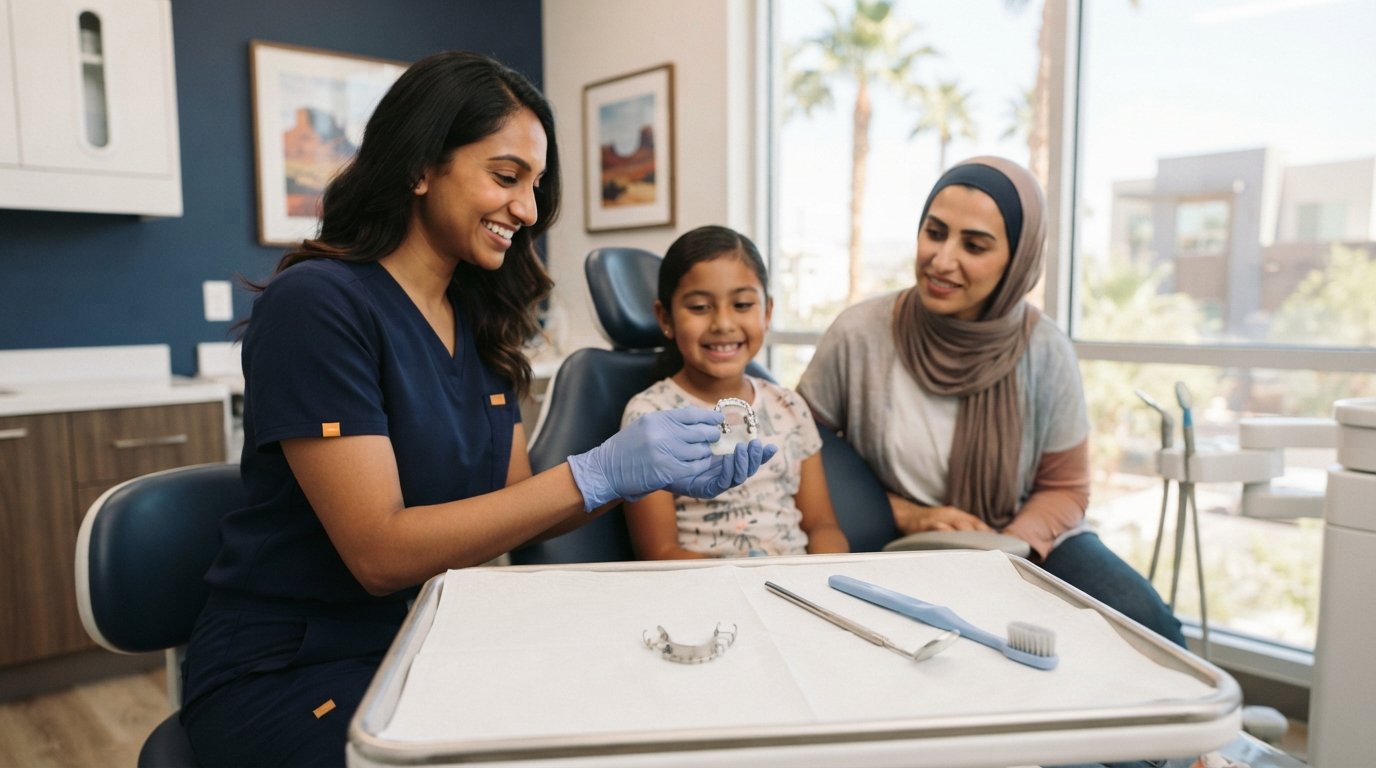
What if the baby tooth your child just lost matters just as much as the adult tooth waiting beneath the surface? If you find yourself asking whether your little one really needs a space maintainer for baby teeth, you are certainly not alone. It’s completely natural to wonder why a temporary tooth requires intervention, especially when you worry about an unfamiliar appliance disrupting your child’s speech, making mealtimes difficult, or causing unnecessary soreness.
We know how much you want to protect your child’s daily comfort while shielding them from severe crowding and complex orthodontic corrections later in life. In this guide, you will learn why space maintainers are vital after early tooth loss and how they safeguard your child’s permanent smile as it develops. You’ll gain a clear look at the different appliance styles, practical tips for smooth daily hygiene, and how pediatric dental and orthodontic specialists work together to keep the experience gentle and stress-free.
Key Takeaways
- Discover why a custom space maintainer for baby teeth is essential for keeping adjacent teeth from shifting into open gaps after early tooth loss.
- Compare fixed and removable options to see why cemented bands remain the comfortable clinical standard for young children.
- Learn how quickly neighboring teeth can drift when space is left unprotected, leading to complex crowding and impaction down the road.
- Pick up easy, practical tips for daily brushing and simple food choices that help your child adjust comfortably within forty-eight hours.
- See the peace of mind that comes when board-caliber pediatric and orthodontic specialists collaborate under one roof to track your child’s developing smile.
What Is a Space Maintainer for Baby Teeth and Why Does It Matter?
A pediatric space maintainer is a small, custom-made oral appliance designed to protect the open room left behind when a primary tooth falls out before its natural time. Rather than moving teeth around like braces do, this gentle hardware acts as a steady placeholder. It keeps adjacent teeth anchored securely in their normal positions until the underlying permanent tooth is ready to emerge safely into the dental arch.
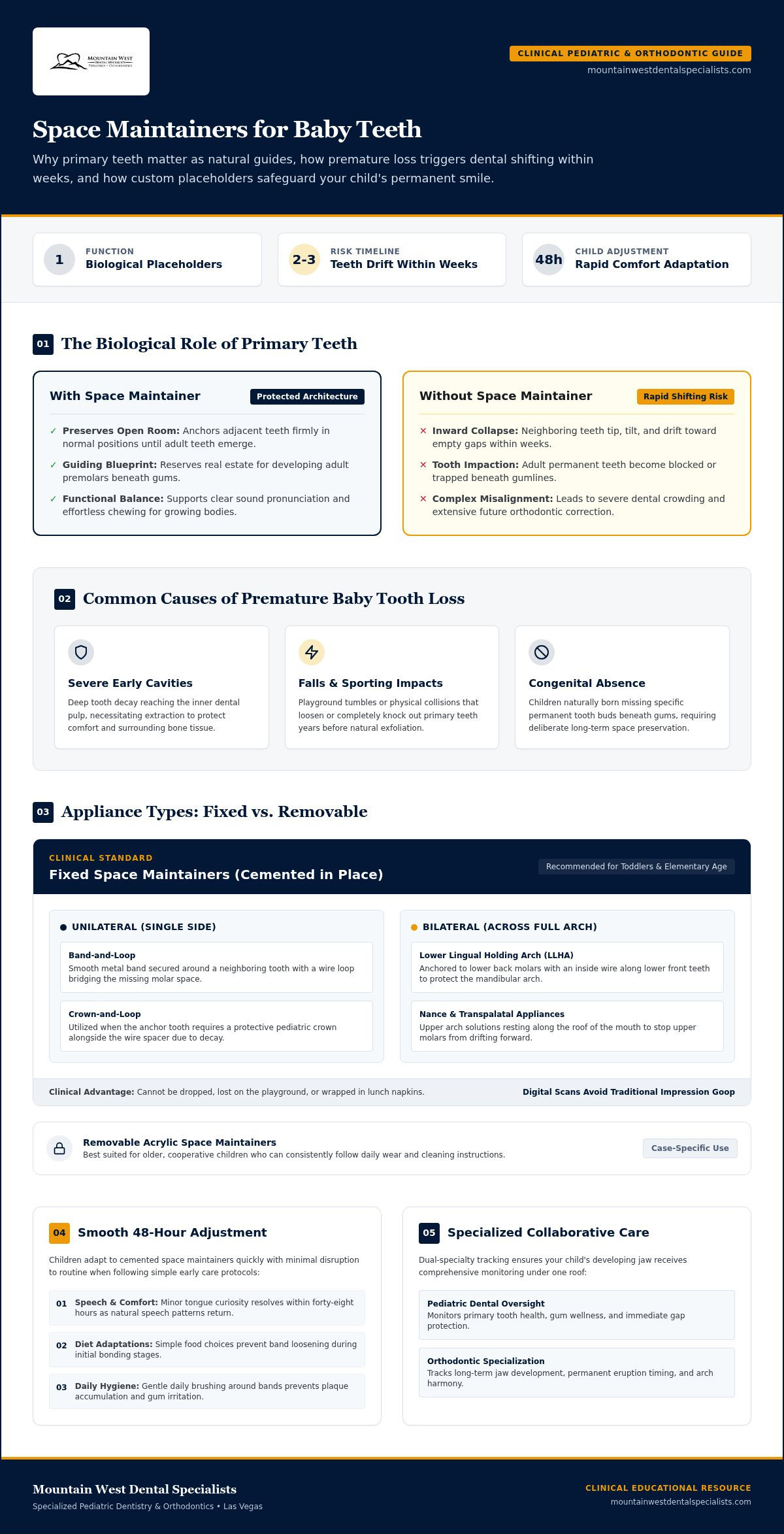
Primary molars are natural guides. They reserve real estate for adult premolars and set the architectural blueprint for your child’s developing jaw. When an empty gap is left completely unprotected, nearby teeth naturally tip, tilt, and drift toward the vacant area within just weeks. Placing a custom space maintainer for baby teeth prevents this inward collapse, sparing your child from severe crowding, bite misalignment, and adult teeth that become trapped under the gumline.
The Crucial Role of Primary Teeth in Oral Development
Healthy primary teeth provide far more than a cheerful smile. They play an indispensable biological role by steering permanent teeth into balanced alignment, helping children pronounce sounds cleanly, and supporting effortless chewing for growing bodies. Establishing a proactive dental home early through children’s first dental visits gives specialists the opportunity to track jaw growth and catch spacing concerns before alignment shifts take hold.
Common Reasons Children Lose Baby Teeth Early
Children lose primary teeth prematurely for several reasons, and understanding the root cause helps shape the gentlest course of care:
- Severe early childhood cavities: Deep tooth decay can reach the inner dental pulp, necessitating an extraction to protect your child’s comfort and keep surrounding bone tissue healthy.
- Physical falls and sporting impacts: High-energy tumble incidents on the playground can loosen or completely knock out primary teeth years before their natural exfoliation timeline.
- Congenital absence: Some children are born naturally missing specific permanent tooth buds beneath the gums, requiring intentional space preservation for balanced long-term restoration.
No matter the cause, acting quickly preserves your child’s oral blueprint and maintains natural pathways for their adult smile.
Types of Space Maintainers: Fixed vs. Removable Options
Every child’s smile is uniquely built, which means the right appliance depends entirely on which tooth was lost, their developmental age, and their daily routine. Broadly speaking, a pediatric dental specialist will recommend either a fixed or a removable appliance. For parents exploring clinical guidelines like the American Academy of Pediatric Dentistry’s resource on What Are Space Maintainers, the primary objective is always the same: keep surrounding teeth steady without disrupting everyday life. Modern practices design these appliances using quick digital scans, sparing sensitive kids the gagging mess of traditional impression goop.
Fixed appliances remain the unquestioned clinical standard for toddlers and young elementary children. Because they are gently cemented in place, fixed designs don’t rely on your child remembering to wear them. They won’t get wrapped in a lunch napkin or dropped on the playground.
Fixed Space Maintainers: Band-and-Loop, Crown-and-Loop, and Lingual Arches
Fixed designs are divided into unilateral (protecting one side) and bilateral (spanning across the whole jaw) configurations:
- Band-and-loop: A unilateral option featuring a smooth metal band secured around a neighboring tooth, with a small wire loop resting against the next tooth to bridge a single missing molar gap.
- Crown-and-loop: Nearly identical to a band-and-loop, but utilized when the anchor tooth has significant decay and needs a protective pediatric crown alongside the wire spacer.
- Lower Lingual Holding Arch (LLHA): A bilateral lower arch appliance anchored to back molars on both sides, with a discreet wire running along the inside of the lower front teeth to preserve space across the entire mandibular arch.
- Nance and transpalatal appliances: Bilateral upper arch solutions that rest along the roof of the mouth, keeping multiple upper molars from drifting forward after early extractions.
Removable Acrylic Appliances for Older Children
Removable options look very similar to traditional orthodontic retainers. Fabricated from smooth, body-safe acrylic and thin clasps, these devices occasionally include artificial replacement teeth to maintain front-smile aesthetics. They work best for older, conscientious kids who only need short-term space preservation before their adult premolars arrive.
Choosing the right style of space maintainer for baby teeth ensures your child’s jaw develops naturally and comfortably. If you ever feel uncertain about which appliance best fits your child’s needs, visiting Mountain West Dental Specialists can give you the clear answers and tailored care your family deserves.
What Happens If You Skip a Space Maintainer? Addressing the Big Question
It is reasonable to ask why temporary teeth deserve this level of proactive care. Since primary molars eventually fall out on their own, placing an appliance can feel like an extra step. However, premature tooth loss is not simply a cosmetic issue. It directly impacts the underlying structural balance of your child’s developing jaw, chewing muscles, and future airway development.
When you leave an extraction site empty, surrounding teeth begin to shift rapidly. In as little as a few weeks, neighboring molars tilt inward toward the opening, while opposing teeth in the opposing jaw over-erupt downward. Skipping a space maintainer for baby teeth creates a roadblock, trapping developing adult teeth under the bone. Instead of a straightforward eruption, permanent premolars can become severely impacted, requiring extensive surgical exposures and prolonged corrective interventions later on.
The Domino Effect of Unmonitored Tooth Migration
Allowing teeth to drift unchecked sets off a cascade of structural disruptions:
- Severe permanent tooth impaction: When a baby molar is lost early, the adult tooth beneath loses its eruptive runway and can become locked beneath dense jawbone.
- Ectopic eruption: Blocked adult teeth often push through abnormally, emerging sideways or piercing delicate palate tissue inside the mouth.
- Bite collapse and jaw strain: As multiple posterior teeth lean inward, your child’s dental arches narrow, compromising proper tongue posture and balanced jaw development.
Addressing these misalignments early preserves natural space, significantly streamlining adolescent smile care through comprehensive, expert orthodontic planning.
When Is a Space Maintainer NOT Necessary?
Specialists take a conservative, measured approach. A space maintainer for baby teeth is not automatically required every time a primary tooth departs. If routine digital imaging shows that the permanent successor is already close to the surface, the space will protect itself. Similarly, when a child loses a front baby incisor, the broad canine spacing rarely collapses, making maintainers unnecessary in most cases. Specialists also look closely at root formation; if more than two-thirds of the adult tooth root is fully formed, natural emergence is right around the corner.
Daily Life with a Space Maintainer: Eating, Cleaning, and Parent Troubleshooting
Watching your child adapt to an oral appliance can feel daunting at first, but kids adjust with remarkable speed. Most children speak and chew with complete confidence within forty-eight hours. The smooth metal band settles comfortably against the tooth, quickly becoming second nature as your little one goes about their normal daily routines.
A few simple lifestyle habits will protect the appliance cement and keep the surrounding gumline healthy throughout treatment. Living with a space maintainer for baby teeth is straightforward once you know how to navigate mealtimes, daily hygiene, and minor adjustments.
Foods to Enjoy and Foods to Temporarily Avoid
Protecting the dental cement requires mindful kitchen choices to ensure bands stay securely anchored:
- Skip sticky and hard treats: Steer clear of taffy, caramels, chewy fruit snacks, and chewing on ice cubes, which can pull metal bands off anchor teeth.
- Cut crunchy favorites into small pieces: Slice crisp apples, raw carrots, and hard crusty bread into bite-sized wedges so your child chews them with their front teeth.
- Serve soft, comforting meals early on: Smoothies, warm pasta, scrambled eggs, and yogurt are gentle on tender gums during the first few days after placement.
Brushing, Flossing, and Preventing Appliance Cavities
Consistent hygiene prevents plaque from gathering along metal loops and wires. Have your child angle their soft toothbrush bristles toward the gumline to sweep away debris around the band. Water flossers and floss threaders make cleaning underneath stabilization wires simple and tear-free. A quick daily check ensures gum tissue looks firm and pink without food trapped beneath the hardware.
Parent Troubleshooting: What to Do If the Appliance Loosens
Even with careful habits, rough play or an accidental bite of hard food can cause a band to shift. If your child’s space maintainer for baby teeth feels loose, remain calm and follow these gentle steps:
- Never try to bend the wire back into shape, force a loose band, or use household adhesives.
- Place a small pinch of clean dental wax over any poky wire rubbing against the cheek or tongue.
- Store the appliance in a clean, dry container if it slips off entirely.
Whenever an appliance shifts or comes off, schedule a pediatric dental checkup with our team so we can safely adjust or recement the hardware.
Specialized Pediatric and Orthodontic Care in Las Vegas: The Mountain West Advantage
Managing your child’s dental growth shouldn’t mean running between different clinics across town. At Mountain West Dental Specialists in Las Vegas, pediatric dentistry and orthodontic specialty care live seamlessly under one roof. Led by Dr. Keaton Tomlin and Dr. Allison Tomlin, our practice brings a family-to-family approach to clinical excellence. We look at every child’s smile holistically, blending gentle primary tooth preservation with forward-thinking bite alignment.
Having pediatric and orthodontic specialists collaborating directly in the same practice transforms how a space maintainer for baby teeth is monitored. Instead of guessing when an appliance has finished its job, our doctors coordinate closely at every step. This seamless communication ensures your child’s appliance is placed with precision, adjusted comfortably, and removed at the exact right moment for natural adult tooth emergence.
Collaborative Pediatric and Orthodontic Oversight Under One Roof
When pediatric dental checkups and orthodontic guidance happen in the same clinic, your family gains continuous, stress-free care:
- Coordinated growth tracking: Our pediatric team safeguards gum health and cleans around appliances, while our orthodontic team evaluates underlying bone development and facial balance.
- Zero wasted appointments: You avoid duplicate visits, redundant evaluations, and the hassle of transferring medical records between disconnected practices.
- Tailored removal timing: Dual oversight ensures the maintainer is safely detached the moment the permanent successor begins emerging, avoiding unnecessary appliance wear.
Comfort-First Technology for Anxious Las Vegas Kids
Every clinical tool we choose is designed to make dental visits calming and positive. We utilize advanced, low-radiation Cone Beam CT imaging to produce crystal-clear three-dimensional views of unerupted adult teeth, mapping their exact depth and angle with remarkable accuracy. Paired with light-touch digital scanners that eliminate messy, uncomfortable impression trays, we keep visits quick and tear-free.
Whether your little one needs proactive space preservation or routine preventive care, our welcoming practice on S. Cimarron Road is built around safety, comfort, and kindness. We invite your family to visit our Las Vegas clinic, where managing a space maintainer for baby teeth becomes a gentle, confidence-building milestone for your child.
Protecting Your Child’s Natural Smile for the Road Ahead
Early tooth loss doesn’t have to complicate your child’s developing bite. Placing a custom space maintainer for baby teeth preserves critical room in the dental arch, protecting permanent successors from impaction and sparing your family from extensive orthodontic corrections down the road. With simple daily hygiene and mindful snacking, children adapt effortlessly to these gentle devices within just a couple of days.
At Mountain West Dental Specialists, you don’t have to navigate this milestone alone. Dr. Keaton Tomlin and Dr. Allison Tomlin blend dual-specialty pediatric dentistry and orthodontic care under one roof, using low-dose Cone Beam CT imaging to track permanent tooth growth with pinpoint accuracy. We treat your family like our own, ensuring every visit feels comfortable, positive, and stress-free. Schedule your child’s gentle smile evaluation with our family today, and take the first step toward a lifetime of healthy, confident smiles.
Frequently Asked Questions
How long does a child have to wear a space maintainer on baby teeth?
A child typically wears a space maintainer for a few months up to several years, depending on their age when the tooth was lost. The appliance stays in place until the underlying permanent tooth starts breaking through the gumline. At our Las Vegas practice, we track this progress during routine pediatric visits to ensure the hardware is removed at the exact right moment.
Does getting a space maintainer hurt or require numbing shots?
No, placing a space maintainer is completely needle-free and painless. Because the metal band slips gently over an existing tooth and is secured with soft dental cement, there is no cutting or drilling involved. Your child might feel slight tightness or pressure for the first day or two, but normal over-the-counter children’s pain relievers and soft comfort foods easily soothe any minor adjustment soreness.
What should I do if my child’s space maintainer falls out or feels loose?
If the appliance comes loose, keep your child calm and never attempt to force it back into place with glue or tools. Apply a dab of dental wax over any exposed wire that rubs against their cheek, place any detached hardware in a clean container, and call our Las Vegas clinic promptly. Our pediatric team will gently check the area and recement the band securely.
Can my child still eat normally with a space maintainer in place?
Yes, kids can eat virtually all their favorite healthy meals once they settle into their space maintainer for baby teeth. The main adjustment involves avoiding sticky candies, hard caramel, and chewing ice cubes, which can break the cement seal. Slicing crisp apples and carrots into thin wedges keeps pressure off the appliance, letting your child chew with complete comfort and safety.
Will my child definitely need braces later if they wear a space maintainer now?
Wearing a maintainer does not guarantee your child will avoid braces, but it prevents severe underlying crowding and impactions that make future orthodontic treatment much longer and more complex. By preserving natural spacing today, you keep their bite aligned and simplify any adolescent orthodontic treatment they might choose down the road. Our dual pediatric and orthodontic specialists track both needs under one roof.
Are space maintainers necessary if a front baby tooth is knocked out?
In most situations, space maintainers are not necessary for missing front baby incisors. The broad spacing between primary canine teeth naturally resists drifting, allowing permanent adult incisors to erupt cleanly on their own schedule. However, if multiple front teeth are lost or if early speech patterns are affected, our Las Vegas pediatric specialists can evaluate whether an aesthetic removable appliance offers helpful developmental support.
How do dentists know when it is time to remove the space maintainer?
Dentists determine removal timing by monitoring the physical eruption of the permanent tooth and reviewing routine digital imaging. As the adult cusp emerges through the gumline, a space maintainer for baby teeth has fulfilled its biological mission. Using low-dose Cone Beam CT imaging at our S. Cimarron Road office, we can watch root formation advance and comfortably remove the appliance in a single quick appointment.