
What if the reason your child is struggling to feed or sleep isn’t something you can easily see, but something a specialized eye needs to feel? Many parents visit us after being told their baby doesn’t have a tongue tie, simply because there isn’t a visible string at the tip of the tongue. We understand how frustrating it is to deal with a painful latch or poor weight gain when you know intuitively that something is wrong. If you are looking for a posterior tongue tie specialist Las Vegas families rely on, you’ve come to a practice that prioritizes your child’s long-term airway health and comfort.
It’s natural to feel anxious about surgical procedures for your little one, especially when you’ve already faced the confusion of a misdiagnosis. You deserve a partner who sees the whole picture, from breastfeeding mechanics to how your child breathes during sleep. In this guide, you’ll discover how a specialized posterior tongue tie release can improve feeding, speech, and sleep using precision laser care. We’ll walk you through our compassionate, expert-led approach to treatment, ensuring you feel like a member of our inner circle every step of the way.
Key Takeaways
- Understand why posterior tongue ties are frequently missed during routine exams and how these submucosal restrictions can impact your child’s feeding and breathing.
- Identify the specific symptoms in infants and toddlers that signal it’s time to consult a posterior tongue tie specialist Las Vegas families trust for expert care.
- Learn how precision laser technology provides a more comfortable, functional release compared to traditional methods while supporting better airway health.
- Discover the step-by-step process of a specialized release, including the gentle pain management techniques we use to keep your little one at ease.
- Explore why an airway-focused pediatric specialist is the gold standard for treating oral restrictions and ensuring your child’s long-term developmental success.
What is a Posterior Tongue Tie? Understanding the ‘Hidden’ Restriction
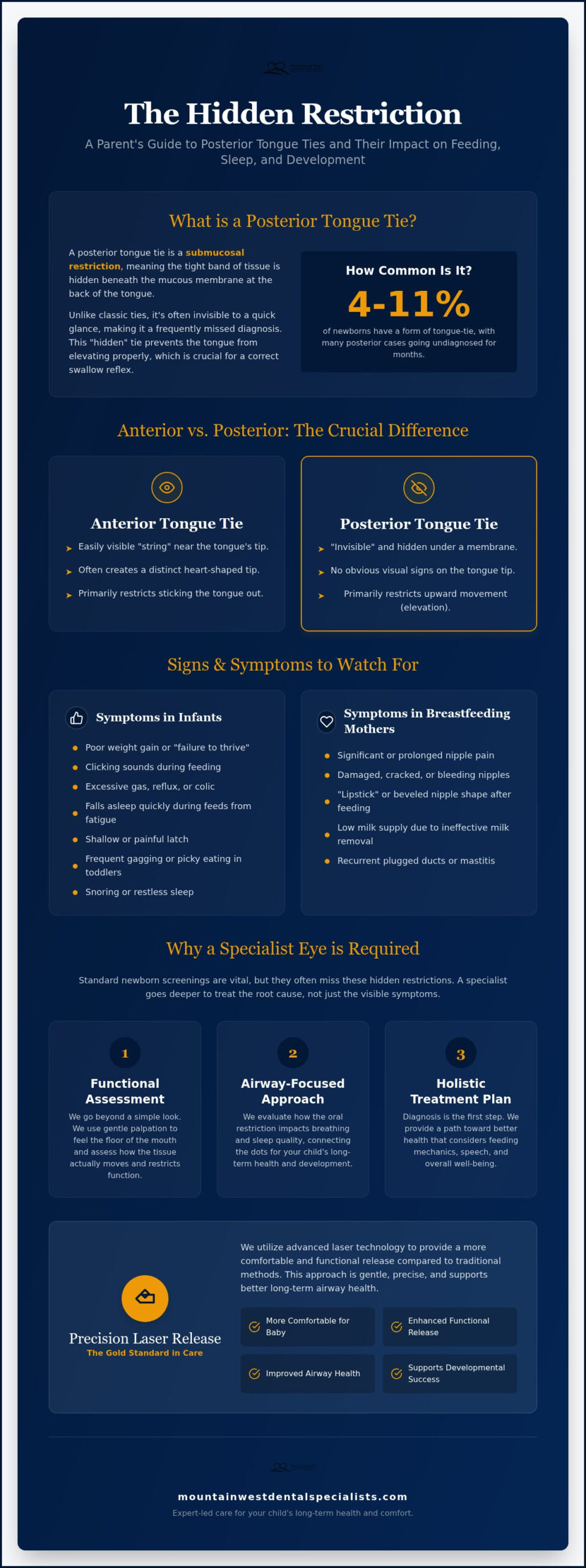
A posterior tongue tie is often described as a submucosal restriction. This means the tight band of tissue is tucked away beneath the mucous membrane, making it nearly invisible during a quick glance. Unlike a classic anterior tie that creates a visible heart-shaped tip, this condition involves the back portion of the tongue. To get a better grasp of the clinical background, many parents begin by researching What is a Posterior Tongue Tie? to see how these oral restrictions are classified. Essentially, the tissue is too thick or non-elastic, preventing the tongue from lifting toward the roof of the mouth. While the prevalence of tongue-tie is estimated to be between 4% and 11% of newborns, many of these cases are posterior and go undiagnosed for months.
This lack of elevation is a significant concern for your child’s development. The back of the tongue is the engine for a proper swallow reflex. If it can’t reach the palate, your baby might struggle to create a seal, leading to clicking sounds or gulping air during feeds. Over time, children who “wait it out” often develop compensatory habits. They might use their jaw or lips to manage food, which can lead to fatigue and picky eating later in life. We see this as a functional issue that affects the whole child, not just a physical string to be cut.
Posterior vs. Anterior Tongue Ties
The primary difference between these two types is visibility. An anterior tie is usually easy to spot because it attaches near the tip of the tongue. A posterior tie is the “invisible” version. You might not see a string at all, but you’ll notice the symptoms. Functionally, while anterior ties often interfere with sticking the tongue out, posterior ties restrict the upward movement needed for clear speech and efficient swallowing. We look for thick, non-elastic tissue that feels like a “speed bump” under the tongue when we perform our assessment. Identifying this hidden restriction is the first step toward relieving your child’s discomfort.
Why a Specialist Eye is Required for Diagnosis
Standard newborn screenings are excellent for many health milestones, but they often miss these hidden restrictions. Most general practitioners are trained to look for obvious, visible ties. A posterior tongue tie specialist Las Vegas parents can turn to will go deeper. We use functional palpation, which involves gently feeling the floor of the mouth to assess how the tissue moves under tension. Our airway-focused approach means we aren’t just looking at the mouth; we are evaluating how that restriction might be impacting your child’s breathing and sleep quality. This specialized perspective ensures we treat the root cause, providing a path toward better long-term health for your family.
Signs and Symptoms: When to Seek a Specialist in Las Vegas
Recognizing the signs of an oral restriction can be an emotional journey for any parent. Many families we meet in our office arrive feeling a heavy sense of “failure to thrive” anxiety, wondering why feeding feels like such a struggle. You might feel like you’re doing everything right, yet your baby isn’t gaining weight or seems constantly frustrated. It’s vital to remember that these challenges aren’t your fault. Often, the culprit is a hidden physical barrier that requires a posterior tongue tie specialist Las Vegas families can trust to provide clarity and a gentle path forward.
Beyond the immediate feeding issues, we look at the whole child’s development. For older children, symptoms might manifest as picky eating, frequent gagging, or speech delays that don’t seem to improve with traditional therapy. We also watch for airway red flags like snoring or restless sleep, which are often overlooked. For a deeper look into the clinical classifications of these issues, you can review this comprehensive medical overview of ankyloglossia, which details how these restrictions present across different age groups and stages of growth.
Symptoms in Breastfeeding and Bottle-Feeding Infants
If you’re breastfeeding, you might experience significant nipple pain or notice a “lipstick” shape to the nipple after a session. This happens because your baby is using their gums to compensate for a lack of tongue elevation. You may also notice your baby making clicking sounds during feeds as their suction breaks, or they might suffer from excessive gas and reflux from swallowing too much air. These aren’t just “new parent” hurdles; they are functional signs that your baby’s tongue isn’t moving with the precision needed for efficient milk transfer.
Long-Term Impact on Speech, Sleep, and Orthodontics
When a tongue tie remains untreated, it changes how the mouth and face develop. The tongue should naturally rest against the roof of the mouth, acting as a natural expander for the palate. Without this gentle pressure, the palate can become narrow and high-arched, which often leads to future orthodontic crowding and a lack of space for adult teeth. This is why we take a holistic approach to every child’s care.
Mouth breathing is another critical sign that shouldn’t be ignored. It’s essentially a functional emergency for a growing child because it bypasses the body’s natural filtration system and can lead to poor oxygen quality during sleep. If your child wakes up tired or struggles with focus, their tongue posture might be the hidden cause. Addressing these issues early with a posterior tongue tie specialist Las Vegas residents rely on can help prevent a lifetime of dental and respiratory challenges, giving your child the best possible start.
The Mountain West Approach: Precision Laser Release & Airway Integration
At Mountain West Dental Specialists, Dr. Keaton and Dr. Allison Tomlin believe that every child deserves a “medical home” where their unique needs are understood and respected. As a family-owned and operated practice, we treat every little one who walks through our doors as a member of our inner circle. We know that the decision to pursue a procedure for your baby can be heavy with anxiety. That’s why we’ve built our practice around a “family-to-family” care model, combining high-level clinical authority with neighborly kindness. Choosing a posterior tongue tie specialist Las Vegas parents can trust means finding a team that looks beyond the surface to ensure your child’s long-term well-being.
Our approach is fundamentally different because we prioritize a functional release over a simple “snip.” A traditional scissor cut often fails to address the deep, submucosal tissue that characterizes a posterior tie. If the release isn’t complete, the tongue still won’t have the range of motion needed for proper swallowing and breathing. We focus on restoring the tongue’s ability to reach the palate, which is the “engine” for healthy facial development and airway health. By looking at the whole child, we ensure that the treatment provides lasting relief rather than just a temporary fix.
Advanced Diagnostics and Airway Management
Precision begins with seeing what others might miss. We utilize on-site Cone Beam CT (CBCT) imaging to create a detailed 3D map of your child’s oral structures and airway. This advanced technology allows us to assess the relationship between the tongue’s position and the space available for breathing. Because our practice holds a dual specialty in Pediatric Dentistry and Orthodontics, we offer a unique perspective on how an oral restriction today might affect dental crowding or sleep-disordered breathing tomorrow. We don’t just look at the mouth; we look at how your child’s anatomy supports their overall vitality.
The Laser Advantage: Safety, Comfort, and Precision
We utilize advanced CO2 and Er:YAG laser technology to perform releases with a level of precision that traditional tools simply cannot match. This modern methodology is designed to improve the human experience for both the child and the parent. The benefits of our laser-focused approach include:
- Minimal Bleeding: The laser seals blood vessels as it works, which often eliminates the need for traditional sutures.
- Enhanced Comfort: Laser energy is incredibly gentle, reducing the inflammatory response and the need for heavy sedation.
- Faster Healing: The precision of the laser means less trauma to the surrounding healthy tissue, leading to a quicker recovery.
- Decontamination: The high-energy light naturally reduces the risk of infection at the site of the release.
By using these sophisticated tools, we can achieve a more complete release of deep tissue, ensuring the tongue is truly free to move. This commitment to cutting-edge methodology reflects our role as a posterior tongue tie specialist Las Vegas families rely on for safe, modern, and compassionate care.
The Procedure and Recovery: What Parents Need to Know
The day of the procedure often brings a mix of relief and nervous anticipation. We want you to know that your feelings are completely valid. Our goal is to make the experience as gentle as possible for both you and your little one. By choosing a posterior tongue tie specialist Las Vegas families trust, you’re ensuring that your child’s comfort remains the top priority from the moment you walk through our doors. We’ve designed our clinical environment to feel less like a sterile office and more like a supportive home for your family’s health journey.
Preparation and Procedure Day
The actual laser release is remarkably efficient. In most cases, the procedure itself takes only a few minutes. We prioritize keeping your child calm throughout the visit, and because the laser is so precise, there is typically very little discomfort. One of the most rewarding moments for parents is being reunited with their baby almost immediately. We actually encourage you to feed your baby right after the release. This provides instant comfort and allows us to see the immediate functional improvement in their latch or swallow.
During the first 72 hours of recovery, it’s normal for your child to be a bit fussy as they adjust to their new range of motion. We’ll provide you with a detailed plan for pain management and comfort measures tailored to your child’s age. This initial window is a time for extra cuddles and patience as the site begins its rapid healing process. Because the laser decontaminates as it works, the risk of infection is significantly lower than with traditional methods, giving you one less thing to worry about.
The ‘Secret Sauce’: Myofunctional Therapy and Exercises
While the release creates the physical space for movement, the “secret sauce” for long-term success lies in the follow-up care. A posterior tongue tie specialist Las Vegas knows that the tongue is a muscle that needs to be retrained. Without gentle post-release stretches, the tissue can naturally try to grow back together, leading to re-attachment. We’ll teach you exactly how to perform these exercises at home to ensure the site heals with the maximum functional lift.
We also believe in a collaborative approach to healing. This often involves working alongside local lactation consultants, speech therapists, or bodyworkers here in Las Vegas. These professionals help your child integrate their new tongue mobility into daily life, whether that’s through better breastfeeding mechanics or clearer speech development. If you’re ready to see how our family can support yours, we invite you to schedule a tongue-tie consultation with our expert team today. We’re here to guide you through every stretch and every milestone.
Choosing Your Posterior Tongue Tie Specialist in Las Vegas
Selecting the right provider for your child’s care is one of the most significant decisions you’ll make as a parent. It’s about more than just finding someone who can perform a procedure; it’s about finding a partner who understands the intricate relationship between oral function, breathing, and long-term growth. A pediatric dental specialist is the gold standard for these procedures because of their specific training in the unique anatomy of developing mouths. When you search for a posterior tongue tie specialist Las Vegas, you’re looking for an expert who can navigate the complexities of submucosal restrictions with both precision and heart.
The Tomlin family believes that the best care happens when clinical expertise meets approachable, neighborly kindness. We don’t want you to feel like a number in a busy medical system. Instead, we invite you into a practice where your concerns are heard and your child is treated with the same protective advocacy we’d give our own family. This “family-to-family” connection is the cornerstone of our practice, ensuring that the anxiety often associated with specialized procedures is replaced by a sense of safety and belonging.
Our Las Vegas Location and Family-Focused Care
Our office is conveniently located on S. Cimarron Road, making it easy for local families to access high-quality care without traveling far from home. We’ve intentionally designed our space to be a welcoming, non-clinical environment that helps children feel at ease from the moment they arrive. Being rooted in the Las Vegas medical community allows us to collaborate closely with your child’s pediatrician, lactation consultant, or speech therapist, ensuring a seamless circle of care. Having a local home base is especially important for the follow-up visits and functional assessments that are vital to a successful recovery.
The Value of a Multi-Specialty Perspective
One of the unique advantages of our practice is the integration of pediatric dentistry and orthodontics under one roof. This dual-specialty approach allows us to monitor your child’s growth and development long after the initial tongue-tie release. We look at how the tongue’s new mobility influences the shape of the palate, the alignment of the teeth, and the health of the airway over time. This long-term monitoring ensures that your child stays on the path toward optimal health as they grow from an infant into a thriving toddler and beyond. If you’re ready to take the next step for your child’s well-being, we invite you to schedule a consultation with Dr. Tomlin today. We look forward to welcoming your family into our dental home.
A Path to Better Breathing and Brighter Smiles
Your journey toward understanding your child’s oral health shouldn’t be a path you walk alone. We’ve explored how hidden posterior restrictions can impact everything from infant feeding to long-term airway development. By choosing a posterior tongue tie specialist Las Vegas families trust, you’re opting for a practice that looks beyond the surface. Our family-owned office, led by the Tomlin family, combines a warm touch with advanced laser technology and on-site CBCT imaging. This ensures your child receives precise care that prioritizes their comfort and future growth.
We’re dedicated to being your child’s medical home for pediatric airway management and specialized dental needs. Whether you’re struggling with a painful latch or concerned about your toddler’s speech, we’re here to provide the expert guidance you deserve. You can take the first step toward a functional solution by visiting our welcoming office on S. Cimarron Road. We invite you to Book a Functional Tongue Tie Assessment on S. Cimarron Road today. Your child’s health is our greatest priority, and we look forward to helping them thrive with confidence and ease.
Frequently Asked Questions
Is a posterior tongue tie the same as a regular tongue tie?
No, a posterior tie is a specific type of oral restriction that is hidden beneath the mucous membrane at the back of the tongue. While a “regular” or anterior tie is easily visible at the tip, a posterior tie is submucosal. This makes it much harder to detect without a specialized functional assessment that looks at how the tongue lifts rather than just how it looks.
Can a posterior tongue tie affect speech in older children?
Yes, these restrictions often interfere with a child’s ability to produce complex sounds that require tongue elevation. You might notice your child struggling with “r,” “l,” “s,” or “z” sounds. Because the tongue has to work much harder to move, children may also experience speech fatigue or develop compensatory habits that affect their clarity and confidence when speaking.
Does insurance cover posterior tongue tie release in Nevada?
Coverage for this procedure depends entirely on your specific medical or dental insurance plan. While some Nevada providers recognize the functional necessity of a release, others may have specific requirements for documentation. We recommend checking with your carrier directly to understand your benefits. Our team can provide the clinical notes and codes you need to help navigate your claim process.
How do I know if my baby’s tongue tie is posterior?
You likely won’t see a visible string, so you have to look for functional red flags. If your baby makes clicking sounds while feeding, struggles to stay latched, or seems excessively gassy, a restriction may be present. A posterior tongue tie specialist Las Vegas families trust will use gentle palpation to feel for the thick, non-elastic tissue that characterizes these hidden ties.
Is laser tongue tie release painful for infants?
Laser technology is designed to be incredibly gentle and is often much more comfortable than traditional scissor methods. The laser energy naturally numbs the area and seals blood vessels as it works, which minimizes discomfort and eliminates the need for sutures. Most babies are back in their parents’ arms and ready to feed within just a few minutes of the procedure.
What happens if a posterior tongue tie is left untreated?
Leaving a restriction untreated can lead to long-term challenges with airway health and facial development. Since the tongue cannot rest against the roof of the mouth, the palate may become narrow, leading to mouth breathing and future orthodontic crowding. Addressing the tie early helps ensure your child develops healthy breathing patterns and a proper swallow reflex as they grow.
How long does the recovery process take after a frenectomy?
The initial healing of the site typically occurs within the first 48 to 72 hours. You’ll notice a small diamond-shaped patch that changes color as it heals. However, the true recovery process involves several weeks of gentle myofunctional exercises. These stretches are vital to ensure the tongue gains its full range of motion and adapts to its new mobility.
Can a tongue tie come back after it is released?
The tissue does not actually grow back, but the site can re-attach if the post-procedure stretches aren’t performed consistently. The body’s natural healing process wants to close the wound, which can pull the tongue back down. This is why the follow-up care provided by a posterior tongue tie specialist Las Vegas is so critical for ensuring a successful, permanent functional result.