
Persistent mouth breathing can affect more than how a child breathes. The effects of mouth breathing in children may include dry mouth, increased cavity risk, crowded teeth, bite changes, and differences in jaw or facial development. Occasional mouth breathing during congestion or exercise is common, but a pattern that continues deserves attention.
It’s understandable to wonder whether an open mouth during sleep is a passing habit or a sign of something more. Sometimes the cause is temporary, such as a cold or allergies; in other cases, nasal blockage or oral development may play a role. The pattern and any related symptoms can help determine whether an evaluation may be useful.
This article explains what mouth breathing is, why it happens, and which signs may be worth discussing with a healthcare professional. You’ll also learn how persistent mouth breathing may relate to teeth, bite, facial growth, sleep, and breathing, and why identifying the underlying cause matters.
Key Takeaways
- Learn how to distinguish occasional mouth breathing from a persistent pattern that may deserve attention.
- Recognize common causes, including congestion, allergies, and airway or oral-structure concerns.
- Understand which sleep, breathing, dental, or behavior changes may make an evaluation helpful.
- See how ongoing mouth breathing may relate to dry mouth, crowded teeth, bite changes, and facial development.
- Explore how pediatric dental checkups and orthodontic care can help assess oral development and possible next steps.
What Is Mouth Breathing?
Mouth breathing means drawing air through the mouth rather than mainly through the nose. It’s common during exercise or a stuffy cold. The effects of mouth breathing in children depend partly on whether the pattern is temporary or persistent. Ongoing mouth breathing may affect oral health, sleep, and facial development, so a recurring pattern matters more than a single episode.
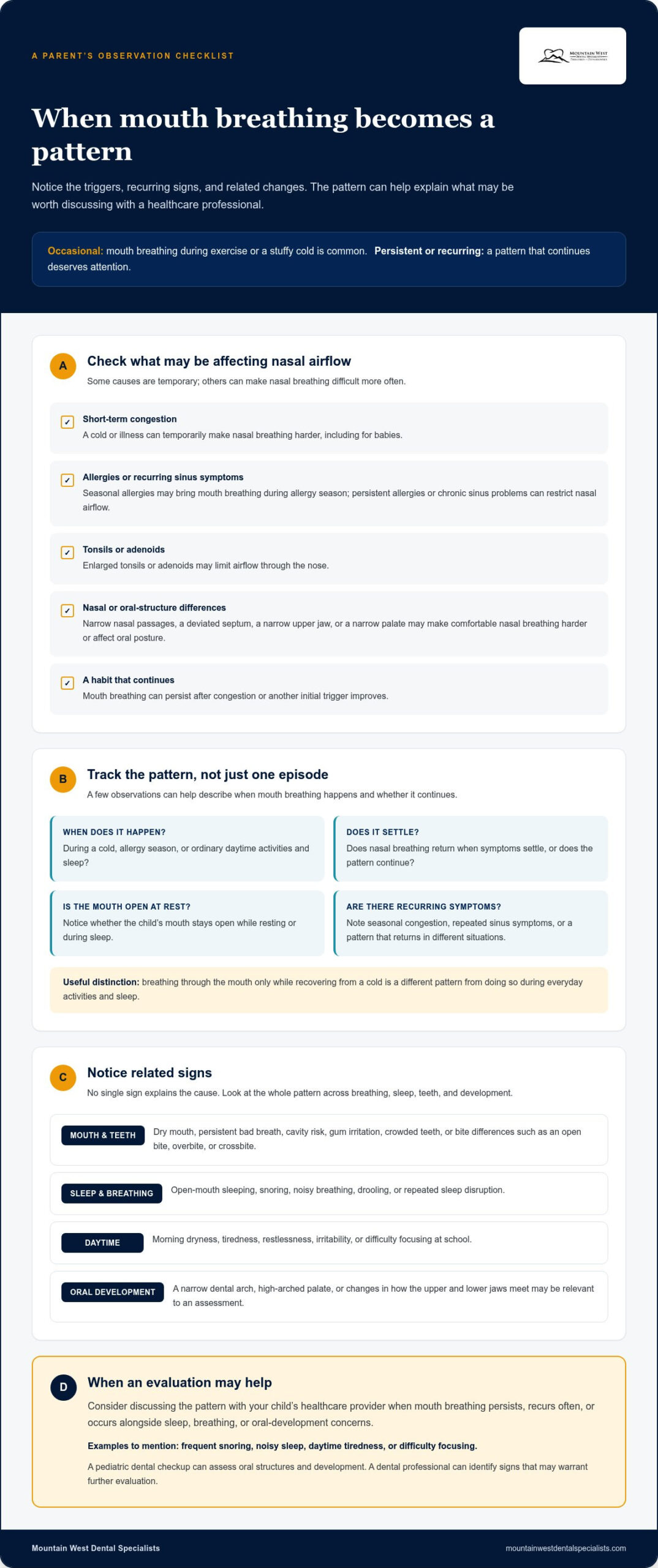
The nose filters and humidifies incoming air and helps regulate airflow. Breathing through the mouth bypasses these functions and can leave a child with a dry mouth. Parents may notice open-mouth sleeping, morning dryness, snoring, drooling, or persistent bad breath. No single sign explains the cause, but a recurring pattern can help families describe what they observe during the day and at night.
Persistent mouth breathing may be associated with differences in jaw and facial development. A child’s tongue may rest lower in the mouth rather than against the palate, or roof of the mouth. This resting posture may be linked to a narrow upper jaw, a high-arched palate, or a longer-looking face. The effects of mouth breathing in children may therefore involve jaw position and growth as well as breathing habits.
These changes may also affect how the upper and lower jaws meet. Some children may develop a receding lower jaw, a narrower dental arch, or facial features that appear longer or narrower. These features don’t predict an individual child’s development, but they help explain why persistent breathing patterns and facial changes are worth noticing.
Dryness can have direct consequences for teeth and gums. Saliva helps protect the mouth, so reduced moisture can increase the risk of cavities and gum irritation. Chronic mouth breathing may also occur alongside crowded teeth or bite differences, including an open bite, overbite, or crossbite. For example, an open bite means the front teeth don’t meet when the back teeth close. These signs can affect chewing and how the teeth fit together.
Sleep and daytime behavior can offer other clues. Snoring, noisy breathing, or repeated sleep disruption may leave a child tired, restless, irritable, or less focused at school. Poor sleep can affect attention and mood, but those changes have many possible causes. A pediatric assessment can consider the whole pattern, including nasal breathing, sleep, dental development, and speech. Mouth breathing can also continue as a habit after congestion or another initial cause improves, so it’s useful to note whether the pattern persists.
Common causes of mouth breathing
Children may breathe through their mouths when nasal airflow feels blocked or oral structures affect breathing. The cause may be temporary, such as a cold, or persistent, such as recurring allergies or an airway obstruction.
Causes in Children
Common causes in children include congestion from colds or allergies, enlarged tonsils or adenoids, and structural differences. These matter because children may switch to mouth breathing whenever nasal airflow becomes difficult.
For example, a child with seasonal allergies may breathe through their mouth during allergy season, then return to nasal breathing when symptoms settle. Congestion from an illness can also cause temporary mouth breathing, including in babies. Narrow nasal passages, a deviated septum, or a narrow upper jaw may make comfortable nasal breathing harder. Noting when the pattern occurs can help families describe it clearly.
Causes of Chronic Mouth Breathing
Chronic mouth breathing is a recurring pattern associated with ongoing blockage, oral structure, or habit. Identifying the likely cause matters because mouth breathing can continue even after the original trigger improves.
Chronic sinus problems, persistent allergies, and enlarged tonsils or adenoids can restrict airflow through the nose. A structural nasal issue, such as a deviated septum, may also contribute. Some children have a narrow palate or bite concern that affects oral posture. Others continue breathing through their mouths after congestion clears, making the habit part of the pattern rather than its original cause.
A useful distinction is whether mouth breathing follows a clear, short-term trigger or continues in different situations. A child who breathes through their mouth only while recovering from a cold has a different pattern from one who does so during ordinary daytime activities and sleep. Note examples such as seasonal congestion, repeated sinus symptoms, or persistent open-mouth posture. These observations can help describe how often the pattern occurs.
Several causes can overlap. Allergies may cause nasal congestion, while enlarged adenoids or tonsils further limit airflow. A child may then rely on mouth breathing even when symptoms vary from day to day. In other cases, a structural feature, such as a narrow palate, may affect oral posture without a recent illness. A dental professional can assess oral development and identify signs that may warrant further evaluation.
Parents can pay attention to the pattern without trying to diagnose its cause at home. Consider whether the child’s mouth stays open while resting, whether congestion returns regularly, and whether mouth breathing persists after an illness passes. A pediatric dental checkup can help assess oral structures and development when breathing patterns raise concerns.
When treatment or specialist evaluation may be appropriate
An evaluation may help when mouth breathing persists, recurs often, or occurs alongside sleep, breathing, or oral-development concerns. Frequent snoring, noisy sleep, daytime tiredness, and difficulty focusing are examples to discuss with your child’s healthcare provider.
Can children outgrow mouth breathing, and how long does treatment take? Temporary mouth breathing from a cold or allergy symptoms often resolves when nasal breathing becomes comfortable again. A persistent pattern may continue as a habit after its original cause improves. Treatment duration depends on the cause and the approach used.
Start by sharing the pattern and symptoms with your child’s pediatrician. Note whether mouth breathing happens during sleep, at rest, or only during congestion, and mention snoring or changes in sleep and behavior. A pediatrician can assess the nose and airway and determine whether further evaluation is appropriate. If enlarged tonsils or adenoids may be obstructing airflow, an ear, nose, and throat specialist can assess the child’s airway and symptoms.
Care focuses on why nasal breathing is difficult. Allergy-related symptoms may be managed with antihistamines or steroid nasal sprays, while persistent nasal blockage may need further assessment. Enlarged or infected adenoids can block the airway; adenoidectomy may be recommended when they contribute to obstruction. Tonsil and adenoid concerns require an assessment of the child’s symptoms and airway. Surgery isn’t needed for every child who breathes through the mouth.
For some children, tongue posture and swallowing patterns are part of the assessment. Myofunctional therapy may address tongue position and oral-muscle patterns, often alongside care for an underlying airway issue. A dentist may coordinate with a myofunctional therapist or speech-language pathologist when tongue posture or swallowing exercises are relevant. These approaches address different factors, so they don’t replace evaluation of congestion, allergies, or enlarged adenoids.
A useful treatment plan connects symptoms to their likely cause. For example, persistent snoring with suspected enlarged adenoids may lead to an ENT assessment, while allergy symptoms may prompt a plan focused on allergy management. A sleep study may be recommended when sleep apnea or enlarged tonsils or adenoids are suspected. If mouth breathing may affect oral development, an orthodontic or dental evaluation can assess the bite and palate. Coordinated airway management can bring these concerns into one discussion, while treatment remains focused on the condition affecting the child’s breathing.
Dental crowding and bite problems
Persistent mouth breathing may affect oral posture, tooth position, and how the upper and lower jaws meet. When the tongue rests low instead of against the palate, the upper dental arch may become narrower. A narrower arch can leave less room for teeth and contribute to crowding. These patterns don’t occur in every child who breathes through the mouth, but they’re useful signs to discuss during a dental evaluation.
Bite differences can take several forms. An open bite occurs when the front teeth don’t meet while the back teeth close. An overbite describes upper front teeth extending over the lower front teeth, while a crossbite occurs when upper teeth sit inside the lower teeth. Mouth breathing may contribute to these alignment problems, which can affect chewing. For example, a child with an open bite may find it harder to bite into some foods.
Dryness is another important oral health concern. Mouth breathing reduces moisture in the mouth, while saliva normally helps protect teeth and gums. With less saliva, a child may face greater risk of cavities, irritated gums, or gingivitis. Morning dry mouth, persistent bad breath, and dry or inflamed gums are signs to notice. They don’t identify the cause on their own, but they add useful detail to a child’s dental history.
Tooth crowding may become easier to spot as permanent teeth emerge. Look for teeth that overlap, appear rotated, or have little space between them. A high-arched palate or narrow-looking dental arch may also be relevant. These observations aren’t a diagnosis. Instead, note what you see, such as crowding around newly erupted teeth, and share it at a pediatric dental checkup.
A dental evaluation can examine tooth alignment, palate shape, gum health, and bite function. The dentist can also ask about mouth posture, sleep, and nasal congestion, as these details may help explain the pattern. If airway obstruction or enlarged tonsils or adenoids are concerns, a medical evaluation can assess those factors. Dental and medical findings address different parts of the picture.
Timing depends on the child’s development, not simply on whether every permanent tooth has appeared. Early orthodontic treatment often begins around ages 6-8, while traditional orthodontic treatment often waits until permanent teeth have erupted, around ages 12-14. These ages describe common treatment timing, not a requirement for every child. An assessment can clarify whether crowding or a bite concern needs monitoring or orthodontic attention.
Persistent tongue thrust can also influence tooth position. In this swallowing pattern, the tongue pushes forward against or between the teeth instead of lifting toward the roof of the mouth. That pressure may contribute to an open bite, a narrowed dental arch, or speech-sound differences. Noting whether the tongue moves forward during swallowing gives the dental team another specific detail to consider.
Possible growth effects and airway obstruction
The key distinction is between mouth breathing itself and the airway problem behind it. Mouth breathing doesn’t directly cause growth issues, but disrupted breathing and sleep can affect a child’s development. Enlarged tonsils or adenoids can obstruct airflow and make comfortable nasal breathing harder, especially during sleep.
Sleep apnea is one concern when an airway obstruction repeatedly interrupts breathing during sleep. Snoring, noisy breathing, daytime sleepiness, crankiness, and difficulty focusing are signs worth discussing with a healthcare provider. A child who wakes often or seems unusually tired during the day may not be getting restorative sleep. These signs don’t establish a diagnosis, but together they help describe the pattern.
Sleep also matters because airway problems can affect the pituitary release of human growth hormone, which plays a role in growth. This doesn’t mean every child who breathes through their mouth will have a growth concern. However, persistent breathing difficulty alongside poor sleep or changes in growth deserves attention as a connected set of observations. Families can share sleep patterns and growth concerns during an evaluation.
Facial and jaw development provide another reason to notice persistent airway symptoms. When a child mainly breathes through the mouth, the tongue may rest lower rather than against the roof of the mouth. Over time, this posture may be associated with a narrow jaw, a longer facial shape, or a receding lower jaw. These features have multiple influences, so they should be considered alongside breathing and dental findings.
Airway obstruction may also influence posture. A child who moves their head forward to make breathing easier may place extra strain on the neck and contribute to muscle imbalance. Notice whether forward head posture occurs alongside open-mouth breathing, snoring, or noisy sleep. Posture alone doesn’t show the cause, but a recurring combination gives a healthcare provider useful context. When addressing compensatory musculoskeletal strain or neck tension, integrative practices like Dr. Philip Boamah | Natural Medicine & Physical Therapy illustrate how targeted physical therapy can support healthy posture and alignment.
When speaking with a provider, describe specific observations rather than relying on a general label. Note whether snoring happens regularly, whether breathing sounds noisy, and whether your child seems sleepy or irritable during the day. Mention any changes in facial growth, speech, or swallowing, too. Suspected sleep apnea or enlarged tonsils and adenoids may lead to further airway assessment, including consideration of a sleep study.
The main takeaway is to connect the signs: persistent mouth breathing, disrupted sleep, and changes in daytime energy or facial development can point toward an airway concern that deserves evaluation. For support assessing a child’s breathing pattern, schedule an airway management evaluation.
Mountain West Dental Specialists: Orthodontic Braces and Aligners
Mountain West Dental Specialists offers orthodontic braces and aligners for children with crowding or bite concerns that may benefit from orthodontic assessment. Pediatric dental checkups help monitor developing teeth and oral structures, while Cone Beam CT imaging provides greater precision, safety, and confidence in treatment planning when imaging is appropriate. For Las Vegas families noticing persistent mouth breathing alongside dental changes, these services offer a way to assess oral development and discuss next steps. Tongue-tie release is also available when relevant to a child’s needs. Dental care can assess teeth and bite, while airway concerns may call for broader evaluation as part of care planning.
If you’d like to discuss your child’s dental or orthodontic concerns, contact Mountain West Dental Specialists in Las Vegas or visit mountainwestdentalspecialists.com.
Take the Next Step With Confidence
Your next step can be a focused conversation about the pattern you’ve noticed, what matters most for your child, and which concern needs attention first. The effects of mouth breathing in children can feel overwhelming when sleep, speech, or dental questions overlap, but you don’t need to solve everything at once. Bring a brief note of your observations and questions; a clear starting point can make the conversation more useful.
Mountain West Dental Specialists offers pediatric dental checkups to discuss developing oral health, orthodontic braces and aligners for bite or alignment concerns, and tongue-tie release when relevant. The right next step depends on your child’s needs and the concern being assessed. A thoughtful evaluation can help you understand what belongs in the dental conversation and what may need a broader care plan.
Contact Mountain West Dental Specialists to take that next step. Your attention and steady support already give your child a caring advocate.
Frequently Asked Questions
How can I help my child breathe through their nose?
Help your child breathe through their nose by addressing what makes nasal breathing difficult. Note whether congestion appears with colds, seasonal allergies, or particular settings, then share that pattern with their pediatrician. Treating the underlying cause may involve allergy management or nasal sprays recommended by a healthcare provider. Don’t try to hold your child’s mouth closed or assume breathing exercises will resolve a blocked airway.
When should I seek care?
Seek an evaluation when mouth breathing keeps happening, especially alongside frequent snoring, noisy sleep, daytime sleepiness, or trouble concentrating. You can also raise concerns if you notice changes in your child’s bite, speech, or swallowing. Describe when symptoms occur and how long the pattern has continued. A pediatrician can assess breathing concerns, while a dental professional can examine oral development and identify signs that may need further evaluation.
Why does my child sleep with their mouth open?
Children may sleep with an open mouth because congestion or another obstruction makes nasal breathing harder. Enlarged tonsils or adenoids, allergies, and structural nasal differences can affect airflow, while a mouth-breathing habit may continue after an earlier cause improves. Notice whether open-mouth sleeping occurs with snoring, noisy breathing, or restless sleep. That added context helps distinguish an occasional posture from a recurring breathing pattern.
What are the common causes of mouth breathing in children?
Common causes include temporary congestion from a cold, seasonal allergies, chronic sinus problems, enlarged tonsils or adenoids, and structural differences such as a deviated septum or narrow nasal passages. A narrow upper jaw or oral concern may also be relevant. More than one factor may contribute at once. For instance, allergies can cause congestion while enlarged adenoids further restrict airflow, so the pattern may persist beyond allergy symptoms.
What short-term symptoms can mouth breathing cause in children?
Short-term symptoms can include a dry mouth or throat, dry lips, hoarseness, bad breath, and drooling during sleep. A child may wake feeling less rested after noisy or disrupted sleep. For example, note whether morning dryness follows nights when your child sleeps with their mouth open. These observations don’t establish a cause, but they help a healthcare professional understand which symptoms occur together.
Can chronic mouth breathing affect children’s facial growth, teeth, or bite?
Yes. Persistent mouth breathing may be associated with changes in tongue posture, a narrower upper jaw, dental crowding, and bite differences such as an open bite or crossbite. These changes don’t occur identically in every child, and mouth breathing alone doesn’t explain every growth difference. If you notice overlapping teeth, a changing bite, or a narrow-looking dental arch, mention those specific observations at a dental evaluation.
Does mouth breathing affect children’s sleep, behavior, or school performance?
It may be associated with disrupted sleep, daytime tiredness, irritability, and difficulty focusing at school. Poor sleep may influence behavior, but inattention or mood changes have many possible causes and don’t by themselves identify a breathing problem. Share specific examples, such as repeated reports of tiredness after noisy nights or a new struggle to stay focused in class. A clinician can consider these alongside breathing and sleep symptoms.
How is mouth breathing diagnosed in children, and which specialists evaluate it?
Evaluation begins with a review of symptoms and a physical examination focused on breathing, the nose, throat, and mouth. A healthcare provider may use a lip seal, mirror, or water test to assess mouth breathing. A pediatrician can evaluate general airway concerns, and an ear, nose, and throat specialist can examine nasal or throat obstruction. A pediatric dentist or orthodontist can assess oral structures, tooth alignment, and bite development.