
What if helping your child feel ready means explaining what might happen, rather than promising the visit will be easy? It’s natural to want to reassure them while wondering how much detail to share. For parents searching “how to prepare child for first dental visit,” a calm, honest introduction can make the experience feel more familiar without creating expectations that may not fit.
The American Academy of Pediatric Dentistry recommends a first visit by age one or within six months of the first tooth appearing, whichever comes first. That early appointment is a chance to begin preventive care and get guidance tailored to your child. This article covers what to say, how to practice in an age-appropriate way, and what a first checkup may involve. It also offers ways to respond to your child’s reactions while keeping expectations realistic. Mountain West Dental Specialists provides pediatric dental checkups and baby dental care for families in Las Vegas.
Key Takeaways
- Learn when pediatric dental organizations recommend scheduling a child’s first visit and why early care matters.
- Discover how to prepare child for first dental visit with simple, age-appropriate guidance that sets expectations without promising a perfect experience.
- Get a sense of what may happen during the appointment, while remembering that the care team adapts the visit to your child and their needs.
- Explore a flexible before-the-appointment plan, including how to choose a time that suits your child’s routine when possible.
- See how Mountain West Dental Specialists’ pediatric checkups and baby dental care can support your family’s start in dental care.
When Should a Child Have a First Dental Visit, and Why Prepare?
A first dental visit can bring questions for everyone. Your child may wonder what the office will be like, while you may be deciding how much to explain and when to schedule. Preparation doesn’t mean guaranteeing your child won’t feel unsure or that the appointment will go a certain way. It means offering useful context, setting realistic expectations, and giving your child room to respond in their own way.
When do experts recommend a child’s first dental visit?
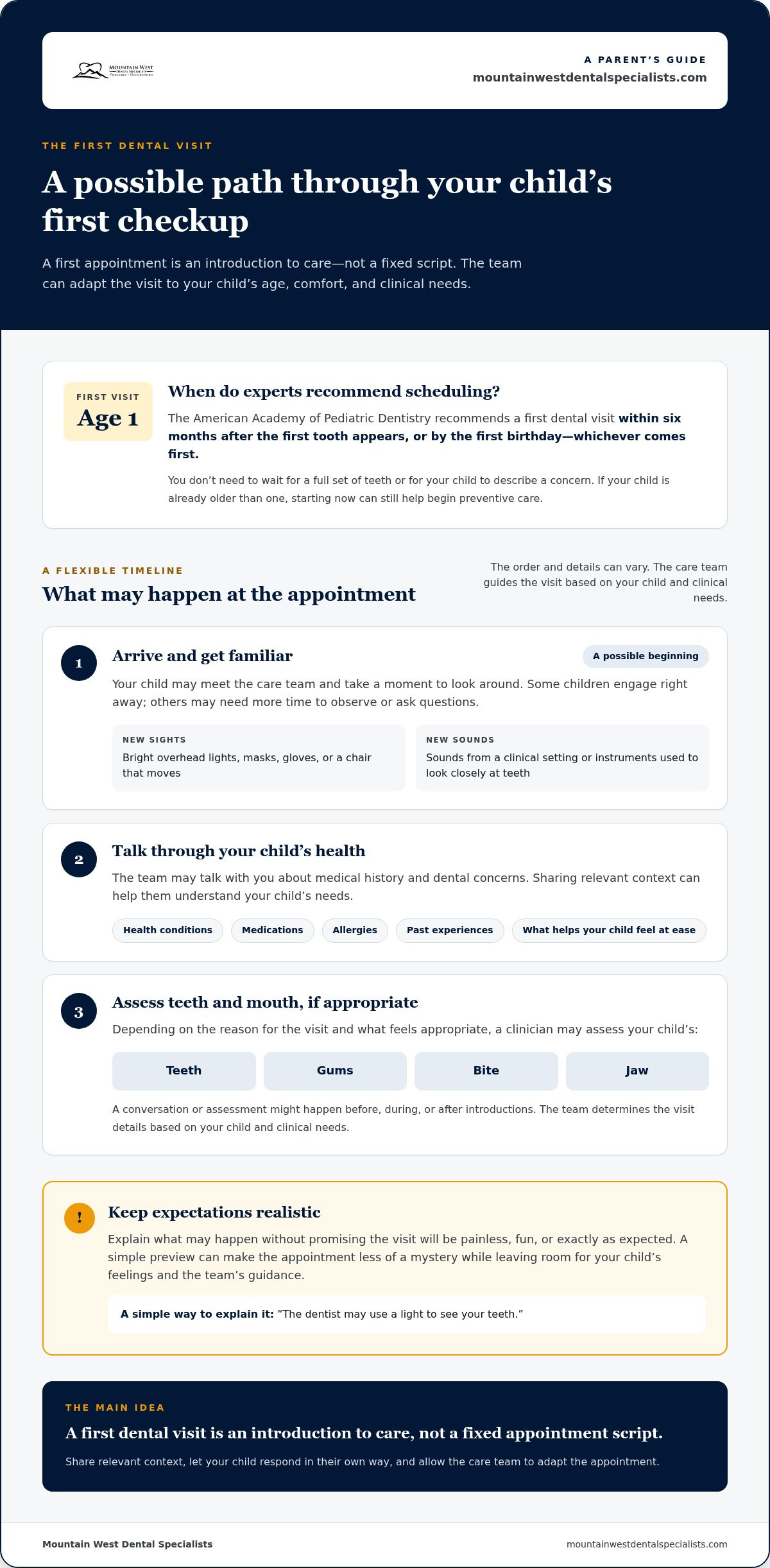
The American Academy of Pediatric Dentistry (AAPD) recommends scheduling a child’s first dental visit within six months after the first tooth appears, or by the first birthday, whichever comes first. You don’t have to wait until your child has a full set of teeth or can describe a dental concern. If your child is already older than one, it isn’t a reason to feel you’ve missed your chance. Starting now gives the care team an opportunity to understand your child’s needs and help you build a preventive care routine.
Early visits can establish a dental home, an ongoing source of dental care and guidance as a child grows. The overview of pediatric dentistry also describes the field’s focus on children’s oral health and the role of a dental home. For families with a baby, the guide to your baby’s first dental visit in Las Vegas offers more context for beginning care.
Why preparation matters at any age
An unfamiliar room, new faces, and new sounds can be a lot to take in. A brief, honest explanation beforehand helps a child form a basic picture of what the visit is for, without asking them to predict exactly how they’ll feel. The right amount of preparation depends on the child. A toddler may benefit from a few simple words, while an older child may want more time to talk through questions. Communication style, temperament, and previous medical or dental experiences can all shape what feels helpful.
A routine first visit is generally an opportunity to learn about a child’s oral health and individual needs. The care team may discuss health history and assess the teeth, gums, bite, or jaw, depending on the child and clinical needs. There isn’t one fixed sequence or a single experience that applies to every family. Share relevant context about your child and allow the team to guide the appointment based on what they observe.
Early preventive dental care builds familiarity and gives families a place to receive guidance as a child’s needs change. That relationship starts with an appointment, but preparation can begin at home. Treat the visit as a normal part of caring for growing teeth, not a test your child has to pass. Learning how to prepare child for first dental visit is about making the experience understandable, not controlling every moment.
What Happens During a Child’s First Dental Visit?
Knowing the possible flow of an appointment can help you answer your child’s questions without promising exactly what will happen. A first visit may begin with arrival and introductions, then move into a conversation with you about your child’s health. If appropriate, the dental team may also assess your child’s teeth and mouth. The order and details can vary according to your child’s age, comfort, and clinical needs.
How the appointment may begin
Meeting the care team and taking a moment to look around may help your child become familiar with the setting. The team may start by talking with you about your child’s medical history and dental concerns. Share relevant information about health conditions, medications, allergies, past experiences, or anything that tends to help your child feel at ease.
From there, a clinician may look at your child’s teeth, gums, bite, or jaw, depending on the reason for the visit and what feels appropriate. A conversation or assessment might happen before, during, or after introductions. Children may participate in different ways. Some are ready to engage right away; others need more time to observe or ask questions. The care team determines the visit’s details based on the child and clinical needs.
A first dental visit is an introduction to care, not a fixed appointment script. Keeping that distinction in mind lets you explain what may happen while leaving space for the team to adapt the visit to your child.
What children may see and hear
A dental setting can include new sights and sounds: bright overhead lights, masks, gloves, a chair that moves, or instruments used to look closely at teeth. These are ordinary parts of a clinical environment, but they may be unfamiliar to a child. You don’t need to describe every detail in advance. Start with a simple explanation that fits your child’s age and the questions they’re asking.
For example, you might say, “The dentist may use a light to see your teeth,” or, “You’ll meet people who help take care of children’s teeth.” If your child asks about an instrument, answer in plain language without adding details that could make it sound alarming. You can also tell them the dental team can explain unfamiliar steps as the visit unfolds.
As you consider how to prepare child for first dental visit, focus on sharing enough information to make the appointment less of a mystery, not rehearsing every possibility. For families beginning pediatric care in Las Vegas, Mountain West Dental Specialists’ pediatric dental checkups offer a local starting point.
How to Talk About the First Dental Visit Without Adding Pressure
You don’t have to convince your child that a first dental visit will be painless, fun, or exactly as expected. Those promises can leave a child confused if the experience feels different. A steadier approach is to explain the purpose of the visit and what might happen, while being honest that you can’t predict every detail. The goal isn’t to remove every worry. It’s to help your child feel heard and supported.
Threats and shame can add pressure, even when they’re meant to encourage cooperation. Avoid comments such as “If you don’t behave, the dentist will…” or “There’s nothing to be scared of.” These can make a child feel responsible for managing feelings they can’t simply switch off. Instead, acknowledge their concern without amplifying it: “It’s okay to have questions. We’ll find out what the visit is like together.”
Helpful words to use before the appointment
Keep your explanation simple, truthful, and suited to your child’s age. You could say, “The dentist will look at your teeth and explain what they see,” or, “We’re going to learn how to take care of your teeth.” Then pause. Answer the question your child actually asks rather than listing every possible step or instrument. A younger child may only need a short explanation; an older child may want more time to talk.
It’s fine to say that you don’t know exactly what will happen. You might add, “The dental team will explain what they’re doing as we go.” Avoid promising a particular outcome or experience, such as that nothing will feel unusual or that the appointment will be over quickly. When learning how to prepare child for first dental visit, honest, manageable information is more useful than certainty you can’t guarantee.
How parents can set a steady example
Talk about dental care in a matter-of-fact, supportive way. If you feel uneasy, take a moment to sort through your own concerns with another adult rather than sharing frightening stories or predictions with your child. You don’t need to perform excitement, either. A calm explanation that treats the visit as a normal part of caring for health can feel more genuine than insisting it will be wonderful.
Children show uncertainty in different ways. One may ask many questions; another may stay quiet, cling to you, or need time before joining a conversation. These reactions aren’t proof that your child is being difficult or that you prepared incorrectly. Try naming what you notice without judgment: “You seem unsure. I’m here with you.” Share relevant concerns with the dental team so they can understand your child’s needs and respond thoughtfully.
A successful first appointment doesn’t depend on a child being perfectly calm or cooperative. Your child’s feelings are part of the experience, not a scorecard. Offer truthful reassurance, listen, and let the care team guide the visit. That supports your child without placing the burden of making the appointment go smoothly on their shoulders.
A Simple Before-the-Appointment Plan for Parents
A little planning can make appointment day feel more manageable for you and your child. Use this timeline as a flexible guide, not a checklist your family has to complete perfectly. Choose the steps that suit your child’s age, temperament, and routine.
- When scheduling, choose a time that fits your child. If you have options, consider when your child is usually rested, fed, and more available to handle something new. A time that works well for one child may not work for another, so use your knowledge of their routine as a guide.
- The day before, give a simple explanation. In a few sentences, tell your child where you’re going and that the dental team will help look after their teeth. Invite questions, but don’t feel you need to describe every possible part of the visit. Keep your words calm and truthful.
- Make the idea familiar if your child enjoys it. You could play pretend dentist with a favorite toy or read a children’s book about a dental visit. Let your child take the lead. If pretend play makes them uncomfortable or uninterested, skip it. Preparation doesn’t need to become a lesson or rehearsal.
- Gather useful details before appointment day. Make a note of relevant health history, medications, allergies, and questions you want to raise. You might write down a concern about toothbrushing, eating, or a change you’ve noticed in your child’s mouth. Having these details ready can help you focus on your child during the conversation.
- On the day, keep the routine manageable. Allow enough time to get ready and arrive without adding a last-minute rush. If it suits your child and the setting, bring a small familiar comfort item. Share relevant concerns with the dental team yourself rather than expecting your child to explain them.
- Afterward, reflect without grading the experience. Ask your child what they noticed or how they felt, and listen without correcting their response. Recognize their effort, whether that meant asking a question, entering the room, or simply giving something new a try. A child doesn’t have to appear completely calm for the visit to be worthwhile.
This flexible sequence can help you think through how to prepare child for first dental visit while leaving room for plans to change. If your child needs more time, respond to what you see rather than treating the checklist as a deadline. Your steady presence and useful information are practical forms of support.
For a local starting point, explore pediatric dental care at Mountain West Dental Specialists. The family-owned Las Vegas practice is operated by Dr. Keaton and Dr. Allison Tomlin and provides pediatric dental checkups and baby dental care.
Starting Pediatric Dental Care with Mountain West Dental Specialists
Choosing where to begin pediatric dental care is part of preparing for a first visit. Mountain West Dental Specialists provides pediatric dental checkups and baby dental care for families in Las Vegas. The family-owned and operated practice is led by Dr. Keaton Tomlin and Dr. Allison Tomlin, offering a local starting point as your family begins building a relationship with pediatric dental care.
A family-focused local setting for pediatric care
Children’s dental needs change as they grow, and parents often have questions at each stage, from caring for a baby’s first teeth to understanding what belongs in a child’s ongoing dental care. Pediatric checkups and baby dental care give families a place to begin those conversations and address their child’s oral health. The specific care and discussion depend on the child, so there’s no need to arrive with a fixed idea of how an appointment must go.
Families considering a local practice may also value knowing that Mountain West Dental Specialists is family-owned. Dr. Keaton Tomlin and Dr. Allison Tomlin lead the practice, located on S. Cimarron Road in Las Vegas. The location gives local families useful context as they look for pediatric care, and the practice’s focus on children and babies connects directly with the first steps in a child’s dental care.
You can make the appointment more useful by bringing what you know about your child: relevant health information, medications, and any questions or concerns you’ve been thinking about. If your child is too young to explain what feels unfamiliar, you can share those details on their behalf. Preparation doesn’t require having every answer. A short list of questions can help you remember what matters to your family and make space for a clear conversation.
Take the next step at your family’s pace
Parents looking into how to prepare child for first dental visit may find it helpful to think of preparation as a conversation that continues at the appointment. Explain what you know in simple terms, bring relevant details, and let the care team guide the visit according to your child’s needs. Your child doesn’t have to arrive knowing exactly what to expect, and you don’t have to plan for every possibility in advance.
Mountain West Dental Specialists provides pediatric dental checkups and baby dental care in Las Vegas. Visit the practice’s website to learn more, or schedule an appointment at the S. Cimarron Road office when you’re ready to begin. A few thoughtful questions and the information you already know about your child are a good place to start.
Let Your Child’s First Visit Be a Beginning
Your child doesn’t need to feel completely confident before the appointment for it to be a meaningful first step. A question, a pause, or a change of plans can all be part of getting acquainted with dental care. Keep supporting your child afterward by listening to what stood out and answering new questions as they come up. Each conversation gives you a chance to make future care feel more familiar, without expecting every visit to unfold the same way.
Learning how to prepare child for first dental visit isn’t about finding perfect words or controlling your child’s reaction. It’s about showing up with care, sharing what you know, and making room for your child’s individual needs. That’s a thoughtful place to start.
When you’re ready, explore pediatric dental care at Mountain West Dental Specialists and schedule an appointment in Las Vegas. Take things at your family’s pace as you begin this new part of your child’s care.
Frequently Asked Questions
When should a child have their first dental visit?
A child should have a first dental visit within six months of the first tooth appearing or by their first birthday, whichever comes first, according to the American Academy of Pediatric Dentistry. If your child is past that age, schedule a visit when you can rather than worrying that you’ve missed your opportunity. Early care gives you a place to discuss questions such as teething, brushing, and your child’s changing teeth.
Is a child’s first dental visit painful?
A first visit doesn’t automatically involve treatment, but no one can promise exactly how it will feel for every child. The clinician’s assessment and any next steps depend on your child’s needs. If your child is worried about discomfort, acknowledge the concern without guaranteeing a painless experience. You can tell them the dental team will explain what’s happening and that you’ll be there to help them share how they feel.
Can I stay with my child during a first dental visit?
Parents are usually encouraged to stay with their child during a first visit, though the care team will guide how you can support your child during each part of the appointment. Your presence can help you hear recommendations directly and share context, such as how your child communicates when they need a break. Before the visit begins, let the team know what helps your child feel supported, whether that’s sitting close or holding your hand.
What should I do if my child refuses to open their mouth?
Stay calm and avoid forcing your child’s mouth open or treating hesitation as defiance. Tell the dental team what’s happening and give your child a moment to settle. The clinician can decide how to proceed based on the child and the reason for the visit. A brief pause, a simple explanation, or another approach may help, but the response depends on the situation. Your child’s comfort and clinical needs guide the next step.
Can my child visit the dentist while teething?
Teething alone doesn’t necessarily mean a child can’t attend a dental appointment. Let the care team know which teeth are coming in and describe any changes you’ve noticed, such as tender gums or a change in eating habits. That context can help them understand what your child is experiencing during the assessment. If your child seems unwell for another reason, share that information too so the team can consider it when planning care.
Does dental insurance cover a child’s first dental visit?
Coverage depends on your specific plan, including its rules for preventive visits, examinations, and any additional care. Before the appointment, review your plan’s pediatric dental benefits and note any limits or cost-sharing details that apply. In the United States, pediatric dental coverage is an essential health benefit under the Affordable Care Act for plans subject to that requirement, but how coverage is arranged can vary. Las Vegas families should review their own policy documents for details.
What if a cavity is found during a child’s first dental visit?
If the examination identifies a cavity, ask the clinician to explain where it is, what they observed, and what options may suit your child. A finding doesn’t mean you need to make a decision without understanding the recommendation. Your child’s age, oral health, and clinical needs inform the discussion. You can write down questions, such as how the tooth will be monitored or what care is advised, and take time to understand the proposed next step.