
What if your child’s dental checkup could also help you understand how their bite and jaw are developing? It’s natural to wonder when orthodontic attention might be useful, and coordinating care between separate offices can add logistics to a busy family schedule. The benefits of seeing a dual specialist in orthodontics and pediatric dentistry can include a more connected perspective, with pediatric dental and orthodontic expertise available as your child grows. That doesn’t mean every child needs orthodontic treatment or that one clinician must hold both specialties.
Pediatric dentists focus on children’s oral health and development, while orthodontists specialize in tooth alignment and the growth of the face and jaws. When both areas of expertise are available within one practice, families have a convenient place to discuss concerns and understand possible next steps. This article explains how the specialties differ, what coordinated care can make easier, and what to compare when choosing a care model. For families in Las Vegas, it also offers a practical starting point for questions about a child’s teeth or bite.
Key Takeaways
- Pediatric dentistry and orthodontics bring different expertise to a child’s oral health. Both perspectives may help inform care as dental development changes.
- The benefits of seeing a dual specialist in orthodontics and pediatric dentistry may include simpler coordination and familiarity with your child’s dental history.
- Compare connected and separate care models by considering visit logistics, communication, continuity, and access to each specialty.
- Before a visit, note your concern, relevant dental history, and questions. This can help clarify whether pediatric dental care, an orthodontic evaluation, or both may be appropriate.
- Mountain West Dental Specialists is a family-owned Las Vegas practice led by Dr. Keaton and Dr. Allison Tomlin, with pediatric dental care and orthodontic services in one practice.
What Does Dual-Specialty Care in Pediatric Dentistry and Orthodontics Mean?
When pediatric dental and orthodontic expertise are available through one practice, your family can access care focused on children’s oral health and care focused on tooth and bite alignment in the same setting. That makes it easier to discuss how different concerns relate to your child’s development without assuming every visit or treatment decision will involve both specialties.
Dual-specialty care means having access to pediatric dental and orthodontic expertise in one connected care setting. It describes the practice’s range of expertise, not necessarily one clinician’s credentials. Pediatric dentists and orthodontists have distinct specialty training, and seeing both specialties does not mean a single provider holds both qualifications.
What pediatric dentistry and orthodontics each address
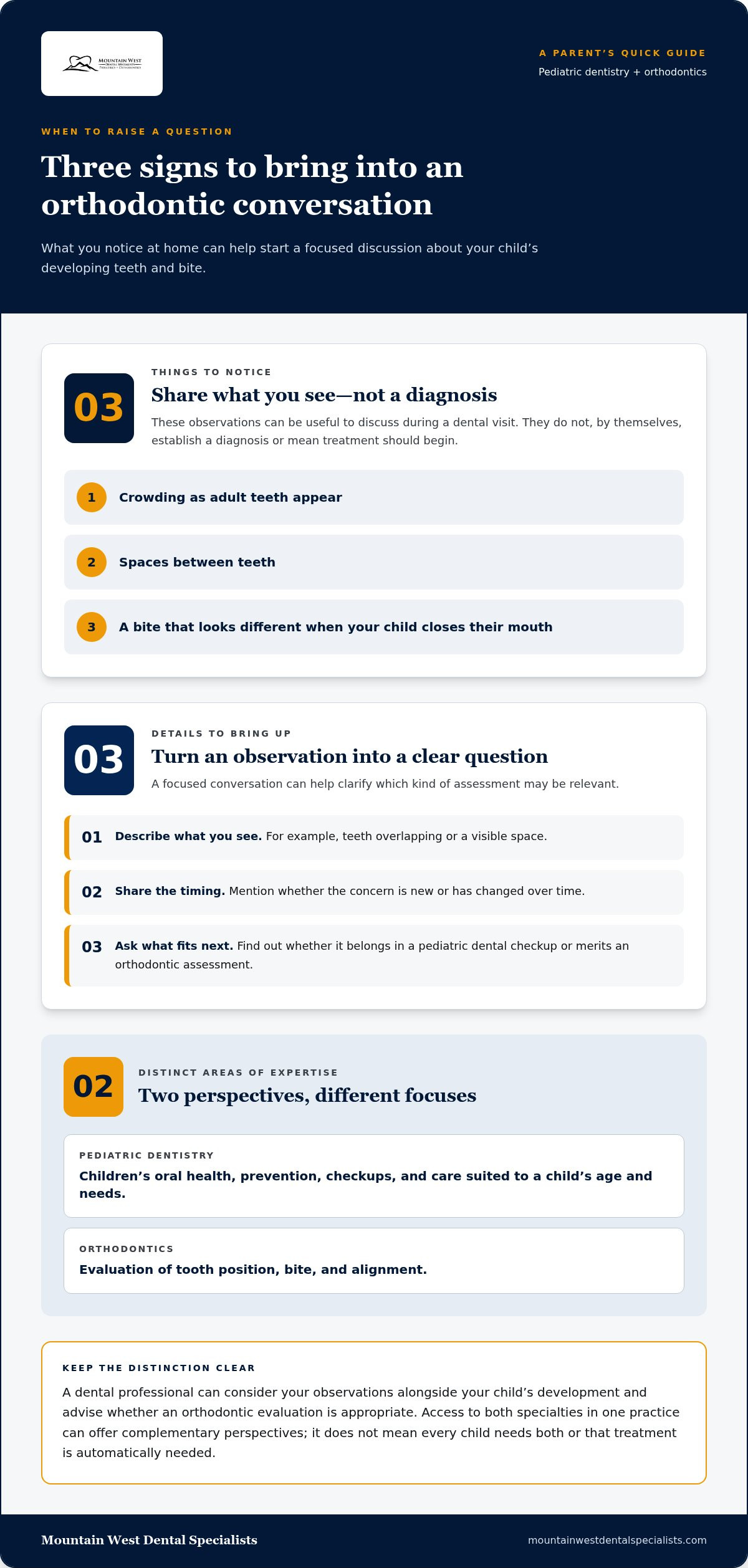
Pediatric dentistry focuses on children’s oral health, including prevention, dental checkups, and treatment suited to a child’s age and needs. Orthodontics focuses on evaluating tooth position, bite, and alignment. A pediatric dental visit may center on routine care, while an orthodontic visit may assess how teeth fit together or are positioned.
These areas can become relevant at different points as a child grows. For example, a question raised during a dental checkup about whether certain teeth are coming in as expected may prompt a discussion about an orthodontic evaluation. That doesn’t mean treatment is automatically needed. It gives you a chance to consider the question in the context of your child’s developing teeth and jaws.
What a connected specialty practice can offer
A connected practice gives families access to both kinds of expertise in one setting. Depending on your child’s needs, care may involve pediatric dental checkups, an orthodontic evaluation, or both at different times. For parents, this can make it easier to identify which specialty addresses a particular question and where to bring follow-up concerns.
Coordination is an opportunity, not a promise of shared decisions or one treatment plan. Each specialist evaluates concerns within their area of training, and recommendations depend on the child’s individual situation. For example, a child may continue routine pediatric dental visits while an orthodontist separately evaluates a concern about bite or alignment. The two perspectives can inform your understanding while remaining distinct.
Having both specialties in one practice also doesn’t mean every child needs to see both. It means pediatric dental and orthodontic expertise are available as questions arise. The benefits of seeing a dual specialist in orthodontics and pediatric dentistry are best understood as access to complementary perspectives, not a guarantee of a particular outcome. That distinction helps keep decisions centered on your child’s needs.
How Pediatric Dental and Orthodontic Expertise Can Support Care Over Time
A child’s dental history unfolds over time: teeth come in, baby teeth are lost, and the bite changes as the mouth develops. Continuity means a care team can become familiar with that history and the questions you’ve raised. It doesn’t guarantee a particular result or mean treatment will be needed. It can give you a clear place to bring new concerns and discuss which kind of assessment may be relevant.
Recognizing when a child may benefit from an orthodontic conversation
Parents often notice changes at home first. You might see crowding as adult teeth appear, spaces between teeth, or a bite that looks different when your child closes their mouth. These observations are useful to share during a dental visit, but they don’t establish a diagnosis or mean orthodontic treatment should begin. A qualified dental professional can consider what you’ve noticed alongside your child’s development and advise whether an orthodontic evaluation is appropriate.
- Describe what you see, such as teeth overlapping or a visible space.
- Share whether the concern is new or has changed over time.
- Ask whether it fits within a pediatric dental checkup or merits an orthodontic assessment.
A focused conversation can help distinguish a question worth monitoring from a concern that needs closer evaluation. The benefits of seeing a dual specialist in orthodontics and pediatric dentistry may include access to both perspectives as questions arise, while keeping each assessment within the relevant specialist’s expertise.
Making the transition between types of care feel familiar
Moving from a familiar pediatric dental visit to a new specialty setting can feel like a big step for a child. Returning to a practice your family already knows may make arranging care feel more straightforward. Familiarity isn’t a substitute for a specialist’s assessment, but it can give you and your child a known setting for discussing concerns and understanding what happens next.
Ask what each specialty will assess and how that relates to your child’s concern. For example, you can ask whether the visit will focus on routine oral health, tooth position, the bite, or more than one question. A clear explanation helps you understand the purpose of an evaluation without feeling that a treatment decision has already been made.
Early observation is a way to understand development; it doesn’t automatically mean orthodontic treatment should start. A professional may recommend continued observation, an orthodontic evaluation, or another appropriate next step based on the individual child. For Las Vegas families seeking pediatric dental and orthodontic care in a familiar setting, Mountain West Dental Specialists brings both areas of expertise together in one practice.
Dual-Specialty Practice vs. Separate Providers: What Should Families Compare?
Choosing where your child receives dental and orthodontic care is a practical decision, not a test with one right answer. A practice offering both specialties makes it possible to access each kind of expertise in one setting. Separate providers may also suit a family’s preferences or existing relationships. Compare how care is coordinated, what visits involve, and how clearly each clinician explains their role.
| What to compare | Both specialties in one practice | Separate providers |
|---|---|---|
| Coordination | There is an opportunity to discuss pediatric dental and orthodontic concerns within the same practice. How information is shared can vary. | Parents may need to relay details between offices or coordinate communication themselves. |
| Visit logistics | Both types of care are available through one practice, though appointments may still happen on different days. | Visits take place at separate offices, which may mean managing different schedules and locations. |
| Familiarity | A child may return to a practice they already know when a new specialty question comes up. | A family may already have trusted relationships with clinicians at each office. |
| Distinct expertise | Pediatric dental and orthodontic expertise are accessible within one practice, but each concern still calls for the relevant specialist’s assessment. | Each provider focuses on their own area, with coordination potentially involving the family. |
A combined setting can simplify how you navigate care, but it doesn’t guarantee fewer visits or lower fees. Appointment needs depend on the child’s situation, and each specialty may have its own assessment or follow-up. Compare the benefits of seeing a dual specialist in orthodontics and pediatric dentistry in terms of access and coordination, rather than assuming savings or that one model is right for every family.
Questions that reveal how care is coordinated
Clear answers help you understand what a connected care model means in practice. Ask how pediatric dental and orthodontic concerns are discussed, which clinician evaluates a specific issue, and what information is useful to share between visits. Keep a brief note of your child’s concern, relevant dental history, and questions. That makes it easier to carry the same context from one appointment to another.
When a combined or separate care model may suit a family
A combined practice may appeal if you value having both specialties available in one setting and want a familiar place to raise new questions. Separate providers can also meet a family’s needs, especially when a child already has trusted relationships or the arrangement fits family preferences. Consider your child’s needs, your family’s logistics, and how clearly each clinician communicates.
A helpful care model makes it clear who is addressing each concern and how you can stay informed. Las Vegas families exploring pediatric dental and orthodontic care can learn about the connected services at Mountain West Dental Specialists.
How to Decide Whether a Dual-Specialty Visit Fits Your Child’s Needs
You don’t need to know in advance which specialist your child should see. Start with what you’ve noticed, then discuss whether the question is best addressed through pediatric dental care, an orthodontic evaluation, or both. The goal is to understand the concern and appropriate next steps, not to arrive with a diagnosis or treatment decision already made.
Prepare for a useful conversation about your child’s smile
A little preparation can help you explain what prompted your questions. Note concerns about your child’s teeth, bite, comfort, or dental development. You might mention crowding, a change in how the teeth meet, or something your child has said feels uncomfortable. These observations help start a conversation, but they don’t determine whether treatment is needed.
- Identify the concern. Describe what you’ve noticed and when it caught your attention.
- Gather relevant history. Bring details about previous dental visits or care that may help the clinician understand the context.
- Write down your questions. Ask which specialist will assess the concern, what that assessment involves, and how you’ll learn about possible next steps.
During the visit, ask whether your child’s concern fits within pediatric dental care, calls for an orthodontic evaluation, or would benefit from both perspectives. You can also ask what the clinician is looking for and what happens after the assessment. A clear explanation can make the process feel more manageable for you and your child.
Understand imaging and individualized recommendations
Mountain West Dental Specialists uses Cone Beam CT imaging, which can create three-dimensional views of structures in the mouth and jaw. It’s a tool, not a routine requirement for every child or every orthodontic question. The clinician determines whether imaging is appropriate for the individual evaluation and can explain its purpose in your child’s situation.
It’s reasonable to ask why an assessment or imaging is being recommended, what information it may provide, and how the findings will guide the discussion. Your child’s care should be based on their individual needs. A visit doesn’t automatically mean that imaging, braces, aligners, or another treatment will be recommended.
The benefits of seeing a dual specialist in orthodontics and pediatric dentistry may include access to both kinds of expertise as you consider a concern. A useful first step is to share what you’ve observed and allow for a professional assessment. Bringing notes and questions can help keep the conversation focused.
For a local next step, explore pediatric and orthodontic care at Mountain West Dental Specialists, a family-owned Las Vegas practice led by Dr. Keaton and Dr. Allison Tomlin.
Pediatric Dentistry and Orthodontics in Las Vegas at Mountain West Dental Specialists
Families in Las Vegas can find pediatric dental and orthodontic care at Mountain West Dental Specialists. This family-owned practice is led by Dr. Keaton Tomlin and Dr. Allison Tomlin. Its services include pediatric dental checkups, orthodontic braces, and clear aligners, bringing distinct areas of expertise together within one practice.
This connected setting gives parents a local place to bring questions about routine dental care as well as tooth position or alignment. It doesn’t mean every child needs to see both specialties or that one clinician necessarily holds both sets of specialist credentials. The right conversation depends on your child’s needs, and each concern can be considered through the relevant area of expertise.
A family-owned Las Vegas practice for pediatric and orthodontic care
Mountain West Dental Specialists serves families at its Las Vegas office on S. Cimarron Road. Having pediatric dental care and orthodontic services within one practice offers a practical starting point when a routine checkup raises a question about the bite or when you’re seeking guidance about braces or clear aligners. The practice also uses Cone Beam CT imaging. This imaging isn’t necessary for every child; the clinician determines whether it is appropriate for an individual evaluation.
The value of a connected care model is access to relevant expertise, not a promise that every concern will lead to treatment. A child may need a pediatric dental visit, an orthodontic assessment, or a discussion to understand what a parent has noticed. Explain the concern in everyday terms, even if you’re unsure which specialty applies.
A comfortable next step for your family
Make a visit more useful by bringing a short list of questions and relevant dental history. Ask what the clinician will assess, whether imaging is appropriate for your child’s situation, and what possible next steps involve. Clear explanations can help you feel informed without pressure to decide before you understand the recommendation.
The benefits of seeing a dual specialist in orthodontics and pediatric dentistry include having both kinds of expertise available within a connected practice, while keeping your child’s individual needs at the center. For Las Vegas families, Mountain West Dental Specialists offers a local setting to start that conversation. If you have a question about your child’s dental development or alignment, request an appointment with Mountain West Dental Specialists to discuss a comfortable next step for your family.
Take the Next Step with Confidence
You don’t need to have every answer before seeking guidance. A thoughtful conversation can help turn a concern about your child’s dental development into a clearer understanding of what to consider next. The benefits of seeing a dual specialist in orthodontics and pediatric dentistry come from access to distinct expertise, while decisions remain focused on your child’s individual needs.
Bring the questions you’ve been holding onto and share what you’ve noticed. It’s a simple way to feel more prepared and make the visit more useful. Mountain West Dental Specialists is led by Dr. Keaton Tomlin and Dr. Allison Tomlin and offers pediatric dental and orthodontic care, along with Cone Beam CT imaging when appropriate for an individual evaluation.
Explore pediatric and orthodontic care at Mountain West Dental Specialists and take a comfortable next step for your family.
Frequently Asked Questions
Does seeing a dual specialist mean one dentist has training in both pediatric dentistry and orthodontics?
No. “Dual specialist” can describe a practice or care setting where families can access pediatric dental and orthodontic expertise, rather than a single clinician with both credentials. Pediatric dentists focus on children’s oral health, while orthodontists assess and treat tooth and bite alignment. Ask which clinician will evaluate your child’s specific concern and how recommendations will be explained.
Does every child need orthodontic treatment?
No. An orthodontic evaluation doesn’t automatically mean a child needs treatment. A clinician considers the child’s teeth, bite, development, and individual concerns before discussing whether any next steps are appropriate. Noticing a gap or crowded teeth is a reason to raise a question, not a diagnosis. If you’ve observed a change, mention it at a dental visit and ask whether an orthodontic perspective may be helpful.
Can a child have an orthodontic evaluation before all permanent teeth come in?
Yes, an evaluation may be considered before all permanent teeth have erupted, depending on the child’s development and professional judgment. An assessment is different from starting braces: it can clarify what the clinician observes and whether follow-up is appropriate. There isn’t one timing rule that applies to every child. If you’re unsure, ask about your child’s tooth development at a routine dental visit and whether an orthodontic conversation makes sense.
Will a child need Cone Beam CT imaging at every orthodontic visit?
No. Cone Beam CT is an imaging technology, not an automatic requirement for every child or every orthodontic visit. Whether it’s appropriate depends on the individual evaluation and the clinician’s judgment. Mountain West Dental Specialists in Las Vegas uses Cone Beam CT imaging, but that doesn’t mean every patient needs it. If imaging is recommended, ask what it is intended to show and how the information may inform your child’s assessment.
Can my child keep seeing a pediatric dentist while receiving orthodontic care?
Yes, families may continue pediatric dental care while a child receives orthodontic care, since the visits address different needs. The benefits of seeing a dual specialist in orthodontics and pediatric dentistry can include access to both perspectives, while each clinician focuses on their area. Ask how routine checkups and orthodontic appointments fit together for your child. If you notice a change or have a concern during care, bring it up with the team.
What should I bring to a first pediatric dental or orthodontic visit?
Bring relevant dental history, a list of medications if applicable, and questions about your child’s teeth, bite, or development. If you have prior dental records or imaging, let the care team know and ask whether those materials would be useful. You might also note when you first noticed a concern and how it has changed. You don’t need to arrive with a diagnosis or a complete file.
Can airway concerns be discussed during a pediatric dental visit?
Yes. You can raise questions about your child’s breathing, sleep, or other concerns with the dental team. Share what you’ve noticed and ask whether further evaluation is appropriate; the team can discuss individualized next steps. A dental visit should not be taken as a diagnosis or a promise that dental care will resolve breathing, sleep, or behavioral concerns. For Las Vegas families, an open conversation can help clarify what to consider next.