
What if the most useful number in your orthodontic plan isn’t a monthly payment, but a clear explanation of what your treatment includes? Planning orthodontic treatment without insurance can feel daunting when you’re unsure what a quoted fee covers or how different options compare.
It’s reasonable to worry that paying without coverage could put care out of reach. A practical plan starts with understanding your needs, the recommended treatment, and the details behind the estimate. Once you have that information, you can compare the full cost and payment timing with your budget.
This guide explains what can shape orthodontic fees, which treatment-plan details to review, and common ways to budget for care without dental insurance. You’ll also learn how braces and clear aligners may fit different treatment needs. At Mountain West Dental Specialists, our family-owned Las Vegas practice provides orthodontic care for children, teens, and adults. Reviewing your goals and individual plan with our team can help make the next step more manageable.
Key Takeaways
- Orthodontic treatment without insurance is easier to plan when you understand your treatment needs before setting a budget.
- Review the written treatment plan to see which diagnostic records, appointments, and other services are included or separate.
- Compare savings, payment arrangements, and third-party financing by considering timing, eligibility, and the full terms.
- Use a step-by-step budget process: identify your goals, attend an evaluation, review plan details, and map out payment timing.
- Mountain West Dental Specialists provides braces and clear aligners for children, teens, and adults in Las Vegas.
Orthodontic Treatment Without Insurance: What to Understand Before You Begin
When considering orthodontic treatment without insurance, a practical first question is what care may involve and what you’ll be responsible for paying. A broad online estimate can’t show what a particular patient needs or what a proposed fee covers. An evaluation and a clear treatment outline provide a more useful basis for planning.
Paying without insurance means planning for orthodontic care without dental benefits contributing to the treatment cost. Insurance isn’t required to seek an orthodontic evaluation. During an evaluation, the orthodontic team can learn about your goals and assess your teeth and bite. The recommended approach and its fee can then be explained in relation to your individual plan, rather than treated as a one-size-fits-all amount.
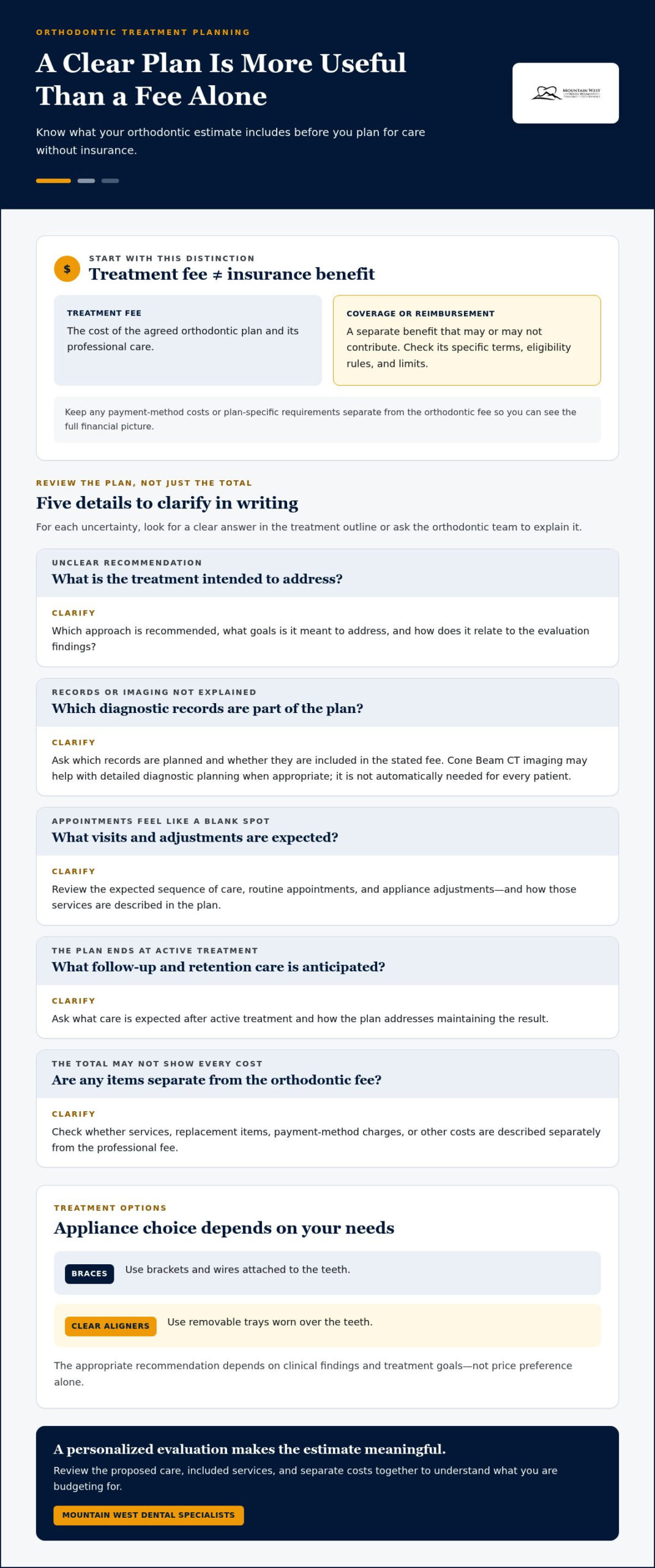
A treatment fee is the cost of the agreed orthodontic plan; insurance coverage or reimbursement is a separate benefit that may or may not contribute toward it. This distinction helps you read an estimate accurately. The professional fee for orthodontic care may not be the only expense connected with arranging or paying for treatment. For example, third-party financing can have its own terms or charges, separate from the orthodontic fee. Understanding which costs relate to treatment and which relate to payment gives you a clearer financial picture.
What does paying for orthodontic care without insurance mean?
It means planning for care without dental benefits contributing to the cost. The treatment plan should describe the orthodontic services and professional fees associated with the proposed care. Keep any separate costs tied to a payment method or plan-specific requirements distinct, so you can see both the cost of treatment and the cost of paying for it.
If you have insurance or an account that might apply, review its details alongside your treatment plan. Having insurance doesn’t automatically mean orthodontic benefits will contribute. The specific terms, eligibility rules, and limits determine what applies to your situation, so avoid building a budget around an assumed benefit.
Why a personalized plan matters more than a general estimate
An examination helps the orthodontic team understand your teeth, bite, and treatment goals before discussing an approach. Orthodontics includes different methods for guiding tooth and jaw alignment, as outlined in this overview of Orthodontics. The appropriate method depends on the patient’s findings, not simply on a general price comparison.
The treatment approach, diagnostic records, and expected appointments can all shape the plan. Cone Beam CT imaging, for example, may provide a detailed view when appropriate for diagnostic planning, but it isn’t automatically needed for every patient. An online figure can’t account for these individual details. A personalized plan gives you a sounder basis for reviewing care and preparing for its financial commitment.
What an Orthodontic Treatment Plan May Include, and What to Clarify
A useful treatment plan does more than name braces or clear aligners. It connects evaluation findings to a proposed approach, explains the intended goals, and outlines the care involved. When planning orthodontic treatment without insurance, reviewing these details helps you understand what you’re budgeting for.
Treatment-plan details vary with each patient’s orthodontic needs, so a clear written outline matters more than assumptions about what a standard plan includes. The evaluation guides which diagnostic records are appropriate and which treatment approach fits the patient. A plan may describe the recommended appliance, the expected sequence of care, routine appointments, and follow-up after active treatment. The exact scope should reflect the individual assessment.
Which treatment-plan details should you review?
Read the plan as a description of care, not just a total fee. Confirm that you understand the proposed treatment and what it is intended to address. Then review the expected sequence, appointment pattern, and services included in the stated fee. If the plan uses unfamiliar terms, ask the Mountain West Dental Specialists team to explain what each stage means for your care.
Use this checklist as you review the outline:
- Treatment and goals: What approach is recommended, and what changes is it intended to address?
- Records and imaging: Which diagnostic records are planned, and are they included in the stated fee?
- Visits and adjustments: What routine appointments or appliance adjustments are expected, and how are they described in the plan?
- Follow-up and retention: What care is anticipated after active treatment, including the plan for maintaining the result?
- Separate items: Are any services, replacement items, or other costs described separately from the orthodontic fee?
These details matter because the fee alone may not show how care is organized from the initial records through follow-up. A written outline also lets you compare your actual plan with your budget, rather than relying on a broad estimate that may leave out important components.
How braces, clear aligners, and diagnostics affect planning
Braces use brackets and wires attached to the teeth, while clear aligners are removable trays worn over them. Both are orthodontic treatment options, but the right recommendation depends on clinical findings and treatment goals, not price preference alone. An individualized assessment helps the orthodontic team explain which approach is suitable and what the care sequence may involve.
Diagnostic records also depend on the evaluation. Cone Beam CT imaging can provide a three-dimensional view when it’s clinically appropriate for planning; it isn’t automatically needed for every patient. At Mountain West Dental Specialists in Las Vegas, our team provides braces and clear aligners and can walk you through your individual plan. Learn more about orthodontic treatment planning as you consider your next step.
Compare Ways to Plan for Orthodontic Treatment Without Insurance
Once you understand the proposed treatment and its expected costs, compare ways to prepare for payment. Savings, payment arrangements, and third-party financing are different approaches, not interchangeable discounts. Consider each option’s timing, eligibility, terms, and fit with your budget and treatment schedule before deciding.
Savings, payment arrangements, and third-party financing
Personal savings let you set aside funds before treatment or as care progresses. A payment arrangement divides payments over time according to its terms. Third-party financing involves a separate company and its own approval process. Review the full agreement for each option, including payment timing, fees, interest, and what happens if your circumstances change.
| Approach | Eligibility and timing | Terms to understand | Questions to consider |
|---|---|---|---|
| Personal savings | You decide how much to set aside and when to use it. | Funds are available according to your savings plan. | How much can you set aside, and when will it be available? |
| Payment arrangement | Payment timing depends on the arrangement’s terms. | Review the schedule, any initial payment, and applicable conditions. | How do payment dates relate to the treatment timeline? |
| Third-party financing | Approval and eligibility depend on the financing company. | Review interest, fees, promotional terms, and repayment conditions. | What is the total repayment amount, and when does each term apply? |
Use the table as a comparison framework. Before agreeing to a payment method, read its terms and compare the expected total obligation with your budget. A monthly amount on its own doesn’t show the complete cost or repayment schedule.
Dental insurance, discount plans, and health accounts
Insurance benefits depend on the specific policy, the patient’s eligibility, and the plan’s orthodontic terms. Don’t assume that having dental insurance means it will contribute to orthodontic care. A dental savings or discount plan is different from insurance. It may provide access to set discounts under its own participation terms, but it doesn’t guarantee a particular reduction in treatment cost.
Health Savings Accounts (HSAs) and Flexible Spending Accounts (FSAs) may be relevant ways to plan eligible expenses, but use depends on your account and its rules. Review the account documents to understand how orthodontic expenses are handled before counting those funds toward your budget.
For a clearer comparison, start with your personalized treatment plan, then consider which payment approach aligns with its timing and your financial priorities. The family-owned Las Vegas team at Mountain West Dental Specialists provides braces and clear aligners and can review your orthodontic goals and plan details with you. Learn more about orthodontic treatment planning and prepare the questions you want answered before deciding how to pay.
Build a Realistic Budget for Orthodontic Care: A Step-by-Step Plan
A clear budget comes together one decision at a time. For orthodontic treatment without insurance, first learn what care is recommended, then map the plan’s costs and timing against your household priorities. Don’t build your budget around a monthly figure alone. The total plan, payment schedule, and any separate expenses all matter.
Prepare for your orthodontic evaluation
Before your visit, jot down what you hope treatment will address, any concerns, relevant dental history, and questions about timing. If you’d like insurance or account details considered, bring the information you have. These notes can help you make the most of the discussion, whether you’re planning for yourself or a family member.
An online estimate can offer general context, but it can’t determine which records or care fit an individual. The assessment guides the personalized treatment conversation. Use these four steps to turn that conversation into a practical budget:
- Gather your goals. Write down what you’d like to understand or improve, along with questions about the process and schedule. For a child or teen, include questions from both the patient and parent.
- Attend an evaluation. Share your goals and history so the orthodontic team can assess individual needs and discuss an appropriate treatment approach.
- Review the plan details. Read the proposed care, what the fee includes, expected appointment timing, and any items that may be separate. Make a note of anything you’d like explained more clearly.
- Map payment timing. Compare the full financial commitment with your expected household cash flow. If considering a payment arrangement or outside financing, include its terms and timing rather than focusing only on the monthly amount.
Review the plan and choose a manageable next step
Once you have the plan, organize the information in a simple worksheet: the treatment fee, included care, any separate expenses, payment dates, and the source of funds you expect to use. Keep insurance or account information nearby, but don’t count on benefits until you understand the specific terms that apply. This gives you a more realistic picture of what’s due and when.
Next, consider how the proposed schedule fits alongside household priorities. A manageable plan accounts for the full timeline, not just the first payment. If you have a time-sensitive clinical concern, discuss it with the orthodontic team rather than putting off advice solely to complete a budget. For added context as you consider care in the area, this Las Vegas orthodontist guide offers another perspective on making an informed decision.
Take the next step at a comfortable pace. Discuss your orthodontic goals and treatment plan with Mountain West Dental Specialists, a family-owned Las Vegas practice serving children, teens, and adults.
Explore Orthodontic Treatment Without Insurance at Mountain West Dental Specialists
Planning orthodontic treatment without insurance is more manageable when you understand the care before making decisions. Mountain West Dental Specialists is a family-owned orthodontic practice in Las Vegas, led by Dr. Keaton Tomlin and Dr. Allison Tomlin. Our practice provides braces and clear aligners for children, teens, and adults, with treatment discussions shaped around each patient’s needs.
An evaluation is an opportunity to talk through what you hope to address, your concerns, and your questions about the process. It also helps the orthodontic team understand your individual needs before discussing suitable treatment. You can then consider the proposed care and its details in context, rather than relying on assumptions about a general plan.
A family-oriented orthodontic consultation in Las Vegas
At our S. Cimarron Road office, patients and families can begin by sharing their goals and concerns with the team. You might want to understand what treatment could involve for your child, or explore braces and clear aligners for yourself. These conversations bring your priorities into the planning process and make space for questions at each stage.
For families, that may mean discussing how a child or teen feels about treatment alongside a parent’s practical questions. Adults can describe their own goals and discuss how the recommended approach fits their circumstances. You don’t need to arrive with every decision made. Starting with an open conversation can help clarify what you’d like to learn next.
Move forward with a clearer understanding of your options
The evaluation guides which diagnostic records are appropriate and how the orthodontic team develops an individualized plan. If Cone Beam CT imaging is clinically appropriate, it can support diagnostic planning with detailed imaging. The findings inform the discussion of suitable care, whether braces or clear aligners are recommended. Review the treatment outline and ask for clarification so you understand the proposed plan before deciding how to proceed.
Bring questions about treatment goals, diagnostic records, expected care, and the plan’s financial details. Understanding those pieces can help you make a considered decision at a pace that feels right for you or your family. An initial discussion is a chance to learn what your individual needs may involve before choosing how to proceed.
Ready to discuss your goals with our Las Vegas team? Schedule an orthodontic visit with Mountain West Dental Specialists to learn more about your options and treatment plan.
Take the Next Step at Your Own Pace
You don’t need to have every detail settled before beginning a conversation. Start by identifying what would help you feel more prepared: understanding your options, discussing timing, or getting clarity on the financial commitment. Bringing that priority to your visit can make the discussion focused and useful.
Planning orthodontic treatment without insurance is a process, not a decision you have to make all at once. Take time to understand the recommendations, consider how they fit your circumstances, and decide what feels manageable. Clear information can help you move forward with greater confidence, whether you’re exploring care for yourself or someone you love.
When you’re ready, schedule an orthodontic visit with Mountain West Dental Specialists in Las Vegas to talk through your goals and questions.
Frequently Asked Questions
How much does orthodontic treatment cost without insurance?
There isn’t one standard fee for orthodontic care. The amount depends on clinical needs, the recommended treatment type, diagnostic requirements, and which services the plan includes. For example, two people considering braces may need different records or appointment schedules, so their plans can differ. Review an individualized written plan with the Mountain West Dental Specialists team, including the full scope of care and payment timing, before deciding.
Can I get orthodontic treatment without dental insurance?
Yes, you can seek an orthodontic evaluation without dental insurance. Insurance is one possible way to contribute toward care, not a prerequisite for discussing your needs. At an evaluation, the orthodontic team can assess your situation, explain suitable options, and outline the financial details connected with the proposed plan. You’ll have information to consider next steps, even if you’re still deciding when or how to proceed.
Does dental insurance cover braces or clear aligners?
It depends on your policy and eligibility. Plans may have age limits, lifetime orthodontic maximums, waiting periods, or rules about which treatments and circumstances qualify. Some policies may treat braces and clear aligners differently. Before including a benefit in your budget, review your plan documents to understand how the terms apply to the patient and proposed treatment. Don’t assume coverage until you’ve checked the details.
Are monthly payment plans available for orthodontic treatment?
Payment timing depends on the payment method and its terms. Paying from savings means setting aside your own funds; a payment arrangement follows the terms of that arrangement; third-party financing requires reviewing the lender’s eligibility rules and agreement. Compare the total amount, payment dates, fees, and any interest terms in writing. A low monthly figure alone may not show the full commitment.
What should an orthodontic treatment fee include?
There isn’t a universal list of services included in every orthodontic fee. The written plan should make clear how it handles diagnostic services, routine appointments, adjustments, and follow-up expectations. Check whether records or retention care are described as part of the plan or separately. Ask the Mountain West Dental Specialists team to explain unclear terms in plain language. That makes it easier to understand the proposal without assuming different plans cover identical care.
Can I use an FSA or HSA for orthodontic treatment?
Possibly, but eligibility depends on your account rules, the expense, required documentation, and your specific plan. Before using FSA or HSA funds in your budget, review your account materials to understand how the proposed orthodontic expense and payment method are handled. Don’t assume every service or arrangement qualifies. These accounts are separate from dental insurance, and checking the rules first can help prevent unexpected issues with reimbursement or payment.
Is it better to wait until I have insurance before starting orthodontic treatment?
There’s no single answer; timing depends on clinical needs, personal circumstances, and the actual terms of any current or future coverage. A policy may include eligibility rules or limits, so don’t assume a new plan will pay for proposed care. Compare its written benefits with the treatment plan, and discuss timing with the orthodontic team before postponing care, especially if you have a dental concern that needs timely attention.