
After a frenectomy, frenectomy aftercare for infants starts with understanding your baby’s instructions and knowing what changes to watch for. It’s natural to wonder how feeding will go, how to soothe your baby, and whether the healing site looks as it should. Advice about stretches can vary. The American Academy of Pediatrics’ 2024 clinical report advises against exercises that repeatedly reopen the wound, so it’s understandable to want clear guidance.
You don’t have to figure out every change on your own. This guide explains what recovery may involve and why your baby’s instructions should be individualized. It also offers a practical way to think about feeding, comfort, healing, and when to contact the treating dental team.
At Mountain West Dental Specialists, Drs. Keaton and Allison Tomlin provide baby dental care and tongue-tie release in a family-centered setting in Las Vegas. As you read, you’ll learn what to monitor, how to follow your baby’s specific aftercare plan, and what to do if recovery doesn’t seem to be going as expected.
Key Takeaways
- Frenectomy aftercare for infants should follow your baby’s individualized instructions, since the treated tissue and procedure can differ.
- Use a simple step-by-step approach to support feeding, comfort, and observation in the first hours and days.
- Healing and feeding changes vary; note what you observe and share it with the treating dental team.
- Know when to raise questions, seek prompt clinical advice, or get urgent assessment for concerning symptoms.
- Prepare for follow-up by noting feeding changes and bringing questions about comfort, wound care, and next steps.
What Does Frenectomy Aftercare for Infants Involve?
A frenectomy releases or removes part of a frenulum, the small fold of tissue connecting the tongue or lip to the mouth. The treatment area and extent of release depend on the procedure your infant received. Ankyloglossia, or tongue-tie, refers to a restrictive lingual frenulum, the tissue beneath the tongue. A release involving the upper lip addresses the maxillary labial frenulum, the fold connecting the upper lip to the gum.
These terms describe different areas of the mouth, not a diagnosis you can make by appearance alone. Not every infant needs the same procedure or aftercare routine. The clinician’s assessment and your baby’s individual care plan should guide next steps.
What may be different after a tongue-tie or lip-tie release?
The location and extent of treatment shape what your care team asks you to watch and how to care for your baby’s mouth. Instructions for a lingual release may differ from those for a maxillary labial release. The plan may also reflect your infant’s age, feeding needs, and the clinician’s approach. Don’t assume that another baby’s routine, including any mouth exercises, applies to your child.
Which aftercare instructions should parents follow first?
Keep the treating clinician’s written and verbal instructions somewhere easy to reach, such as with your baby’s discharge paperwork or feeding notes. If anything is unclear, write down the question and ask the care team for guidance rather than filling in the gap with advice from another family or an online source. The clinician’s directions take priority over general information in this guide.
It may help to note feeding changes, your baby’s comfort, and questions as they arise. Bring those notes to the follow-up or share them with the treating team as directed. A brief record can make it easier to describe a change, especially when you’re tired or several days have passed.
Frenectomy aftercare for infants is the individualized care and observation that follow a release procedure, guided by the treating clinician’s instructions. This guide can help you understand the kinds of questions and observations that may come up, but it doesn’t replace medical advice for your baby. If your infant’s instructions differ from general guidance here, follow the treating clinician’s plan.
How to Care for Your Infant in the First Hours and Days
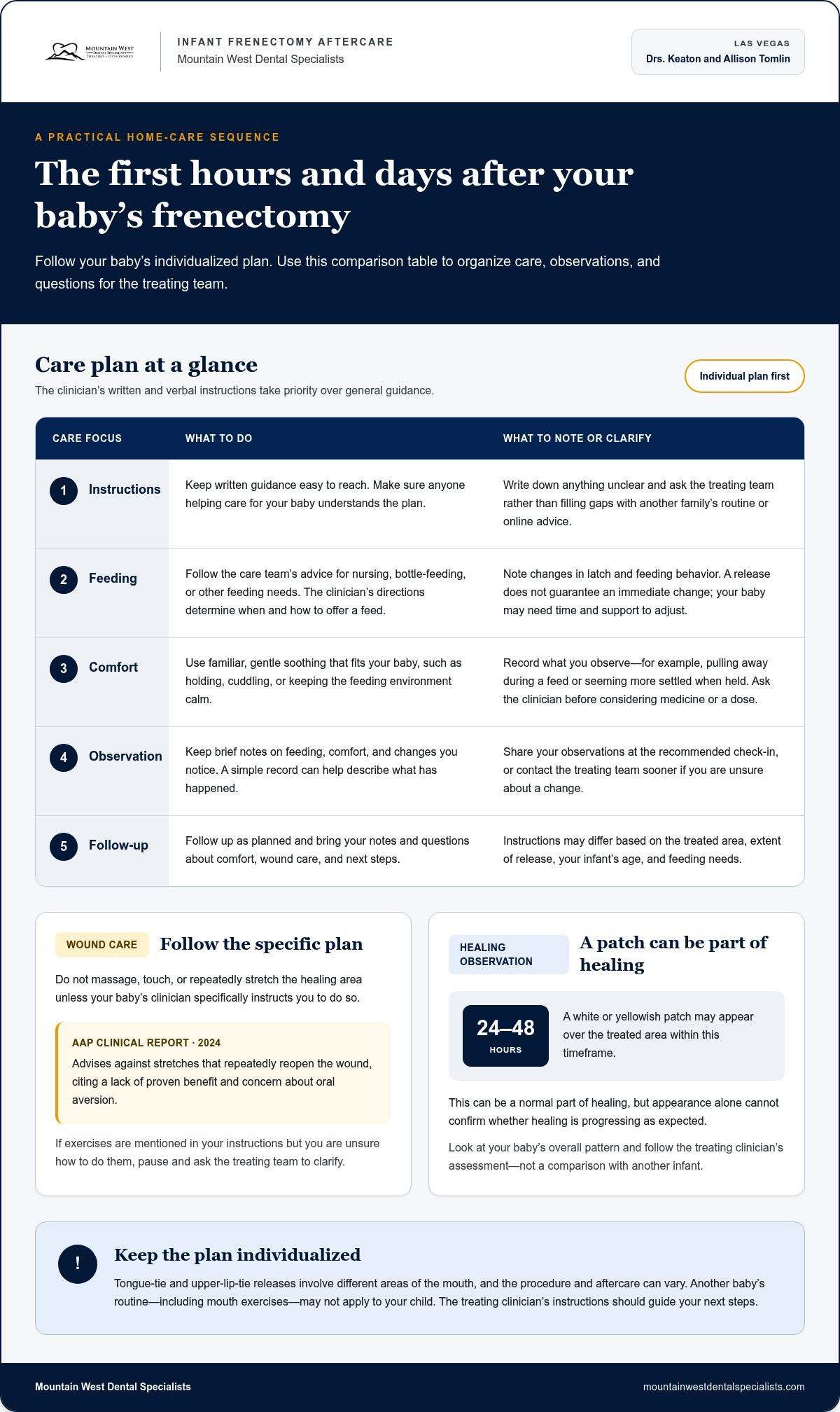
The first days are easier to manage when you have a simple sequence to follow: keep your baby’s care plan close, focus on feeding and comfort, observe changes, and follow up as directed. Your treating clinician’s instructions should guide each step, since care can vary with your infant’s age, needs, and procedure.
- Review the instructions. Keep written guidance handy and make sure anyone helping care for your baby understands the plan.
- Support feeding as directed. Follow the care team’s advice for nursing, bottle-feeding, or other feeding needs. Don’t assume a particular approach is right for every infant.
- Observe and take notes. Record changes in latch, feeding behavior, and comfort, along with questions that come up.
- Follow up as planned. Share your observations with the treating team at the recommended check-in, or contact them sooner if you’re unsure about a change.
Feeding and soothing after an infant frenectomy
Some infants may feed soon after the procedure, but your clinician’s directions should determine when and how to offer a feed. A release doesn’t guarantee an immediate change in nursing or bottle-feeding. Your baby may need time and support to adjust, and feeding concerns can have more than one contributing factor. Johns Hopkins Medicine provides background on Tongue-tie (ankyloglossia), including its possible relationship to feeding.
For comfort, use familiar, gentle soothing that fits your baby’s needs, such as holding, cuddling, or keeping the feeding environment calm. If you’re considering medicine or have questions about discomfort, ask the treating clinician for guidance rather than choosing a dose yourself. Brief notes such as “pulled away during a feed” or “seemed more settled when held” can make follow-up conversations more useful.
Oral care and exercises: follow your baby’s specific plan
Aftercare routines differ, so don’t massage, touch, or repeatedly stretch the healing area unless your baby’s clinician has specifically instructed you to do so. The American Academy of Pediatrics’ 2024 clinical report advises against stretches that repeatedly reopen the wound, citing a lack of proven benefit and concern about oral aversion. If your instructions mention exercises but you’re uncertain how to do them, pause and ask the treating team to clarify.
Clear, individualized guidance can help you feel more prepared at home. Mountain West Dental Specialists provides baby dental care and tongue-tie release in Las Vegas, with care from Drs. Keaton and Allison Tomlin.
How Long Does Infant Frenectomy Healing Take, and What Is Expected?
There isn’t one recovery timeline that fits every baby. Healing at the procedure site and changes in feeding can unfold at different paces, so a single appearance or behavior can’t confirm that healing is complete or that the procedure has achieved its intended effect. Your baby’s overall pattern and the treating clinician’s assessment matter more than a comparison with another infant’s experience.
A white or yellowish patch may appear over the treated area within 24 to 48 hours. This can be a normal part of healing, but appearance alone can’t tell you whether everything is progressing as expected. The healing process may take several weeks; a general range is one to four weeks, but that isn’t a deadline or guarantee for an individual baby. Contact the treating team if you’re concerned about what you see.
Why recovery can look different from one baby to another
The treated area and extent of the release, along with your infant’s individual needs, can shape the recovery plan. Feeding may also take time to adjust, and a frenectomy may not resolve every feeding difficulty. For frenectomy aftercare for infants, use the treating clinician’s guidance as your reference point rather than online timelines or another family’s story. A change that seems different from what you were told to expect is worth discussing with the care team.
What should parents track during recovery?
Brief notes can help you share a clear picture at follow-up, especially when day-to-day changes are hard to recall. You don’t need to assess or diagnose the healing site yourself. Record what you notice and when it started, then include any instructions you’ve already followed.
- Feeding: Note changes in latch, feeding behavior, or how your baby manages feeds.
- Comfort: Describe what concerns you, when you noticed it, and whether it changes over time.
- Healing site: Write down what you observe without touching or manipulating the area to check it.
- Care plan: Keep track of questions and the guidance you’ve received from the treating team.
These details can help the dental team give advice that fits your baby, rather than relying on a general timeline or one isolated sign. Recovery expectations should come from your baby’s treating clinician, based on the procedure and your infant’s individual needs. If your baby seems unwell or a change worries you, contact the care team for an assessment instead of waiting for a particular number of days to pass.
When Should You Call About Frenectomy Aftercare for Your Infant?
It can be hard to tell which changes need a quick question and which need urgent attention. Trust your instincts, and use the treating team’s instructions as your first guide. You don’t need to diagnose a problem from your baby’s behavior or the appearance of the healing area. If you’re concerned, describe what you’re seeing and ask for individualized advice.
Which recovery concerns should you discuss with the treating team?
Contact your baby’s treating clinician about concerns such as worsening discomfort, difficulty feeding, or a change that worries you. Persistent bleeding also needs prompt clinical assessment. Share when the concern began, what you’ve observed, and any care instructions you’ve followed. Avoid relying on online timelines to decide whether a symptom is expected or how long to wait.
Questions about frenectomy aftercare for infants are appropriate, even if you’re unsure whether a change is significant. The treating team can consider your baby’s procedure and individual needs when advising you. Families in Las Vegas can discuss post-frenectomy concerns with the pediatric dental team at Mountain West Dental Specialists.
When does an infant need urgent medical attention?
Some symptoms call for urgent assessment rather than routine follow-up. Seek urgent clinical care for persistent bleeding, signs of dehydration, or an infant who seems seriously unwell. Signs that may raise concern for dehydration include markedly fewer wet diapers than usual or difficulty taking feeds. A clinician needs to assess the cause and decide what care is needed.
- Immediate breathing difficulty or severe symptoms: Call emergency services now. Don’t wait for a routine dental callback.
- Persistent bleeding, possible dehydration, or a seriously unwell baby: Seek urgent clinical assessment and follow the treating team’s directions.
- Feeding changes, worsening discomfort, or other concerns: Contact the treating clinician promptly for guidance tailored to your infant.
This guidance can help you choose a next step, but it can’t determine what’s causing a symptom. A wound’s color or appearance alone doesn’t confirm a complication or prove that healing is complete. If you’re uncertain about urgency, contact a medical professional for direction; for immediate breathing difficulty, call emergency services.
Plan Follow-Up Care After Your Baby’s Frenectomy in Las Vegas
Follow-up is a chance to review how your baby is doing and make sure you understand the next steps. The timing and type of care depend on the treating clinician’s plan, so follow their instructions about when your baby should be seen and whom to contact with questions. Don’t rely on a general online schedule to decide when a check-in is due.
Prepare for a useful follow-up conversation
A few notes can help you explain what has changed since the procedure. Bring observations about feeding, comfort, and anything else that concerns you. You can also jot down when you first noticed a change and which home-care steps you’ve followed. These details help the care team respond to your baby’s experience rather than a general timeline.
- Ask whether your baby’s feeding pattern is progressing as expected and what changes to keep tracking.
- Review comfort and wound-care instructions, including what to do if you’re unsure about something you see.
- If exercises were prescribed, ask the clinician to review how and when to do them. Don’t begin or change exercises based on another family’s routine.
- Confirm the recommended follow-up plan and who to contact if a concern comes up before then.
If you’re also planning your baby’s first dental visit, this guide to your baby’s first dental visit in Las Vegas can help you feel more prepared for that experience.
Get caring pediatric dental guidance in Las Vegas
Frenectomy aftercare for infants is most reassuring when you know what applies to your baby and where to bring questions. Mountain West Dental Specialists is a family-owned Las Vegas practice where Drs. Keaton and Allison Tomlin provide baby dental care, pediatric dental care, and tongue-tie release. The team offers clear, family-centered explanations shaped around each child’s needs.
For pediatric dental guidance for your infant, connect with Mountain West Dental Specialists. Bring your questions and observations so the conversation can focus on your baby’s care and the next appropriate steps.
Move Forward With a Clear Care Plan
Your baby’s recovery is personal, so let the treating clinician’s instructions guide feeding support, oral care, and follow-up. Keep track of changes in feeding and comfort, and reach out when something concerns you rather than relying on a general timeline. A simple record of what you notice can make it easier to get advice tailored to your infant.
With a thoughtful plan, frenectomy aftercare for infants can feel more manageable. Mountain West Dental Specialists is a family-owned Las Vegas practice led by Dr. Keaton Tomlin and Dr. Allison Tomlin, offering pediatric dental care, baby dental care, and tongue-tie release. To discuss your infant’s dental care, connect with Mountain West Dental Specialists.
You’re learning your baby’s cues one step at a time. Trust your observations, follow the care plan, and remember that asking questions is part of caring well.
Frequently Asked Questions
Is it normal for an infant to be uncomfortable after a frenectomy?
Some babies may show temporary changes in comfort after a frenectomy, but each infant’s experience can differ. Your treating clinician can explain what to expect based on the procedure and your baby’s health. Follow the care plan you were given, and contact the dental team if discomfort concerns you, worsens, or affects feeding. Don’t give your baby medication unless their clinician has directed you to do so.
How long does it take an infant to heal after a frenectomy?
There isn’t one healing timeline that applies to every infant or procedure. Healing and feeding changes can vary, so follow your clinician’s instructions rather than comparing your baby’s progress with online accounts. At follow-up, share the changes you’ve noticed and ask when the care team expects to reassess your infant. If you’re concerned before that visit, contact the treating team instead of waiting for a particular date.
Can I breastfeed or bottle-feed my baby after a frenectomy?
Follow the feeding guidance provided by your baby’s treating clinician, since the plan should reflect your infant’s needs. Note any changes in latch, bottle-feeding, or feeding comfort to discuss with the care team. If your baby isn’t feeding as expected, or you’re unsure what to do next, contact the clinician for individualized advice. Don’t change the feeding plan on your own based on general online guidance.
Should I do stretches after my baby’s frenectomy?
Stretches aren’t a one-size-fits-all instruction after an infant frenectomy. Whether to do exercises, when to begin, and how to perform them should come from the clinician who treated your baby. Don’t start or change stretches based on a general online guide or another family’s routine. If your instructions mention an exercise but you’re uncertain how to do it, ask the care team to explain the steps.
What happens if my baby has bleeding or trouble feeding after a frenectomy?
Contact your baby’s treating clinician promptly about bleeding or feeding concerns so they can advise you based on your infant’s situation. If bleeding persists, seek urgent clinical assessment. For difficulty breathing, a baby who seems seriously unwell, or another severe symptom, seek urgent medical care. An article or photo can’t assess your infant, so don’t rely on online advice to decide whether a concerning symptom is safe to monitor.
When should I schedule a follow-up after my infant’s frenectomy?
Follow the appointment plan from your baby’s treating clinician, since timing can depend on the procedure and your infant’s needs. Use the visit to discuss feeding, comfort, home-care instructions, and any changes you’ve observed. If you didn’t receive follow-up instructions or have a concern before the planned visit, contact the care team. For families in Las Vegas, Mountain West Dental Specialists provides pediatric and baby dental care.