
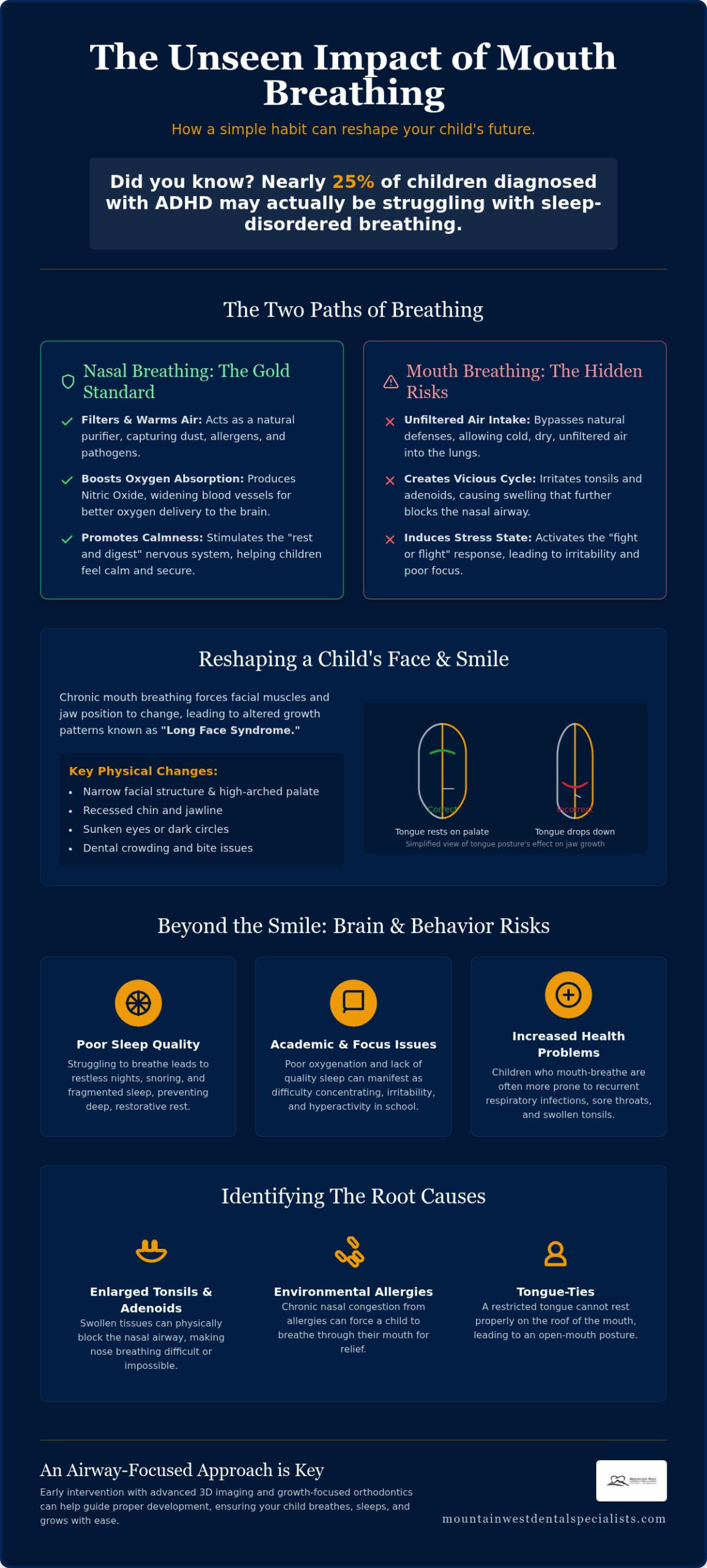
Did you know that nearly 25% of children diagnosed with ADHD may actually be struggling with sleep-disordered breathing instead? It’s a startling statistic that highlights how much mouth breathing effects on child development can ripple through every part of a young life. As a parent, you want to see your child thrive, yet you might feel a growing sense of worry when you notice them restless at night, struggling to focus in school, or developing crowded teeth. It’s natural to feel concerned when you see these subtle changes in their facial structure or energy levels.
You deserve to feel confident and informed about the choices you make for your family’s health. This guide will help you discover how persistent mouth breathing impacts facial growth, sleep quality, and academic success. We’ll show you how to spot the early signs at home and explain the benefits of working with a specialist who looks at the whole airway, not just the teeth. We’re here to help you understand the risks of untreated mouth breathing and provide a clear, low-stress path forward to ensure your child breathes, sleeps, and grows with ease.
Key Takeaways
- Discover why nasal breathing is the body’s natural gold standard for filtering air and maximizing oxygen absorption for your child’s growing brain.
- Learn how mouth breathing effects on child development can lead to visible changes in facial structure, such as a narrow jaw or a recessed chin.
- Understand the connection between sleep-disordered breathing and academic focus, helping you identify if a behavioral struggle is actually an airway issue.
- Identify common root causes like tongue-ties or environmental allergies that may be preventing your child from breathing comfortably through their nose.
- Explore how specialized airway management and advanced 3D imaging can provide a clear path toward better sleep and healthy facial growth.
The Physiology of Breathing: Why Nasal Breathing is the Gold Standard
The nose is more than just a facial feature; it’s a sophisticated biological powerhouse designed to protect your child’s health. When a child breathes through their nose, the air is filtered, warmed, and humidified before it ever reaches the lungs. This process ensures that the delicate tissues of the respiratory system stay moist and healthy. However, when Mouth breathing becomes the primary way a child gets oxygen, these natural safeguards are bypassed. It’s helpful to distinguish between a mouth breathing habit, which can linger after a cold, and a mouth breathing necessity, where a physical obstruction like enlarged tonsils makes nasal breathing impossible. Nasal breathing is the essential foundation for healthy pediatric development.
The Role of Nitric Oxide in Brain Development
One of the most significant benefits of breathing through the nose is the production of Nitric Oxide. This molecule is produced in the paranasal sinuses and is carried into the lungs during nasal inhalation. Nitric Oxide acts as a vasodilator, which means it helps open up blood vessels to improve oxygen absorption throughout the body and brain. This boost in oxygen is vital for cognitive function and memory. Additionally, nasal breathing stimulates the parasympathetic nervous system, which is the rest and digest state that allows a child to feel calm and secure. In contrast, chronic mouth breathing often forces the body into a sympathetic fight or flight state. This constant low-level stress can have profound mouth breathing effects on child development, often manifesting as irritability or difficulty concentrating during school hours. Just as children need balanced physiology for growth, many high-performers look to 5280 Restorative Medicine to optimize their own health and reclaim their vitality through functional medicine.
Filtering and Warming: The Nose as a First Line of Defense
Your child’s nose acts as a built-in air purifier. Microscopic hairs called cilia, along with mucous membranes, capture dust, allergens, and pathogens before they can enter the body. When children breathe through their mouths, they’re taking in cold, dry, and unfiltered air. This raw air can irritate the tonsils and adenoids, causing them to swell and further block the airway. This often creates a cycle where the mouth breathing itself makes it harder to breathe through the nose. Because the mouth lacks the defensive barriers of the nasal passage, mouth-breathing children are often more prone to recurrent respiratory infections and sore throats. Understanding these mouth breathing effects on child development is the first step in helping your child stay healthy and vibrant.
Craniofacial Growth: How Mouth Breathing Reshapes the Developing Face
A child’s face is remarkably adaptable. During the early years, the bones of the face and jaw are still growing and setting their permanent shape. When a child constantly breathes through their mouth, the muscles of the face and the position of the jaw shift to accommodate that airflow. Over time, these subtle changes lead to what specialists call “Adenoid Facies” or “Long Face Syndrome.” You might notice your child developing a narrow facial structure, sunken eyes, or a chin that seems to sit further back than it should. These aren’t just cosmetic concerns; they are physical markers of how mouth breathing effects on child development can alter a child’s anatomy.
One of the most critical structural changes happens in the roof of the mouth. When the mouth is open, the palate often develops a high, narrow arch. Because the roof of the mouth is also the floor of the nasal cavity, this high arch actually reduces the space available for nasal breathing. This creates a challenging cycle where it becomes even harder for your child to breathe through their nose. Many parents are told to wait until their child is a teenager to start orthodontic work. However, waiting until the jaw has finished growing often makes corrections much more difficult and invasive.
The Tongue as the Architect of the Jaw
The tongue is a powerful muscle that should naturally rest against the roof of the mouth. In this position, it acts as a natural expander, gently pushing against the upper jaw to ensure it grows wide enough to fit all permanent teeth. When a child is a mouth breather, the tongue drops to the floor of the mouth. Without that internal support, the upper jaw narrows, leading to dental crowding. By addressing these issues early through airway-focused orthodontics, we can often guide growth to prevent the need for painful tooth extractions later in life.
Dental Alignment and Bite Issues
Mouth breathing also impacts how the teeth meet. You might see an “open bite,” where the front teeth don’t touch even when the back teeth are together. This happens because the constant open-mouth posture prevents the front teeth from erupting into their proper positions. A narrow jaw also leads to severe crowding and can even cause teeth to become impacted. These structural issues don’t just stay in the mouth; they are frequently linked to late-onset TMJ disorders and chronic jaw pain. Identifying these signs early allows us to protect your child’s long-term comfort and dental health. Understanding these mouth breathing effects on child development ensures you can seek help before these growth patterns become permanent.
Beyond the Smile: Cognitive and Behavioral Development Risks
While the physical changes to a child’s face are often the most visible signs, the hidden mouth breathing effects on child development can be even more disruptive to their daily life. Sleep-disordered breathing (SDB) often occurs when a child cannot breathe through their nose, leading to fragmented sleep that starves the brain of vital restorative time. During deep sleep and REM cycles, the body releases essential growth hormones and the brain processes the day’s learning. When this cycle is interrupted by the struggle to breathe, your child might wake up feeling as though they haven’t rested at all, despite being in bed for ten hours.
This chronic exhaustion often manifests as the “ADHD Mimic.” Research suggests that up to 25% of children diagnosed with ADHD may actually have sleep-disordered breathing as a primary or contributing factor. Instead of being hyperactive by nature, these children are often struggling to stay awake. This leads to the same lack of focus, impulsivity, and restlessness seen in traditional behavioral disorders. When we look at the whole airway, we often find that improving nasal breathing can significantly improve a child’s ability to retain memory and focus on their schoolwork.
The Sleep-Airway-Behavior Connection
A healthy night’s sleep is a busy time for a child’s brain. It’s during these quiet hours that the brain clears out metabolic waste and repairs cellular damage. Fragmented sleep caused by mouth breathing prevents the brain from reaching the deep sleep phases necessary for physical growth. You might notice your child is more irritable or prone to “big feelings” that seem out of proportion to the situation. This emotional instability is a direct result of a brain that hasn’t had the chance to reset. It makes it much harder for your child to regulate their mood and responses throughout the day.
Bedwetting and Night Terrors
There is a surprising and often overlooked link between airway obstruction and nocturnal enuresis, or bedwetting. When a child struggles to breathe, their body’s carbon dioxide levels rise. This can trigger a hormonal response that increases urine production. Similarly, night terrors can act as a survival mechanism. The brain, sensing a drop in oxygen, sends a jolt of adrenaline to “wake up” the body and restart the breathing process. If your child experiences these issues, it’s often a sign that their body is working far too hard just to breathe at night. These symptoms should prompt an immediate airway evaluation to ensure the mouth breathing effects on child development don’t continue to impact their well-being.
Identifying the Root Causes: From Allergies to Tongue-Ties
Finding the reason behind your child’s struggle is the first step toward a lasting solution. In the Las Vegas valley, environmental factors often play a major role in how a child breathes. Our local dust and seasonal allergens frequently lead to chronic nasal congestion, forcing children to seek air through their mouths. While many parents are familiar with enlarged tonsils or adenoids blocking the airway, other structural issues are equally important. A deviated septum or narrow nasal valves can make nasal breathing feel like trying to breathe through a straw. These physical barriers are significant contributors to the long-term mouth breathing effects on child development.
Beyond simple blockages, the way a child’s mouth is built internally can dictate their breathing patterns. If the tongue cannot reach the roof of the mouth due to a physical restriction, the airway remains compromised. Identifying these root causes requires a specialized look at how the entire system works together, rather than just treating the surface symptoms. It’s about understanding why the body has adapted this way and how we can safely guide it back to its natural state.
The Role of Tongue-Tie and Lip-Tie
A tongue-tie occurs when the thin piece of tissue under the tongue is too short or tight, restricting its range of motion. This tether prevents the tongue from creating a natural seal against the palate, which is necessary to maintain a closed-mouth posture. Without this internal “suction,” children naturally default to an open-mouth position. This restriction is more common than many realize, as tongue-ties occur in approximately 4% to 11% of newborns. A professional tongue-tie release can be a life-changing foundational step in restoring a functional airway. However, the procedure is only part of the journey. Following a release, myofunctional therapy helps retrain the muscles to ensure the tongue rests in its proper, airway-supporting position.
Environmental and Habitual Factors
Living in a desert climate means managing unique triggers. Keeping indoor air clean and addressing seasonal allergies helps promote clear nasal passages. Sometimes, mouth breathing becomes a habit that persists even after a physical obstruction, like large adenoids, is removed. Early childhood habits like prolonged pacifier use or thumb-sucking can also reshape the dental arches, making it harder for the mouth to close comfortably. If you’ve noticed your child struggling with these patterns, seeking a professional tongue-tie release or airway assessment can provide the clarity your family needs to address the mouth breathing effects on child development.
The Airway-Focused Approach: Diagnosis and Intervention in Las Vegas
Traditional dentistry often focuses solely on the alignment of teeth. However, an airway-focused approach looks much deeper to ensure your child’s breathing is as efficient as possible. By examining the throat and the nasal passages, we can address the root causes that lead to the mouth breathing effects on child development. This holistic view allows us to collaborate with specialists like ENTs, allergists, and myofunctional therapists to create a comprehensive plan for your child’s well-being. Having both pediatric dentistry and orthodontics under one roof in Las Vegas makes this process much more convenient for busy families who want a single home for their child’s care.
Our approach is centered on protective advocacy. We want to identify and resolve issues before they become permanent growth patterns. This means looking at the whole child, from their sleep quality to their jaw structure. By intervening early, we can often guide the natural growth of the face and jaw, reducing the need for more invasive procedures later in life. Specialized medical office environments, such as Northlake Concierge Medical Center, demonstrate how modern facilities can support this level of clinical excellence and patient comfort. We take pride in being a trusted family guide for parents who are concerned about their child’s long-term health and development.
Standard 2D X-rays are helpful for finding cavities, but they often miss critical narrowings in the airway. At Mountain West Dental Specialists, we use advanced Cone Beam CT (CBCT) imaging to gain a precise 3D view of your child’s anatomy. This technology allows us to measure airway volume and visualize bottlenecks that might be restricting airflow. By seeing the airway in three dimensions, we can identify exactly where a child’s breathing path is compromised. This provides a level of precision that traditional imaging simply cannot match, giving us the data needed to make informed decisions about your child’s care.
Treatment Pathways for Success
Once we understand the unique structure of your child’s airway, we can begin targeted interventions. One common solution is maxillary expansion. This involves using specialized orthodontic expanders to gently widen the upper jaw. Because the roof of the mouth is also the floor of the nose, widening the jaw effectively lowers the floor of the nasal cavity. This creates more room for air to flow. This structural change is often paired with myofunctional therapy, which helps re-train the muscles of the face and tongue to support healthy nasal breathing and proper posture.
Restoring a child’s airway is a journey that requires both modern technology and a gentle, neighborly touch. If you’ve noticed your child struggling with the mouth breathing effects on child development, the next step is a specialized evaluation. Our practice on Cimarron Road offers a welcoming environment where your child’s health is our primary focus. We invite you to schedule a visit to explore how airway management and advanced imaging can help your child breathe, sleep, and grow more comfortably.
A Clearer Path to Healthy Growth and Restful Sleep
Watching your child struggle with sleep or seeing changes in their facial structure can feel overwhelming, but you don’t have to navigate these concerns alone. By understanding the mouth breathing effects on child development, you’ve taken a vital step toward protecting your child’s long-term health. Whether the root cause is a tongue-tie or seasonal allergies, identifying these issues early allows for gentle, effective guidance of their natural growth. You now know that better breathing is the foundation for improved focus, restful nights, and a confident smile.
At Mountain West Dental Specialists, Dr. Keaton and Dr. Allison Tomlin provide expert airway management with a neighborly touch. Our Las Vegas practice offers the convenience of comprehensive pediatric and orthodontic care under one roof, utilizing advanced 3D CBCT imaging to see what traditional X-rays miss. We’re here to serve as your trusted family guide, ensuring your child has every advantage for a vibrant future. Schedule a specialized airway evaluation for your child today. We look forward to welcoming your family into our inner circle of care.
Frequently Asked Questions
Is it normal for my child to sleep with their mouth open?
While an occasional open mouth during a cold is expected, chronic mouth breathing during sleep isn’t considered normal for healthy development. It often indicates an underlying airway obstruction or a habit that’s developed over time. In our Las Vegas climate, dust and seasonal allergens can make this worse. If you notice your child consistently sleeping this way, it’s a sign they may be struggling to get enough oxygen through their nose.
Can mouth breathing cause ADHD symptoms in children?
Yes, mouth breathing can frequently mimic ADHD by causing fragmented sleep and poor oxygen absorption. When a child’s sleep is interrupted by breathing struggles, they often wake up exhausted, leading to hyperactivity, irritability, and a lack of focus at school. Research suggests that addressing mouth breathing effects on child development can significantly improve these behavioral issues. Many children misdiagnosed with ADHD actually find relief once their airway issues are resolved.
What is ‘Adenoid Face’ and can it be reversed?
This term describes a long, narrow facial structure, sunken eyes, and a recessed chin that can develop from chronic mouth breathing. While these bone changes become more permanent as a child grows, early intervention can often guide future development. By using maxillary expanders and addressing the root causes of the obstruction, we can help redirect facial growth. Early screening at our Las Vegas office helps manage these changes before they become set.
How does a pediatric dentist help with mouth breathing?
A specialized pediatric dentist looks beyond just the teeth to evaluate the entire airway system. At Mountain West Dental Specialists, we use 3D CBCT imaging to find bottlenecks in the throat or nasal passages that traditional X-rays miss. We provide treatments like tongue-tie releases and guide jaw growth to ensure your child can breathe comfortably. This holistic approach focuses on the root causes to support your child’s overall health and well-being.
What are the signs of a tongue-tie in an older child?
In older children, a tongue-tie might show up as speech challenges, messy eating habits, or an inability to rest the tongue on the roof of the mouth. You might also notice a narrow upper jaw or persistent mouth breathing habits. These physical restrictions prevent proper oral posture and can impact the airway. A quick evaluation on S. Cimarron Road can determine if a tongue-tie release is the right foundational step for your child’s health.
Does my child need surgery for mouth breathing?
Not every child requires surgery to fix breathing issues. Many families find success through non-invasive treatments like maxillary expansion or myofunctional therapy to retrain the facial muscles. However, if the blockage is caused by severely enlarged tonsils or a significant tongue-tie, a minor procedure might be the best path forward. We always prioritize the most conservative treatment plan. Our team collaborates with local Las Vegas ENTs to ensure your child receives the right care.
What is airway-focused orthodontics?
This specialized branch of orthodontics prioritizes a healthy airway over simply straightening the teeth. Instead of pulling teeth to fix crowding, we use expanders to widen the jaw and open the breathing passages. This proactive method addresses the mouth breathing effects on child development by creating more room for the tongue and nasal airflow. It’s a reassuring way to ensure your child develops a beautiful smile and a healthy, functional airway simultaneously.
How can I tell if my child has sleep apnea at home?
You can look for red flags like loud snoring, gasping for air during sleep, or extreme restlessness at night. Some children also experience bedwetting or night terrors as their body struggles to restart the breathing process. If your child seems unusually tired or irritable during the day despite a full night’s sleep, it’s worth investigating. A comprehensive airway screening using our advanced 3D imaging can provide the clear answers and peace of mind you deserve.