
You might think orthodontic care is purely about straightening a teenager’s smile, but the most vital window for your child’s dental health actually opens much earlier than most parents expect. If you’re currently wondering when should a child first see an orthodontist Las Vegas experts, including our family at Mountain West Dental Specialists, agree that age seven is the critical milestone. This isn’t just a random number; it’s the specific age when a specialist can first evaluate how the jaw and permanent teeth are working together to support lifelong health.
It’s natural to feel a bit of worry when you notice your child mouth breathing at night or struggling with crowded baby teeth. You want to protect them from complex procedures or painful extractions later in life, and we’re here to help you navigate those concerns with clinical expertise and neighborly kindness. This guide will show you how early intervention secures your child’s ability to breathe and sleep clearly while setting the stage for a confident smile. We’ll walk through the ideal treatment timeline and explain how modern tools like 3D imaging provide a clear, stress-free roadmap for your family’s peace of mind.
Key Takeaways
- Discover why age seven is considered the “magic number” for a first evaluation, allowing specialists to monitor jaw growth during the vital mixed dentition stage.
- Learn how early orthodontic intervention can improve your child’s airway health, addressing issues like mouth breathing and narrow palates before they become permanent.
- Understand the specific benefits of Phase 1 interceptive treatment and how it can often reduce the complexity or cost of braces during the teenage years.
- Identify five common red flags, such as difficulty chewing or early baby tooth loss, that help you decide when should a child first see an orthodontist Las Vegas specialists for an evaluation.
- Explore how a combined pediatric and orthodontic approach provides a more comfortable, “family-to-family” experience for your child’s long-term dental home.
The AAO Recommendation: Why Age 7 is the Magic Number for Orthodontics
The American Association of Orthodontists suggests that a child’s first visit should happen by age seven. If you’ve been searching for when should a child first see an orthodontist Las Vegas specialists like our team at Mountain West Dental Specialists are here to guide you through this transition. This is when your child enters the “mixed dentition” stage. It’s a unique window where baby teeth and permanent teeth live side by side, providing a clear view of how the adult smile will eventually unfold. The answer is rooted in developmental timing.
Waiting until your child has lost all their baby teeth, usually around age 12 or 13, can sometimes be a missed opportunity. By then, the jaw has mostly finished its major growth spurts. If we wait too long, correcting structural issues like narrow palates or severe overbites might require more invasive surgical options. Early orthodontics focuses on guiding that growth while the bone is still pliable and responsive. It’s about working with nature rather than fighting against it later.
It’s helpful to remember that a first visit doesn’t always mean immediate braces. In fact, for many of our young guests, the goal is simply observation. We want to monitor their progress and step in only when the timing is perfect for their specific needs. This proactive approach ensures your child only receives treatment when it will be most effective and comfortable.
What Happens During a Child’s First Orthodontic Evaluation?
When you’re deciding when should a child first see an orthodontist Las Vegas experts recommend an evaluation that focuses on peace of mind. During this initial visit, we perform a gentle visual assessment of your child’s jaw alignment and how their permanent teeth are erupting. We often use digital records to track growth over time, creating a baseline for their development. This visit isn’t just about teeth; it’s about establishing a “dental home” where your family feels safe and informed as your child grows.
The Biology of Age Seven: Molars and Jaw Growth
Why exactly is seven the magic number? It’s usually when the first permanent molars emerge. These “six-year molars” establish the back bite, which allows us to evaluate the relationship between the upper and lower jaws. We can identify hidden issues, such as impacted teeth or subtle jaw asymmetries, that aren’t yet visible when your child smiles. Catching these early ensures we can protect their long-term health with the most conservative care possible. It gives us the chance to address the foundation before the house is fully built.
Beyond Straight Teeth: The Critical Connection Between Orthodontics and Airway Health
When you think of braces, you likely picture a perfectly aligned smile. However, for parents in our community, the structural foundation of that smile is just as vital for healthy breathing. If you’re currently researching when should a child first see an orthodontist Las Vegas specialists often look beyond the teeth to the airway. In our desert climate, where allergies and dry air are common, clear nasal passages are even more critical. This is because the roof of the mouth is also the floor of the nasal cavity. When a child has a narrow upper jaw, it physically limits the space available for air to flow through the nose. This often forces children into a habit of mouth breathing, which can have lasting effects on their facial development and overall vitality.
By using specialized orthodontic tools to gently expand the palate, we can literally “expand the floor” of the nose. This improves oxygen intake and helps transition a child back to healthy nasal breathing. While the American Association of Orthodontists recommendation focuses on age seven as a developmental milestone, this early window is particularly important for airway screening. It’s a proactive way to protect your child’s long-term health before their growth plates fuse, ensuring they have the respiratory support they need to thrive.
Signs of Airway Issues Every Las Vegas Parent Should Know
Identifying these issues early can be life-changing for your little one. Watch for signs like chronic mouth breathing, loud snoring, or even restless sleep where they toss and turn throughout the night. These aren’t just “growing pains”; they are often symptoms of a narrow dental arch restricting the airway. Restless sleep or gasping for air can be frightening for a parent to witness, but these are often the body’s way of signaling a structural blockage. Additionally, a tongue-tie release might be necessary if the tongue isn’t resting against the palate, as this lack of pressure can prevent the jaw from widening naturally.
How Early Intervention Supports Better Sleep and Focus
There’s a deep correlation between how a child breathes and how they perform in school. When sleep is interrupted by poor oxygen flow, focus, memory, and behavior often suffer. Because we see your children regularly for checkups, an orthodontist is frequently the first professional to spot these subtle airway restrictions. Catching these problems early means we can correct the root cause of the breathing struggle rather than just treating the symptoms. Airway-focused dentistry is the practice of guiding jaw growth to optimize respiratory health, a goal that is also supported by maintaining high indoor air quality with the help of Caribbean Heating & Cooling.
Many parents are surprised to learn that orthodontic care often happens in two distinct stages. Phase 1, also known as interceptive treatment, typically takes place between the ages of 7 and 10 while your child still has a mix of baby and adult teeth. This early stage isn’t focused on a Hollywood smile just yet; instead, it’s about correcting structural issues before they become permanent. By understanding when should a child first see an orthodontist Las Vegas families can take advantage of this unique window of growth. Phase 2 begins later, usually around age 12 or 13, once all the permanent teeth have emerged to refine the alignment and finalize the bite.
At Mountain West Dental Specialists, we use high-tech Cone Beam CT (CBCT) imaging to plan these stages with incredible precision. Unlike traditional 2D X-rays, a 3D CBCT scan gives us a comprehensive view of your child’s developing jaw, airway, and tooth roots. This allows us to see exactly how much room is available and where the adult teeth are hiding. This data-driven approach ensures that we’re only recommending treatment when it’s absolutely necessary to protect your child’s future health. It’s about providing a roadmap that is as unique as your child’s smile.
One of the most significant benefits of this two-stage approach is the prevention of tooth extractions. When we address a narrow jaw early in Phase 1, we can create the space needed for large adult teeth to erupt naturally. Without this intervention, those teeth might become “stuck” or impacted, often leading to the need for surgical extractions later in the teen years. Our goal is always to preserve as much of your child’s natural smile as possible while ensuring the jaw can accommodate every tooth comfortably.
Common Phase 1 Interventions
Interceptive care is highly personalized, but it often involves simple tools to guide growth. These treatments are designed to be comfortable and manageable for younger children.
- Palatal expanders: These gently widen the upper jaw to correct crossbites and create vital space for crowding.
- Space maintainers: If a baby tooth is lost too early due to decay or injury, these keep the “parking spot” open for the adult tooth.
- Eruption guidance: We can subtly shift the path of incoming teeth to prevent them from becoming impacted or damaging neighboring roots.
The Long-Term Benefits of a Two-Phase Plan
When should a child first see an orthodontist Las Vegas specialists often emphasize that a two-phase plan is about more than just efficiency. It’s about creating a stable foundation that lasts a lifetime.
- Better Stability: Correcting skeletal issues while the jaw is still malleable leads to a more functional and lasting result.
- Reduced Treatment Time: Children who complete Phase 1 often spend significantly less time in full braces during their busy teenage years.
- Improved Confidence: Addressing severe overbites or crowding early can help a child feel more confident during their formative elementary school years.
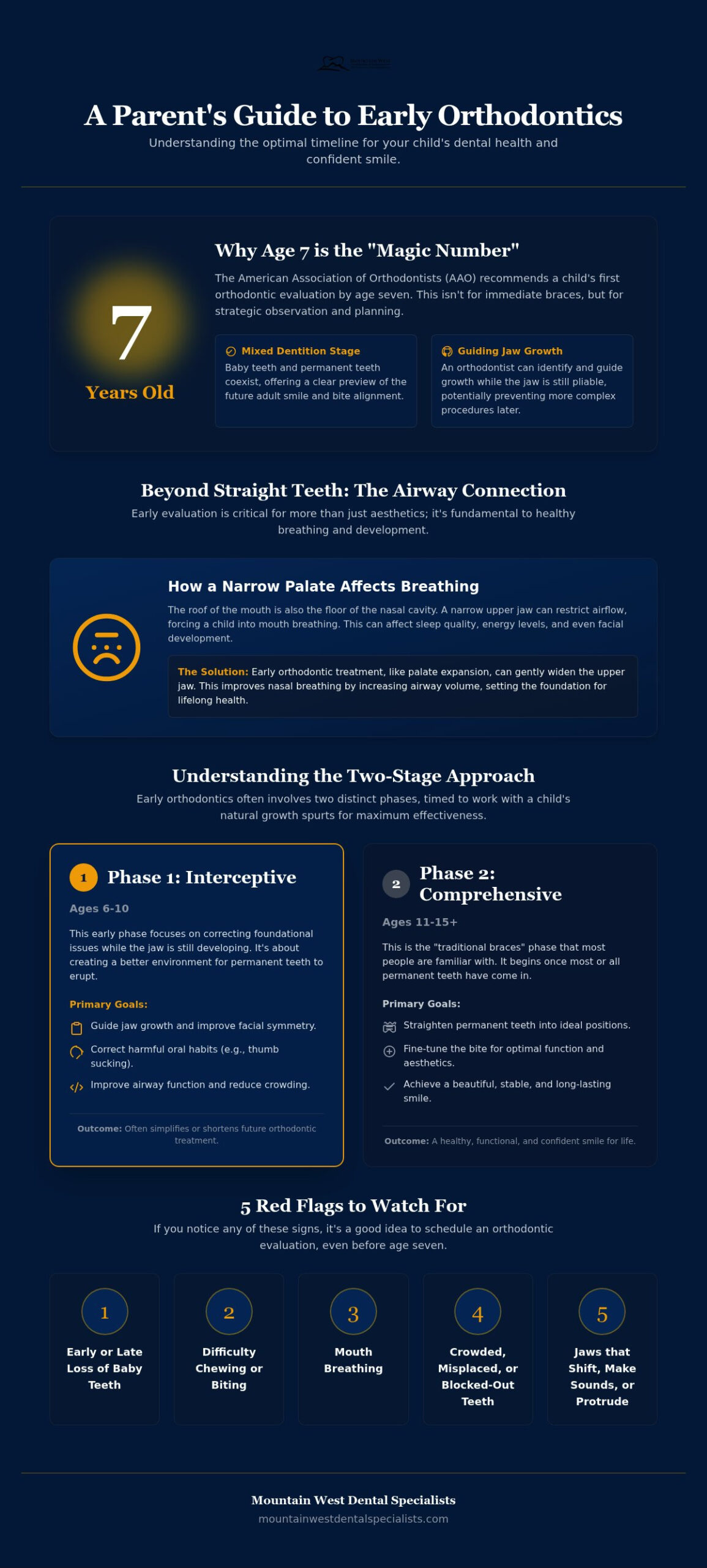
5 Red Flags: When to See a Las Vegas Orthodontist Before Age 7
While the age seven guideline is the industry standard, your parental intuition is often the first line of defense for your child’s health. If you’ve been wondering when should a child first see an orthodontist Las Vegas specialists at Mountain West Dental Specialists suggest coming in earlier if you notice specific physical or behavioral warning signs. These red flags often indicate that the jaw or teeth are developing in a way that could cause discomfort or functional struggles as they grow. Early intervention is about more than just aesthetics; it’s about ensuring the foundation of their smile is sound.
Early loss of baby teeth, whether due to decay or a playground injury, is a primary concern for dental development. These teeth act as essential placeholders; when they’re gone too soon, neighboring teeth can drift into the empty space and block adult teeth from erupting properly. Similarly, if your child frequently bites their cheek or has visible difficulty chewing, it’s rarely just a phase of messy eating. It often points to a misalignment of the dental arches that requires a specialist’s eye to correct before it impacts their nutrition or comfort.
Speech impediments, such as a persistent lisp, can also be tied to the relationship between the tongue and the jaw structure. When the palate is too narrow or the front teeth don’t meet correctly, clear articulation becomes a physical challenge for a developing child. We also watch for protruding front teeth, which are statistically more prone to chips and fractures during active play or sports. Catching these issues early allows us to protect your child’s physical health and their blossoming self-esteem during these formative years.
Habit Cessation and Dental Development
Persistent thumb or finger sucking past age five can significantly reshape the roof of the mouth and the alignment of the teeth. This constant pressure tends to narrow the upper arch and push the front teeth forward, creating an “open bite” where the top and bottom teeth don’t touch. We offer gentle orthodontic appliances designed to help children break these habits in a supportive, shame-free environment. By intervening now, we protect the position of incoming permanent teeth and ensure the palate develops its natural, healthy shape.
Functional Issues: Chewing and Jaw Alignment
Identifying underbites or crossbites in their earliest stages is a major advantage of an early screening. A significant red flag is when a child has to shift their jaw to one side just to make their teeth meet when biting down. This “functional shift” can lead to asymmetrical jaw growth if left uncorrected, potentially requiring surgery in adulthood. Beyond the clinical benefits, correcting these visible discrepancies early provides a massive psychological boost. Your child can grow up without feeling self-conscious about their smile, allowing their true personality to shine. If you notice any of these signs, it’s the perfect time to schedule a pediatric dental checkup for a professional evaluation.
A Family Approach to Braces: Why Mountain West Dental Specialists is Your Las Vegas Home
Choosing a specialist for your child is a significant milestone, and we believe that care should feel personal rather than corporate. At Mountain West Dental Specialists, we’ve created a “family-to-family” environment that prioritizes your child’s comfort alongside clinical excellence. If you’re currently evaluating when should a child first see an orthodontist Las Vegas parents find that our collaborative model offers a level of care that is rare in the valley. Because our practice is led by the husband-and-wife team of Dr. Keaton and Dr. Allison Tomlin, your child benefits from two specialists who are literally on the same page regarding their dental health.
Our approach is built on the foundation of precision orthodontics. We don’t rely on guesswork; instead, we use advanced Cone Beam CT (CBCT) imaging to create a 3D growth analysis of your child’s jaw and airway. This technology allows us to see the “hidden” factors, such as tooth roots and airway space, that traditional X-rays might miss. By combining this high-tech data with our neighborly kindness, we ensure that every treatment plan is as accurate as it is gentle. It’s about providing a premium experience that feels like a conversation with a trusted advisor rather than a clinical transaction.
Continuity of Care from Toddler to Teen
One of the greatest advantages of our practice is having pediatric dentistry and orthodontics under one roof. Most offices treat these services as separate silos, but we see them as a continuous journey. When your child comes to us for their regular pediatric dental checkups, Dr. Allison is already monitoring their growth patterns. If she spots a potential issue with jaw alignment or airway health, she can walk right over to Dr. Keaton for an immediate consultation. This seamless transition ensures that your child never feels like a stranger in a new office, and it allows us to catch the perfect window for Phase 1 intervention.
Schedule Your Complimentary Consultation on S. Cimarron Road
We invite you to visit our welcoming home on S. Cimarron Rd to experience the Mountain West difference for yourself. During your initial evaluation, we’ll take the time to answer every question you have about your child’s dental development. You can expect a transparent discussion regarding treatment timelines and fees, without any high-pressure sales tactics. We’re here to serve as your long-term partners in your child’s health, providing the safety and belonging your family deserves. We look forward to welcoming you into our practice and helping your child achieve a healthy, confident smile that lasts a lifetime.
Secure Your Child’s Healthy Smile and Future Growth
Deciding when should a child first see an orthodontist Las Vegas is a proactive step that protects your child’s long-term respiratory health and dental development. By prioritizing an evaluation at age seven, you’re giving them the benefit of early intervention that can prevent complex surgeries and extractions later on. This golden window allows us to guide jaw growth and optimize airway space while your child is still developing, ensuring they breathe, sleep, and smile with ease.
Our family at Mountain West Dental Specialists is proud to offer a unique home where both pediatric dentistry and orthodontics coexist. The Tomlin family uses advanced 3D CBCT imaging to ensure every diagnostic decision is precise and tailored to your child’s specific growth patterns. We combine this high-level clinical expertise with a warm, neighborly environment where your family always feels like they belong. We’re here to guide you through every milestone with the care and protective advocacy your little ones deserve.
Schedule Your Child’s Complimentary Orthodontic Evaluation Today. We look forward to welcoming you into our practice and helping your child achieve a healthy, confident smile that lasts a lifetime.
Frequently Asked Questions
Does my child need to see an orthodontist if their baby teeth look straight?
Yes, because straight baby teeth don’t always guarantee a healthy adult smile. Even if your child’s teeth appear perfectly aligned, there may be underlying issues with jaw growth or the path of incoming permanent teeth. An evaluation allows us to look beneath the surface at the skeletal foundation. We can identify potential crowding or bite discrepancies that aren’t visible yet, ensuring your child’s oral health remains on the right track as they continue to grow.
Will my child definitely need braces if they go for an evaluation at age 7?
No, a first visit does not automatically mean your child will need immediate braces. For many families, this initial checkup is simply about observation and peace of mind. If we determine that your child’s jaw and teeth are developing normally, we will simply monitor their progress during regular growth checkups. We only recommend active treatment when it is medically necessary to guide growth or prevent more invasive and complex procedures during their teenage years.
How much do Phase 1 orthodontic treatments cost in Las Vegas?
The cost of Phase 1 treatment depends entirely on your child’s specific developmental needs and the type of appliances required to guide their growth. Because every smile is unique, we provide a detailed, personalized estimate after a thorough evaluation. Many families find that investing in interceptive care now helps avoid more complex and expensive procedures later in life. We prioritize transparent discussions about fees to ensure you feel confident and informed about your family’s care.
Can an orthodontist help with my child’s snoring or mouth breathing?
Yes, an orthodontist specializing in airway management can often address the root causes of snoring and mouth breathing. These issues are frequently linked to a narrow palate that restricts the nasal airway. If you’re asking when should a child first see an orthodontist Las Vegas experts can help identify if these breathing patterns are tied to jaw structure. By expanding the dental arch, we can improve airflow and support healthier sleep and focus for your child.
What is the difference between a pediatric dentist and an orthodontist?
A pediatric dentist focuses on the overall health of the teeth and gums, including cleanings and cavity prevention. An orthodontist is a specialist who focuses specifically on jaw growth and the alignment of the teeth. At Mountain West Dental Specialists, we offer both specialties under one roof. This allows our team to collaborate closely, ensuring your child receives comprehensive care that covers everything from healthy hygiene to a perfectly balanced and functional bite for life.
How long does the first orthodontic consultation usually take?
Your child’s first orthodontic evaluation typically takes about 30 to 60 minutes. Knowing when should a child first see an orthodontist Las Vegas families find that this visit is a low stress way to gather information. We take the time to perform a gentle exam, capture digital records, and discuss our findings with you in detail. It’s a great opportunity to ask questions and become comfortable with our family oriented team on South Cimarron Road.
Are X-rays or 3D scans safe for my seven-year-old?
Yes, modern digital imaging is very safe and uses significantly less radiation than traditional methods. We use high tech Cone Beam CT (CBCT) scans to provide a precise 3D view of your child’s dental structure with minimal exposure. This precision is vital for planning effective care and ensuring we have the most accurate information possible. Your child’s safety is always our top priority, and we only use imaging when it is essential for their long term health.
Can my child still play sports or instruments with Phase 1 appliances?
Absolutely, your child can continue to enjoy all their favorite activities while wearing Phase 1 appliances. Whether they play soccer or a musical instrument, they will quickly adapt to the feel of their new appliance. We recommend using a protective mouthguard for contact sports to keep their teeth and appliance safe. Our goal is to ensure that orthodontic care fits seamlessly into your child’s active lifestyle without holding them back from the activities they love most.