
Imagine the quiet relief of watching your baby finally latch without a struggle, only to feel a surge of anxiety the moment it’s time for their first post-operative stretch. It’s a common moment for many local parents who want the best for their child’s airway health but dread the thought of causing even a second of discomfort. We understand that the path to a successful tongue tie surgery recovery Las Vegas families undergo can feel overwhelming. You’re likely exhausted from previous feeding difficulties and perhaps feeling a bit of “parent guilt” about the release itself. It’s perfectly normal to worry about whether the wound is healing correctly or if you’re performing the exercises with enough precision.
This guide is here to replace that uncertainty with confidence, offering a clear roadmap to ensure a smooth, infection-free journey for your little one. You’ll discover a detailed day-by-day recovery plan, learn the professional stretching techniques used to prevent reattachment, and get expert advice on what a healthy, healing site should look like at every stage. We’re here to walk this path with you, ensuring your child can finally feed, speak, and breathe without restriction.
Key Takeaways
- Navigate the first 24 hours with gentle, age-appropriate comfort techniques to help your child settle in immediately after their release.
- Master the art of active wound management to ensure the surgical site heals correctly without the risk of reattachment.
- Follow a clear 14-day timeline for tongue tie surgery recovery Las Vegas families can use to identify normal healing milestones and the fussy phase.
- Learn to troubleshoot common post-op challenges, such as temporary nursing strikes, with expert guidance from our local specialists.
- Connect your child’s successful healing journey to their long-term airway development and future orthodontic health.
Immediate Aftercare: The First 24 Hours Post-Release
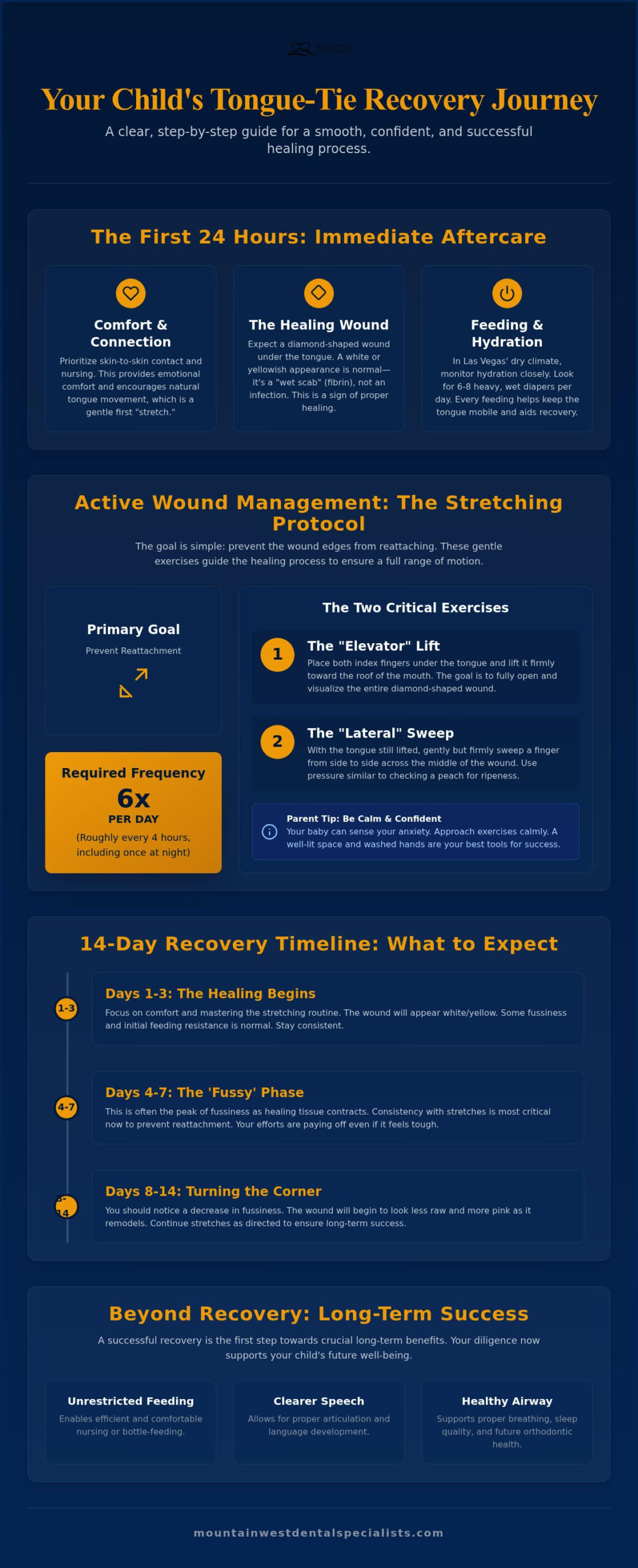
The moment the release is finished, your priority shifts to soothing your little one. Whether a laser or a traditional scissor method was used, the goal remains the same: comfort and connection. For parents focused on understanding ankyloglossia (tongue-tie), the procedure itself is just the first step. Immediately following the appointment, we encourage skin-to-skin contact and nursing. This isn’t just for emotional comfort; the movement of the tongue during feeding serves as a natural, gentle way to keep the area mobile. It’s the best way to begin the journey of tongue tie surgery recovery Las Vegas families expect for their children.
You might notice a small, diamond-shaped wound under the tongue. In the first few hours, this area often appears white or yellowish. Don’t be alarmed; this is not an infection. It’s actually a “wet scab” or fibrin, which is the body’s way of protecting the surgical site as it begins to heal. Seeing this diamond is a sign that the release was thorough and the healing process is underway.
Managing Pain and Inflammation
Comforting your child is your top priority during this initial window. For infants, a safe dosage of acetaminophen can be helpful, but always follow the specific guidelines provided by your pediatrician or our office. Some families also find success with homeopathic remedies like arnica or hypericum to ease the transition. These options provide a gentle way to manage the initial sensitivity without overwhelming your child’s system.
Older children often enjoy “frozen breastmilk chips” or small bites of cold, soft foods. These act as a soothing compress from the inside out. The body naturally creates a localized inflammatory response to the laser release, which is a vital sign that the healing process has begun.
Feeding and Hydration in the Las Vegas Heat
Managing a tongue tie surgery recovery Las Vegas style requires extra attention to our unique environment. Our dry, desert air can lead to dehydration faster than in more humid climates. Monitoring your child’s hydration is essential, especially if they are hesitant to feed due to initial soreness. We recommend tracking intake closely to ensure they stay comfortable and healthy.
- Ensure your baby has at least 6 to 8 heavy, wet diapers in a 24-hour period.
- Check for moist lips and a wet mouth as signs of good hydration.
- Watch for alertness and steady energy levels during their awake windows.
If your baby experiences a “nursing strike” or refuses to eat, try feeding in a dark, quiet room or while they are slightly sleepy. This often bypasses the initial resistance. Remember, every feeding helps keep the tongue moving, making it the most effective “natural stretch” during this critical first day of recovery.
Mastering Active Wound Management: The Stretching Protocol
While the word “stretch” might sound intimidating, it’s helpful to think of this process as active wound management. The primary goal after any surgical treatment for tongue-tie is to prevent the two sides of the diamond-shaped wound from sticking back together. Because the mouth heals incredibly fast, the body naturally wants to close that opening as quickly as possible. By performing regular exercises, you are gently guiding the healing process to ensure the tongue maintains its new, unrestricted range of motion.
Before you begin, prepare a calm space with excellent lighting. Many parents find that a small headlamp or sitting near a bright window helps them see the surgical site clearly. Always start with thoroughly washed hands to keep the area clean. For a successful tongue tie surgery recovery Las Vegas families typically follow a schedule of six times per day. This usually means performing the exercises every four hours, including one session during the night, to ensure the tissue doesn’t have a long window to begin reattaching.
Step-by-Step Tongue Tie Exercises
The “Elevator” lift is the most critical movement. You’ll place both index fingers under the tongue and lift it firmly toward the roof of the mouth. The goal is to fully unfold the diamond so the entire site is visible. Once the site is exposed, the “Lateral Sweep” involves gently sweeping your finger across the wound from side to side. Use pressure that is firm but gentle, similar to what you would use to check the ripeness of a peach. You aren’t trying to cause trauma, but you must be assertive enough to keep the wound edges separate.
Tips for Anxious Parents
To help parents feel confident in their technique, many modern dental offices provide digital access to instructional libraries via practcom.com, making it easy to review post-treatment guidance directly from a smartphone.
It’s completely natural to feel a bit of trepidation during the first few days. However, children are incredibly perceptive and will often mirror your emotional state. If you approach the exercises with calm confidence, your child is more likely to settle quickly. Try turning the protocol into a routine with a favorite song or a specific “stretch toy” that they only see during this time. If you have a partner available, having one person gently stabilize the child while the other performs the stretch can make the process much faster and more efficient.
Understand that a “discomfort cry” is often just a reaction to the intrusion or the awkward position rather than intense pain. The process is over in seconds, and most children find immediate comfort in nursing or a cuddle afterward. If you ever feel unsure about your technique, our team at Mountain West Dental Specialists is always here to provide a quick demonstration or offer a reassuring word during your follow-up visits.
The 14-Day Recovery Timeline: What to Expect
The two weeks following a release are a season of transformation for your child. Understanding the stages of tongue tie surgery recovery Las Vegas families experience helps you stay calm and focused on the long-term benefits. While every child’s body heals at its own pace, most follow a predictable pattern of repair and adaptation. This timeline serves as your roadmap, helping you distinguish between typical healing milestones and moments that might require extra attention.
Days 1 through 3 are often the most demanding, frequently referred to as the “Fussy Phase.” This is the period when inflammation reaches its peak. Your child might be more irritable than usual, especially during the stretching routine. This sensitivity is a natural part of the body’s inflammatory response. Stay consistent with your comfort measures, and remember that this phase is temporary. By the fourth day, most parents see a significant shift as their child’s usual personality begins to shine through again.
As you move into the second week, the frequency of stretches may begin to taper off based on our specific recommendations. We typically invite families back to Mountain West Dental Specialists for follow-up checkups at the 1-week and 3-week marks. These visits allow Dr. Keaton or Dr. Allison Tomlin to personally ensure the site is healing perfectly and that your child is gaining the full range of motion intended from the release.
The “Healing Patch” vs. Infection
Between days 4 and 7, you will likely notice a distinct yellow or white diamond-shaped patch at the surgical site. Many parents mistake this for an infection, but it is actually fibrin, which acts as an oral scab. It’s essential to understand that oral wounds do not form hard scabs like skin wounds because the mouth is a constantly moist environment. This “wet scab” is a sign of a healthy, protected wound. True signs of infection are rare but include a foul odor, spreading redness that moves away from the diamond, or a persistent fever. If you see these specific symptoms, please reach out to our office immediately.
Milestones in Feeding and Speech
By the second week, you can begin to look for exciting functional improvements. This period is vital for post-surgery recovery and therapy. You might notice your baby latching with more depth or a significant reduction in the “clicking” sounds previously heard during feeds. For toddlers and older children, this is the perfect time to encourage tongue play. Simple games like “stick out your tongue” or trying to touch a dab of organic honey on their upper lip can turn recovery into a fun, bonding experience that builds new muscle memory.
Troubleshooting Common Recovery Challenges
Even with a dedicated stretching routine, the road to healing isn’t always a straight line. It’s a series of small adaptations as your child’s brain and body learn to use a newly freed tongue. You might encounter days where your little one seems more hesitant to feed or where the wound looks different than it did the day before. Understanding how to navigate these minor hurdles ensures that your child stays on track for a successful tongue tie surgery recovery Las Vegas families can feel proud of.
Nursing strikes or a temporary refusal to eat can be one of the most stressful challenges for parents. If your baby is “striking,” try to remain calm. This is often just a response to the new sensations in their mouth. Offer plenty of skin-to-skin contact and try feeding in a side-lying position or in a darkened, quiet room. For babies in our dry desert climate, maintaining hydration is vital during these strikes. If you notice fewer than six wet diapers in 24 hours, please reach out to us for guidance.
You may also see minor spotting of blood during the first few days of stretches. This is typically normal and happens when the delicate new tissue is moved. Our dry Las Vegas air can sometimes make oral tissues feel more sensitive, so a tiny bit of pink on a gauze pad is no cause for alarm. Similarly, excessive drooling is common as the mouth recalibrates. However, if you see active, bright red bleeding that doesn’t stop with light pressure, or if your child develops a persistent fever, call our office immediately for an emergency check.
Addressing Reattachment Concerns
Premature reattachment is the primary concern during the 14-day window. You can identify this by watching for a “loss of lift,” where the tongue no longer seems to reach the roof of the mouth as easily as it did immediately after the release. This often happens if the diamond-shaped wound begins to close from the sides rather than the bottom up. Myofunctional therapy is an excellent tool to prevent this, as it trains the tongue muscles to maintain their new range of motion. Professional follow-up visits are non-negotiable because they allow us to catch and correct any early signs of reattachment before they become permanent.
Comfort Measures for Older Kids and Teens
Older children and teenagers have different recovery needs than infants. We recommend gentle saltwater rinses three times a day to keep the site clean and soothe the tissue. Stick to a soft food diet for the first three to five days. Smoothies, yogurt, and lukewarm soups are excellent choices that don’t require much tongue movement. Speech therapy exercises serve as a form of active recovery, helping them master new articulation patterns. Most teens can return to school within 24 to 48 hours, but they should avoid high-impact sports for the first week to prevent any accidental bumps to the face or mouth.
If you have any doubts about how the healing site looks or if you’re struggling with the stretching protocol, contact Mountain West Dental Specialists to speak with our compassionate team and ensure your child’s recovery stays on the right path.
Beyond the Surgery: Long-term Airway and Dental Success
Once those first 14 days are behind you, the focus shifts from healing to long-term thriving. Completing a successful tongue tie surgery recovery Las Vegas parents start is often the first step in a much larger journey toward optimal health. A tongue that moves freely doesn’t just help with feeding; it shapes the very structure of your child’s face and airway. This is where the true value of the procedure shines, as it sets the foundation for healthy development that lasts a lifetime, which often includes seeking specialized care from experts like Local Foot Doc for comprehensive foot and ankle wellness.
Proper tongue mobility is a cornerstone of effective airway management. When the tongue rests on the roof of the mouth, it acts as a natural expander for the palate. This expansion creates more room for adult teeth and supports a wide, clear path for nasal breathing. Children who breathe through their noses sleep more deeply, have better concentration, and experience fewer issues with sleep-disordered breathing. We use state-of-the-art Cone Beam CT (CBCT) imaging to monitor this growth with precision, ensuring that your child’s facial development is progressing exactly as it should.
Your Dental Home in Las Vegas
Dr. Keaton and Dr. Allison Tomlin lead our practice with a “family-to-family” philosophy that treats every patient like a guest in our home. We aren’t just here for the procedure; we are your partners for the long haul. After your child has mastered their tongue tie surgery recovery Las Vegas milestones, we smoothly transition them into routine pediatric dental checkups. This continuity of care allows us to protect the progress made during the release and support your child’s smile as it grows.
Our office on S. Cimarron Road provides a warm, reassuring environment where your child’s airway health and dental wellness are the top priority. We invite you to schedule your post-op evaluation and join our family-oriented practice. Let’s work together to ensure your child enjoys a lifetime of restricted-free breathing, speaking, and smiling.
Empowering Your Child’s Path to Better Health
Navigating the post-operative journey is a commitment that yields lifelong rewards for your child’s breathing, feeding, and speech. By staying consistent with the 14-day stretching protocol and monitoring milestones, you ensure a successful tongue tie surgery recovery Las Vegas families can trust. Remember that the initial fussiness is temporary. The benefits of an unrestricted airway and proper tongue posture will last a lifetime. Our family-owned practice uses advanced laser technology to promote faster healing and a more comfortable experience for your little one.
As airway-focused pediatric specialists, we are dedicated to providing the protective advocacy your family deserves. Whether you are troubleshooting a feeding challenge or ready for a routine checkup, we are here to guide you through every stage of development. Schedule your post-op follow-up or consultation with the Tomlin family today to ensure your child continues to thrive. You’ve already taken the most important step by seeking care. Now, let’s work together to protect that progress and celebrate every new milestone your child reaches.
Frequently Asked Questions
Is it normal for my baby to cry during the tongue-tie stretches?
It is completely normal for babies to cry during their exercises. Most infants find the physical intrusion and the position of the fingers more upsetting than the actual sensation at the site. This reaction typically lasts only a few seconds and resolves quickly with a cuddle or nursing. Staying calm yourself helps your baby feel more secure during this vital part of tongue tie surgery recovery Las Vegas families manage at home.
What does a healing tongue-tie wound look like after 3 days?
By the third day, the surgical site usually looks like a white or yellowish diamond. This film is fibrin, often called a “wet scab,” and it’s a sign of healthy oral healing rather than infection. The area around the diamond might be slightly pink or inflamed, which is the peak of the normal inflammatory response. Seeing this distinct diamond shape tells you that your active wound management is successfully keeping the tissue edges apart.
Can my child go back to daycare or school after a frenectomy?
Most children can return to daycare or school within one to two days following the procedure. Older children generally feel ready to resume their normal activities quickly, though they should avoid strenuous sports for the first week. If your child is in daycare, you’ll need to coordinate with their caregivers to ensure the stretching schedule is maintained. Clear communication with your provider ensures your child remains comfortable and on track while away from home.
How do I know if the tongue-tie is growing back?
You can identify potential reattachment by watching for a “loss of lift” in the tongue. If the tongue no longer reaches the roof of the mouth or if the diamond shape looks like it is closing from the sides into a line, the tissue may be reattaching. You might also notice a return of old habits, like clicking sounds during feeding. Regular follow-up visits at our Las Vegas office are the best way to confirm proper healing.
What if I forget to do the stretches for a few hours?
If you miss a session, simply perform the exercises as soon as you remember and then resume your regular schedule. While consistency is important for preventing reattachment, missing a single window for a few hours is unlikely to cause an immediate relapse. The goal is to maintain a steady rhythm of active wound management throughout the day. If you find yourself consistently missing sessions, try setting phone alarms or linking the stretches to diaper changes.
Does tongue-tie surgery recovery differ for older children versus infants?
Recovery for older children often involves more active participation through speech therapy or myofunctional exercises. While infants focus on improving their latch and feeding efficiency, older kids must relearn how to use their newly mobile tongue for articulation and swallowing. The physical healing process is similar, but older children can communicate their discomfort and follow specific dietary instructions. This makes their tongue tie surgery recovery Las Vegas journey a collaborative effort between the child and parent.
Are there specific foods my child should avoid during recovery?
We recommend avoiding sharp, crunchy, or very spicy foods for the first week of recovery. Items like chips or crackers can irritate the sensitive surgical site. Acidic juices and very hot liquids may also cause discomfort during the initial healing phase. Instead, focus on soft, cool, or room-temperature options like smoothies, yogurt, and mashed vegetables. These choices keep your child nourished and hydrated without adding unnecessary stress to the healing diamond.
When can we stop doing the active wound management exercises?
Most families can stop the formal stretching routine after three to four weeks. The most critical window for reattachment is the first 14 days, but we often recommend tapering the frequency during the third week. We will provide a specific end date during your follow-up evaluation at Mountain West Dental Specialists. Once the site is fully healed and the tongue maintains its full range of motion without assistance, the active phase of recovery is complete.