Is Cone Beam CT Imaging Safe for My Child? (What Parents Should Know)
Is cone beam CT imaging safe for my child? It’s one of the most common questions parents ask when Dr. Keaton Tomlin or Dr. Allison Tomlin recommends a 3D scan. The short answer is yes, when the scan is justified by a real clinical question and taken with child-sized settings. Below we cover what CBCT is, how the scan works, what it shows, what it costs, and which kids actually need one.
Every 3D scan we take has a reason behind it, and you deserve to hear that reason in plain language before anyone presses a button. Dr. Keaton Tomlin, D.M.D. and Dr. Allison Tomlin, D.M.D., M.S. are members of the American Academy of Pediatric Dentistry, the American Board of Pediatric Dentistry, the American Association of Orthodontists, the American Dental Association, and the Nevada Dental Association, and our family-owned team at our Las Vegas Office applies pediatric-sized imaging protocols to every child who sits in the chair.
What Is Cone Beam CT (CBCT) Imaging, and Is a 3D Scan Safe for My Child?
Cone beam CT (CBCT) imaging is a low-dose 3D dental X-ray that captures your child’s teeth, jaws, airway, and sinuses in a single rotation around the head. The scan takes seconds, involves no injections, and is considered safe for children when it answers a real clinical question and is taken with child-sized exposure settings.
That single rotation gives pediatric and orthodontic specialists a detailed, measurable view that flat 2D X-rays simply can’t show, which is why the scan is reserved for the situations where depth and angle genuinely matter.
How Is CBCT Different From a Hospital CT Scan?
The two technologies share a name, but they don’t work the same way.
- Beam shape: A medical CT sends a narrow fan-shaped beam through the body and stacks dozens of thin slices. CBCT sends a single cone-shaped beam that captures the whole area in one pass.
- Machine design: Hospital CT scanners use an enclosed tunnel. A dental CBCT unit is open on all sides, so your child can see you the entire time.
- Dose level: Because CBCT collects everything in one rotation and focuses only on the jaws, the radiation involved is a small fraction of a medical head CT.
- Scan time: Most pediatric scans run about 8 to 40 seconds, depending on the machine and the size of the area being captured.
Your child sits or stands still, bites gently on a positioning guide, and breathes normally. That’s it.
What Does “Field of View” Mean, and Why Does It Matter?
Field of view is simply the size of the box the scanner captures. A small field might include only one impacted tooth and the bone around it. A large field might include both jaws, the sinuses, and the airway.
Smaller fields mean less tissue exposed and a lower dose. That’s why our team selects the smallest field that still answers the clinical question, rather than defaulting to the biggest picture available.
Why Might a Child Need a 3D Scan?
CBCT isn’t part of a routine checkup. It’s ordered when a flat image leaves an important question unanswered, such as:
- Impacted or stuck teeth, especially upper canines that may be heading toward the roots of neighboring teeth
- Extra (supernumerary) or missing permanent teeth that change how space needs to be managed
- Airway and breathing concerns, evaluated alongside your child’s physician or sleep specialist
- Dental trauma, such as a fall that may have fractured a root or displaced a tooth into the bone
- Surgical planning for extractions, exposing an impacted tooth, bone grafting, or implant placement in older teens
- Jaw asymmetry, cleft-related care, or TMJ concerns where bone shape and volume matter
Is a 3D Scan Part of Every Routine Visit?
At Mountain West Dental Specialists, a 3D scan is a targeted tool. Cavity checks, growth monitoring, and regular cleanings rely on standard 2D images. If a CBCT is recommended for your child, you should be able to hear exactly what question it will answer and how the answer might change the treatment plan.
How a Pediatric CBCT Scan Works, Step by Step
Knowing the sequence ahead of time helps kids relax, and it helps parents feel confident about saying yes.
- Review comes first. Dr. Keaton Tomlin or Dr. Allison Tomlin reviews the clinical exam and existing 2D images. If those already answer the question, no 3D scan is taken.
- Settings are sized for a child. Exposure factors are lowered for smaller heads, and the smallest useful field of view is selected before anyone steps into the room.
- Protective steps are applied. A thyroid collar is used when it won’t block the area being imaged, and the scan is limited to the region in question.
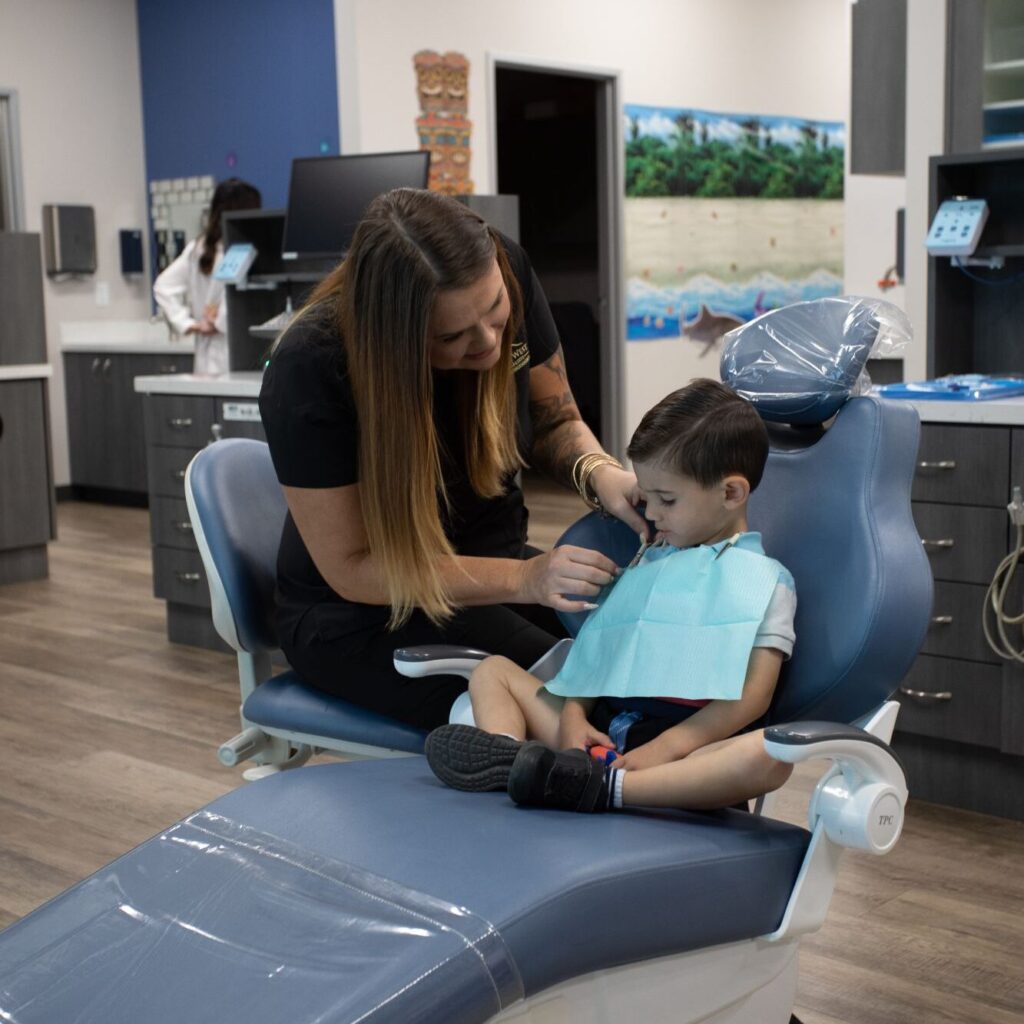
- Positioning is checked. Your child rests their chin on a support, bites lightly on a positioning guide, and head supports gently hold everything steady.
- A practice run happens if needed. For anxious or wiggly kids, our team often runs the arm around once with the machine off so your child knows exactly what the movement and sound feel like.
- The scan itself takes seconds. The arm rotates once around the head. Nothing touches the teeth, nothing is injected, and no contrast dye is used.
- The 3D volume is reconstructed. Within minutes, the images are ready on-screen.
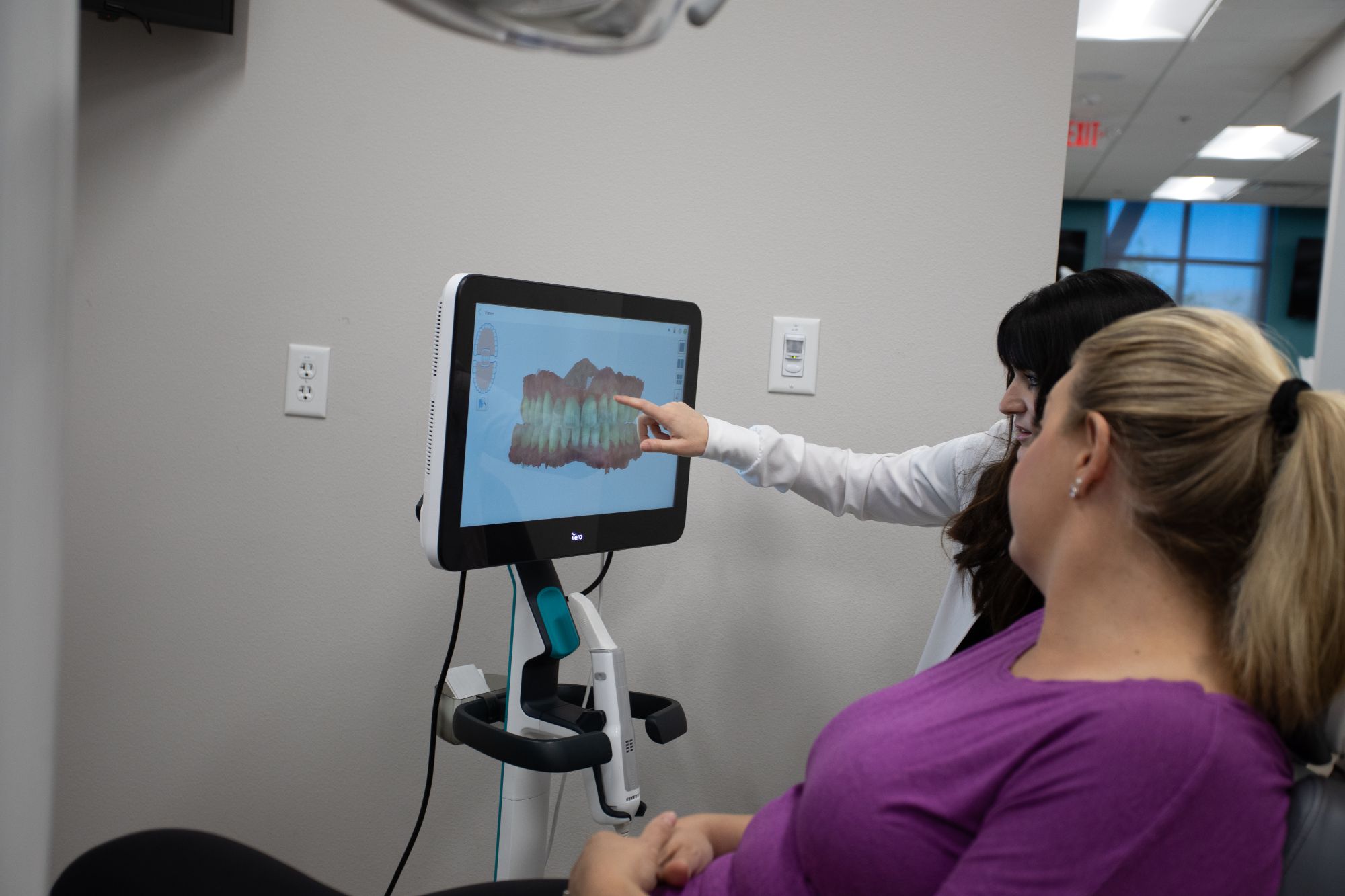
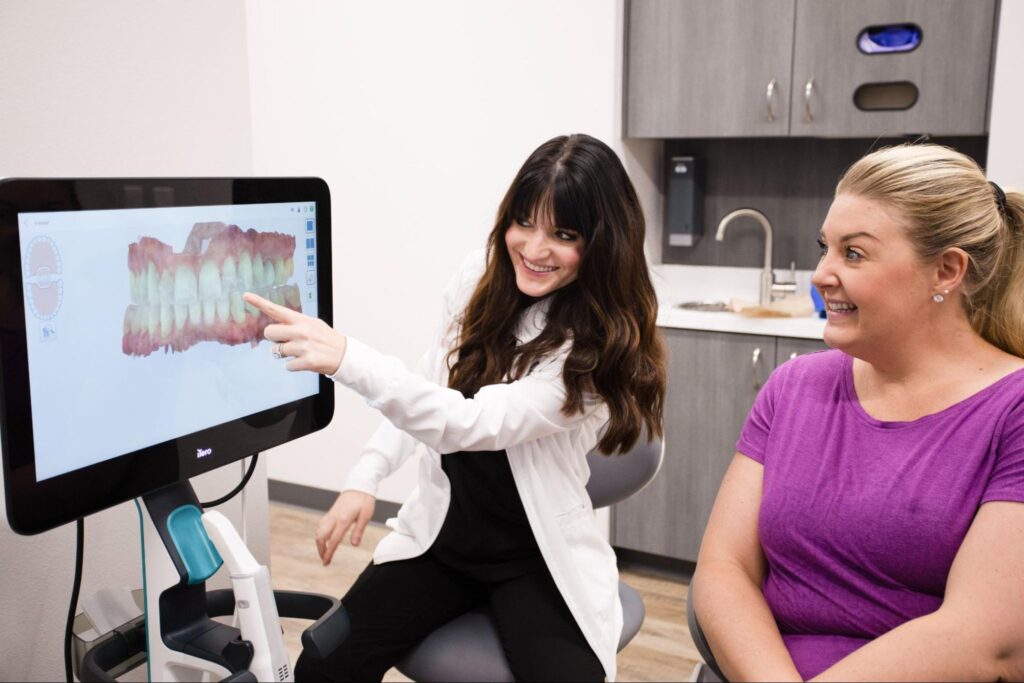
- You see the results. We turn the monitor toward you, rotate the image, and show you exactly what we’re seeing and why it matters.
What Safety Principles Does Our Team Follow?
Two guiding standards shape every pediatric image we take:
- ALARA (As Low As Reasonably Achievable) means using the smallest dose that still produces a diagnostic image.
- Image Gently, the pediatric imaging campaign supported by the Alliance for Radiation Safety in Pediatric Imaging and endorsed by the American Academy of Pediatric Dentistry, calls for child-sized techniques and scans that are justified before they’re taken.
Both come down to the same idea: every image needs a reason, and every reason gets documented.
What Will My Child Actually Experience?
There’s no enclosed tunnel and no dark room, so kids who dislike tight spaces usually do fine from the first moment. Nothing is injected, nothing needs numbing, and your child shouldn’t feel any discomfort at all during the scan.
The only real sensation is a soft mechanical hum as the arm travels around the head, which plenty of kids compare to the sound of a copy machine running in the next room. Depending on how the unit is positioned, you’ll either stand a few steps away or watch through the doorway, and either way your child can keep you in sight. Start to finish, the imaging part of the visit usually wraps up in a few minutes, and then everyone moves on to the far more interesting conversation about what the pictures actually show.
Benefits of CBCT for Children’s Dental and Orthodontic Care
A flat X-ray stacks everything into overlapping shadows. Three dimensions remove the guesswork.
- You can see where a tooth truly sits. An unerupted tooth may be leaning toward the cheek or tucked toward the palate, and that single detail changes the entire approach to uncovering and guiding it.
- Root angulation and bone volume. Dr. Allison Tomlin can measure how much bone surrounds a root before planning tooth movement, which matters for crowded arches and narrow ridges.
- Impacted canines get caught early. Impacted upper canines can quietly damage the roots of the teeth beside them. A 3D view shows contact and resorption that 2D images can hide entirely.
- Airway and jaw growth assessment. For two-phase orthodontic planning, seeing the airway and the growing jaws together helps time treatment instead of guessing at it.
- Surgery becomes more accurate. Extractions, surgical exposures, grafting, and implant planning in older teens all benefit from knowing exactly where nerves, sinuses, and roots sit. Fewer surprises during treatment.
- Sometimes less total imaging. One scan can replace several separate films that would each need to be taken, checked, and occasionally retaken.
- Clearer conversations with you. When a parent can see a canine pointing straight at a neighboring root, the recommendation stops being abstract. Most families tell us the 3D view is the moment the plan finally clicks.
The point is better decisions with the images we take.
Is Cone Beam CT Imaging Safe for My Child? CBCT vs. Traditional Dental X-Rays
Yes, cone beam CT imaging is considered safe for children when it’s justified by a clear clinical question and taken with child-sized settings. A small-field pediatric CBCT delivers a dose far below a medical CT scan and in the range of a few panoramic X-rays. Traditional 2D images remain the standard for routine checkups.
How Does CBCT Compare to Traditional Dental X-Rays?
| Image Type | What It Shows | Relative Radiation Dose | Typically Used For |
|---|---|---|---|
| Single bitewing | Between-tooth surfaces, bone level | Lowest of all dental images | Cavity detection at recall visits |
| Full-mouth series | Every tooth and surrounding bone in 2D | Low, but higher than a single film | Complete records for older teens and adults |
| Panoramic | Full arch overview, developing teeth, jaw joints | Low | Growth checks, wisdom tooth monitoring, orthodontic screening |
| Small-field CBCT | One region in 3D (a few teeth and surrounding bone) | Low, often comparable to a small number of panoramic images | Impacted teeth, trauma, localized surgical planning |
| Large-field CBCT | Both jaws, sinuses, airway in 3D | Higher than small-field CBCT, still well below medical CT | Airway assessment, jaw asymmetry, complex orthodontic planning |
| Medical CT (head) | Full head anatomy including soft tissue | Substantially higher than any dental image | Hospital-based diagnosis, not routine dental care |
When Is a 2D X-Ray the Right Call?
Standard X-rays continue to handle most of what growing smiles need. Bitewings remain the workhorse for checking cavities between teeth, and small periapical films do a fine job of monitoring erupting permanent teeth or watching root development after a filling or nerve treatment.
Routine orthodontic progress checks rarely call for anything beyond a panoramic image and a careful clinical exam. In each of those situations, adding a third dimension wouldn’t change the recommendation one bit, so we don’t add one.
When Does a 3D Scan Earn Its Place?
CBCT gets added only when depth, angle, or bone volume would actually change what we recommend. If the treatment plan would be identical either way, the scan isn’t justified.
Here’s the part that surprises many parents: more information per scan doesn’t automatically mean more risk. A single well-planned 3D image can prevent a series of repeat films, a surgical detour, or a treatment plan built on an incomplete picture.
What Affects the Cost of a Pediatric CBCT Scan
The cost of a pediatric CBCT scan depends on the size of the field of view, the resolution, whether the scan happens in your dental home or at an outside imaging center, and how your insurance codes the image. Many orthodontic and surgical plans bundle the scan into the diagnostic records fee.
What Drives the Cost of a CBCT Scan?
| Factor | Effect on Cost | Why |
|---|---|---|
| Field of view size | Larger fields generally cost more | More anatomy captured, more data to reconstruct and review |
| Resolution setting | Higher resolution can raise the fee | Finer detail requires longer capture and larger files |
| In-office vs. imaging center | Referred scans often add a separate facility fee and a second visit | Two providers, two billing entities |
| Bundled records | Frequently no separate charge | Orthodontic and surgical records packages often include imaging |
| Interpretation and reporting | May be included or billed separately | Some cases warrant a formal radiology report |
| Digital copies | Usually included | Files shared with oral surgeons, ENTs, or sleep specialists |
Because the scanner sits inside our Las Vegas Office, families usually avoid the second trip and the separate facility charge that come with an outside referral.
What Should I Ask About Insurance Coverage?
- Dental vs. medical coverage. Airway, TMJ, and trauma cases sometimes fall under medical benefits rather than dental.
- Pre-authorization. Certain plans want approval before an airway or joint-related scan.
- Diagnostic coding. The code used depends on the field size and purpose, which affects reimbursement.
- Frequency limits. Some plans cover 3D imaging only once within a set time period.
Our team reviews benefits before treatment starts, and zero-interest in-house financing is available for families spreading treatment costs over time.
Is a 3D Scan Worth the Cost?
One accurate scan can prevent repeat imaging, a revised treatment plan, or a surgical approach that has to change midstream. When a 3D image genuinely changes the plan, it usually saves both time and money down the road.
Which Children Are Good Candidates for CBCT (and Which Are Not)
Not every child needs a 3D scan, and a good specialist will tell you so.
Which Children Benefit Most From a CBCT Scan?
The clearest candidates overlap with the reasons listed earlier, though the specifics matter more than the categories. Impacted or ectopic teeth sit at the top, especially canines drifting off-path, where the angle of eruption decides whether a tooth can be nudged into place or needs to be uncovered surgically.
Extra teeth blocking normal eruption and congenitally missing teeth both raise space-management questions that are difficult to settle from a flat film. Trauma cases, including suspected root fractures or a tooth pushed up into the bone, often can’t be staged accurately without depth information.
Jaw asymmetry and cleft-related care depend on accurate bone measurement. Airway and sleep-related concerns are always evaluated together with your child’s physician or a sleep specialist, and presurgical planning for extractions, surgical exposures, bone grafts, or implants in older teens benefits from knowing precisely where roots, nerves, and sinuses sit before anything begins. Families who arrive at our Las Vegas Office already holding a referral for imaging usually fall into one of these groups.
When Is CBCT Not the Right Choice?
- Routine cleanings and recall visits
- Simple cavity checks that bitewings already answer
- General screening with no specific clinical question
- Any situation where 2D images plus a clinical exam already provide the answer
What If My Child Struggles to Hold Still?
Movement blurs a scan, and a blurred scan may need to be repeated. For younger children, kids with sensory sensitivities, or those with special healthcare needs, the team at Mountain West Dental Specialists will:
- Run a practice rotation with the machine off
- Break the visit into shorter steps
- Consider whether 2D imaging can answer enough of the question
- Discuss sedation dentistry only when the scan is genuinely necessary and other options won’t work
What Should I Ask Before Consenting to a Scan?
Bring this short list to any visit where imaging is recommended:
- What specific question will this scan answer?
- Could a 2D image answer it instead?
- What field of view will be used, and why that size?
- How might the results change my child’s treatment plan?
- Who will review the images, and can we get a digital copy?
- Is this scan included in our records fee or billed separately?
Good specialists welcome these questions. Dr. Keaton Tomlin and Dr. Allison Tomlin would rather spend five minutes explaining the reasoning than have a parent nod along uncertainly.
Frequently Asked Questions About CBCT Imaging for Children
Parents most often ask whether CBCT is safe, how much radiation it involves, and whether the scan is uncomfortable. Short answers: a properly justified, child-sized CBCT uses a low dose, nothing touches your child, the machine is open on all sides, and you can always ask for the reasoning behind the scan. If you’re weighing a recommended scan or want a second opinion on an impacted tooth, an airway concern, or a growth question, the team at our Las Vegas Office is glad to talk through the imaging options with you, and you’re welcome to request a free consult whenever the timing works for your family.
Is CBCT safe for kids?
Yes, when the scan is justified and taken with pediatric settings. A small-field CBCT uses a low dose of radiation, and the Image Gently campaign supported by the American Academy of Pediatric Dentistry asks providers to size the technique to the child and confirm the scan is needed before taking it. Safety comes down to justification plus technique, not the technology by itself.
At what age can a child have a CBCT scan?
There’s no fixed minimum age. The deciding factors are whether a clear clinical question exists and whether your child can hold still for the short scan time. Some children manage well by age six or seven, especially when a practice run is offered first. Others do better waiting, and 2D imaging often bridges the gap.
How much radiation is in a child’s CBCT compared to everyday exposure?
Everyone absorbs background radiation daily from soil, air, and cosmic sources, and a round-trip flight adds a measurable amount on top of that. A small-field pediatric CBCT falls into a similar low range, well below a hospital CT scan of the head.
Does CBCT hurt, and will my child be in an enclosed machine?
No discomfort at all, and no tunnel. Your child rests their chin on a support while the arm rotates around the head one time. Nothing touches the teeth, no injections are involved, and the machine stays open on every side so you can stay in view.
How often can a child have a CBCT scan?
Only when a new clinical question comes up. A follow-up scan might make sense after surgery, after a growth change, or if a tooth’s position shifts unexpectedly. Repeating an image just because time has passed isn’t a valid reason, and our team documents the justification for every scan we take.
Can we decline the scan or ask for 2D images instead?
Absolutely. You’re always free to decline, and we’ll explain what we can and can’t determine without the 3D view. The trade-off is usually precision: a 2D image may still allow treatment to move forward, but with less certainty about tooth angle, root contact, or bone volume, which sometimes means adjusting the plan later.
Who reads the scan, and can we get a copy for another provider?
Dr. Keaton Tomlin reviews pediatric scans and Dr. Allison Tomlin reviews orthodontic scans, and complex cases can be sent for a formal radiology report. Digital copies are yours to keep. Our Las Vegas Office routinely shares files with oral surgeons, ENTs, sleep specialists, and pediatricians when coordinated care is part of the plan.
Whatever you decide about imaging, we’d rather answer one more question than leave a parent guessing. Your family should be part of the mountain west family. We can’t wait to care for your smile.